How Therapists Evaluate Functional Movement Patterns: A Complete Guide to Movement Assessment in Rehabilitation

Learn how therapists evaluate functional movement patterns, including posture, mobility, strength, balance, coordination, gait, and movement strategies, to create personalized rehabilitation plans.
Human movement is more than the ability to move a single joint or contract an individual muscle. Everyday activities such as walking, sitting down, standing up, reaching, lifting, climbing stairs, and turning require several body systems to work together. Muscles, joints, the nervous system, balance mechanisms, coordination, flexibility, strength, and sensory information all contribute to how efficiently a person performs these tasks. When movement becomes painful, restricted, unstable, or inefficient, therapists may evaluate functional movement patterns to understand what is affecting a person’s ability to perform everyday activities.
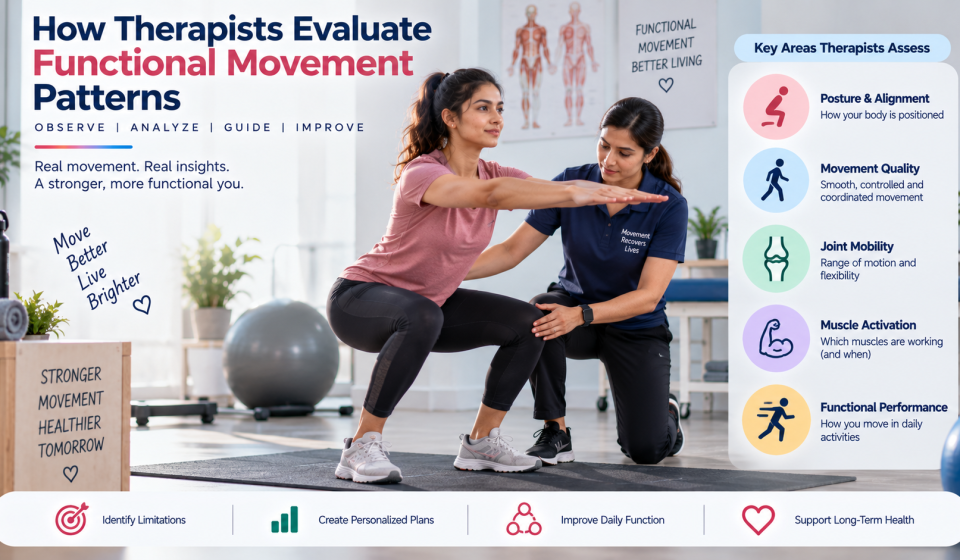
Functional movement assessment focuses on how a person performs meaningful movements rather than looking only at isolated muscles or joints. Therapists may observe movement quality, mobility, stability, balance, coordination, posture, strength, and the strategies a person uses to complete a task. A comprehensive functional assessment can combine clinical history, physical examination, movement observation, and task-specific testing to build a clearer picture of a person’s abilities and limitations.
What Are Functional Movement Patterns?
Functional movement patterns are coordinated movements that people use to complete everyday, occupational, recreational, or sporting activities.
Examples include:
- Squatting
- Walking
- Lunging
- Reaching
- Bending
- Pushing
- Pulling
- Stepping
- Turning
- Getting up from a chair
- Climbing stairs
- Lifting and carrying
These movements usually involve several joints and muscle groups working together.
For example, standing up from a chair requires coordination between the hips, knees, ankles, trunk, and upper body. It also requires adequate strength, balance, joint mobility, and motor control.
Because real-life activities involve combinations of movements, therapists often assess function at both individual body-part and whole-task levels.
Why Do Therapists Evaluate Functional Movement?
The main purpose of functional movement assessment is to understand how a person performs a task and identify factors that may be limiting safe or efficient movement.
A therapist may use movement assessment to:
- Identify movement limitations
- Understand functional difficulties
- Observe compensatory movement strategies
- Assess balance and coordination
- Evaluate mobility and stability
- Monitor rehabilitation progress
- Establish a functional baseline
- Guide exercise selection
- Assess readiness for certain activities
- Help determine whether additional assessment is needed
Functional assessment is an important component of comprehensive rehabilitation because it focuses on a person’s ability to perform specific tasks safely and reliably.
Step 1: Reviewing the Patient’s History
Before observing movement, therapists usually need to understand the person’s background.
The assessment may include questions about:
- Current symptoms
- Previous injuries
- Medical conditions
- Pain
- Previous surgeries
- Activity level
- Work requirements
- Exercise habits
- Daily limitations
- Rehabilitation goals
This information helps the therapist understand the context in which a movement problem occurs.
For example, difficulty climbing stairs may have a different meaning for someone recovering from knee surgery compared with someone experiencing neurological changes or general deconditioning.
A movement pattern should therefore not be interpreted without considering the person’s overall clinical situation.
Step 2: Observing Posture
Posture provides useful information about how the body is positioned before and during movement.
A therapist may observe:
- Head position
- Shoulder position
- Spinal alignment
- Pelvic position
- Hip position
- Knee alignment
- Foot position
However, posture should not automatically be considered “good” or “bad” based on appearance alone.
Therapists generally need to consider whether a particular posture is associated with pain, movement limitations, reduced function, or difficulty performing a task.
Functional movement assessment is more comprehensive than simply identifying whether someone appears to have perfect posture.
Step 3: Assessing Range of Motion
Joint mobility is important for performing many functional movements.
A therapist may assess active and passive range of motion depending on the individual’s condition.
For example, limited ankle mobility may influence squatting, walking, or stair climbing. Reduced shoulder mobility may make reaching overhead difficult.
Range-of-motion assessment can help determine whether restricted movement may be contributing to a functional limitation.
However, having a normal range of motion at individual joints does not automatically mean that a person will perform a complex task successfully. Functional activities require multiple movement systems to work together.
Step 4: Evaluating Muscle Strength
Strength is another important component of functional movement.
Therapists may evaluate strength using manual muscle testing, resistance exercises, functional tasks, or other appropriate methods.
Functional strength can be observed through activities such as:
- Rising from a chair
- Climbing stairs
- Squatting
- Stepping
- Lifting
- Carrying
- Pushing
- Pulling
The therapist may compare movement between the right and left sides when appropriate.
Weakness in one area may also cause other parts of the body to compensate during movement.
Step 5: Assessing Mobility and Stability Together
Mobility and stability are closely connected.
Mobility refers to the ability to move a body segment through an appropriate range, while stability involves controlling the body or a joint during movement.
A person may have excellent mobility but poor control. Another person may have good strength but insufficient mobility.
Functional movement requires an appropriate balance between the two.
Some movement-screening approaches specifically examine fundamental patterns that require combinations of mobility, stability, and neuromuscular control.
Step 6: Observing Balance
Balance is essential for safe functional movement.
Therapists may assess balance during:
- Standing
- Walking
- Single-leg activities
- Turning
- Stepping
- Reaching
- Uneven-surface activities
- Transitional movements
Balance assessment may involve both static and dynamic situations.
For example, standing still tests a different aspect of balance than walking while turning or reaching for an object.
Functional assessment literature includes static balance, single-leg balance, dynamic balance, tandem walking, and other movement-based tests as potential components of physical function assessment.
Step 7: Examining Coordination
Coordination allows different body parts to work together smoothly.
A therapist may observe whether the timing and sequencing of movements are appropriate.
Coordination can become important when a person:
- Reaches while standing
- Walks around obstacles
- Performs alternating movements
- Changes direction
- Uses both arms together
- Performs sport-specific tasks
Poor coordination may cause movements to appear slow, awkward, inconsistent, or inefficient.
Step 8: Watching How a Person Performs Basic Functional Tasks
One of the most useful parts of movement assessment is observing real or simulated everyday tasks.
Depending on the person’s condition, a therapist may ask them to:
- Sit and stand from a chair
- Walk
- Step onto a platform
- Squat
- Reach
- Bend
- Pick up an object
- Turn
- Climb stairs
- Get in and out of bed
The therapist observes not only whether the person completes the task but also how the task is performed.
Structured movement analysis emphasizes observing the movement strategies used to complete tasks and standardizing the testing setup when possible.
Step 9: Identifying Compensatory Movement Patterns
The body often finds alternative strategies when a particular movement is difficult.
For example, if one joint has limited mobility, another part of the body may move more to compensate.
A person with weakness may shift their weight toward a stronger side. Someone experiencing pain may change their posture or movement speed to reduce discomfort.
Compensation is not automatically harmful. It can be a useful way for the body to complete a task.
The therapist’s job is to understand why the compensation is occurring and whether it affects function, safety, symptoms, or rehabilitation goals.
Step 10: Comparing Movement Between Both Sides
When appropriate, therapists may compare right and left sides.
Differences may appear in:
- Strength
- Mobility
- Balance
- Coordination
- Step length
- Weight distribution
- Movement control
Asymmetry can provide useful information, but it should always be interpreted within the individual’s context.
Not every difference between sides represents a problem.
Step 11: Assessing Gait and Walking
Walking is one of the most important functional movements.
A therapist may observe:
- Walking speed
- Step length
- Stride pattern
- Foot placement
- Arm movement
- Balance
- Posture
- Symmetry
- Use of assistive devices
Gait assessment can help identify changes that may be related to pain, weakness, balance limitations, neurological conditions, or reduced mobility.
Walking assessment can also be repeated during rehabilitation to monitor changes over time.
Step 12: Evaluating Movement Under Different Conditions
A movement pattern can change depending on the task and environment.
For example, a person may walk normally on a flat surface but experience difficulty when:
- Walking faster
- Turning
- Carrying an object
- Stepping over obstacles
- Using stairs
- Walking on uneven ground
This is why functional movement assessment may need to include more than one task.
The Academy of Neurologic Physical Therapy’s movement analysis framework emphasizes systematically examining movement tasks and considering how task and environmental conditions influence movement strategies.
Common Functional Movement Assessments
There are many different assessment methods available, and therapists select them according to the person’s needs.
Some may include:
Functional Movement Screen
The Functional Movement Screen is one established movement-screening approach involving seven fundamental movement patterns. It examines patterns such as the deep squat, hurdle step, in-line lunge, shoulder mobility, active straight-leg raise, trunk stability push-up, and rotary stability.
It is important to understand that a movement screen is not the same as a complete clinical diagnosis. A screening result may indicate that further assessment is appropriate.
Functional Performance Tests
Functional performance tests may involve tasks such as walking, lifting, reaching, stepping, jumping, hopping, or other activities relevant to a person’s goals.
These assessments attempt to evaluate combinations of movements rather than only isolated body parts.
Balance Tests
Balance tests can examine the ability to maintain stability in static or dynamic situations.
Gait Assessments
Walking assessments can provide information about mobility, symmetry, speed, and functional movement.
How Therapists Use Assessment Results
Movement assessment results are not simply collected for documentation.
They can help therapists develop individualized rehabilitation plans.
For example, if an assessment identifies limited mobility, treatment may include mobility exercises. If weakness is contributing to difficulty with a task, strengthening may become part of the program. If balance is a major limitation, balance and functional training may receive greater attention.
The therapist may also modify exercises as the person’s movement improves.
Reassessment During Rehabilitation
Movement assessment is not necessarily a one-time event.
As rehabilitation progresses, therapists can reassess important functional abilities.
Changes may be seen in:
- Movement quality
- Strength
- Mobility
- Balance
- Walking speed
- Coordination
- Endurance
- Task performance
A baseline assessment allows future performance to be compared with earlier findings.
Research and clinical frameworks emphasize the value of measuring function through multiple complementary measures rather than relying on a single test.
Functional Movement and Return to Activity
Functional movement assessment can also be useful when a person is preparing to return to sport, work, exercise, or other demanding activities.
The therapist may evaluate whether the individual can safely perform movements that resemble their intended activity.
For athletes, this may involve running, jumping, landing, changing direction, or sport-specific tasks.
For workers, the assessment may focus on lifting, carrying, pushing, pulling, climbing, or prolonged standing.
The assessment should therefore reflect the person’s actual goals whenever appropriate.
Why One Movement Test Is Not Enough
Human movement is complex, so no single movement test can describe every aspect of physical function.
A person may perform well on one task but struggle with another.
For example, someone might have adequate lower-body strength but experience difficulty with balance during walking. Another person might have excellent mobility but limited endurance.
This is why comprehensive functional assessment combines multiple types of information.
A clinical perspective on functional assessment recommends considering several levels of function, from basic movement and balance to higher-level task-specific activities.
The Importance of Individualized Assessment
Every person moves differently.
Age, injury history, occupation, physical activity, medical conditions, goals, environment, and previous experience can influence movement.
Therefore, therapists should avoid assuming that the same movement pattern or exercise plan is appropriate for everyone.
The purpose of functional movement assessment is to understand the individual and their specific movement needs.
Source
https://pmc.ncbi.nlm.nih.gov/articles/PMC4060319/
https://pmc.ncbi.nlm.nih.gov/articles/PMC3172944/
https://pubmed.ncbi.nlm.nih.gov/26777566/
Conclusion
Therapists evaluate functional movement patterns by looking beyond individual muscles and joints to understand how the body works as a coordinated system during meaningful activities. They may examine posture, range of motion, strength, mobility, stability, balance, coordination, gait, and the strategies a person uses to complete functional tasks.
This assessment provides valuable information for creating individualized rehabilitation programs and monitoring progress. Functional movement screening can help establish a movement baseline and identify areas that may require further investigation, while broader clinical assessment provides the information needed to understand the reasons behind movement limitations.
Ultimately, the goal of functional movement assessment is not to make every person move in exactly the same way. It is to understand whether a person can perform the movements that matter to them safely, effectively, and within the context of their individual abilities and goals.
FAQ
1. What is functional movement assessment?
Functional movement assessment is the process of evaluating how a person performs movements and tasks that are relevant to everyday life, work, exercise, sports, or rehabilitation.
2. What does a therapist look for during movement assessment?
A therapist may examine posture, mobility, strength, balance, coordination, stability, gait, movement quality, symmetry, and compensatory strategies.
3. Why is functional movement assessment important?
It helps therapists understand how a person’s physical limitations affect real-life activities and can support individualized rehabilitation planning.
4. What movements are commonly assessed?
Common movements include squatting, walking, lunging, reaching, bending, stepping, pushing, pulling, lifting, and sit-to-stand movements.
5. What is the Functional Movement Screen?
The Functional Movement Screen is a specific screening system designed to observe seven fundamental movement patterns and identify movement limitations or asymmetries that may warrant further assessment.
6. Does functional movement assessment diagnose an injury?
A movement screen by itself should not be treated as a diagnosis. Therapists use movement findings together with clinical history, physical examination, symptoms, and other appropriate assessments.
7. Can functional movement assessment be used after an injury?
Yes. It can help evaluate how an injury affects movement and function and can be repeated during rehabilitation to monitor progress.
8. Can movement assessment help athletes?
Yes. Functional movement assessment may help evaluate fundamental movement abilities and can be incorporated into rehabilitation and return-to-sport processes.
9. Can functional movement patterns improve?
Many movement abilities can improve with appropriate rehabilitation, exercise, practice, and task-specific training. The type and amount of training depend on the individual’s condition and goals.
10. How often should functional movement be assessed?
There is no universal schedule. Assessment frequency depends on the person’s condition, rehabilitation stage, goals, and response to treatment. A therapist can determine when reassessment is appropriate.