
Learn how rehabilitation professionals measure range of motion using goniometers, inclinometers, observation, and digital tools. Discover active and passive ROM, assessment steps, accuracy, and its role in recovery.
Range of motion, commonly called ROM, is an important part of rehabilitation because it helps professionals understand how freely and effectively a joint can move. Everyday activities such as walking, climbing stairs, reaching overhead, bending, dressing, lifting objects, and getting up from a chair all depend on sufficient joint movement. When ROM becomes restricted because of injury, surgery, pain, stiffness, swelling, or other conditions, measuring it can help rehabilitation professionals understand the limitation and monitor changes over time.
Rehabilitation professionals do not simply look at a joint and decide whether it is moving normally. They use structured assessment techniques and measurement tools to quantify joint movement, compare findings over time, and evaluate whether treatment is producing meaningful changes. A goniometer is one of the most commonly used clinical tools, while inclinometers, digital devices, smartphone applications, photography, and motion-analysis systems may also be used depending on the joint and purpose of the assessment. Research shows that measurement accuracy can depend on the device, joint being assessed, testing position, anatomical landmarks, and examiner experience.
What Is Range of Motion?
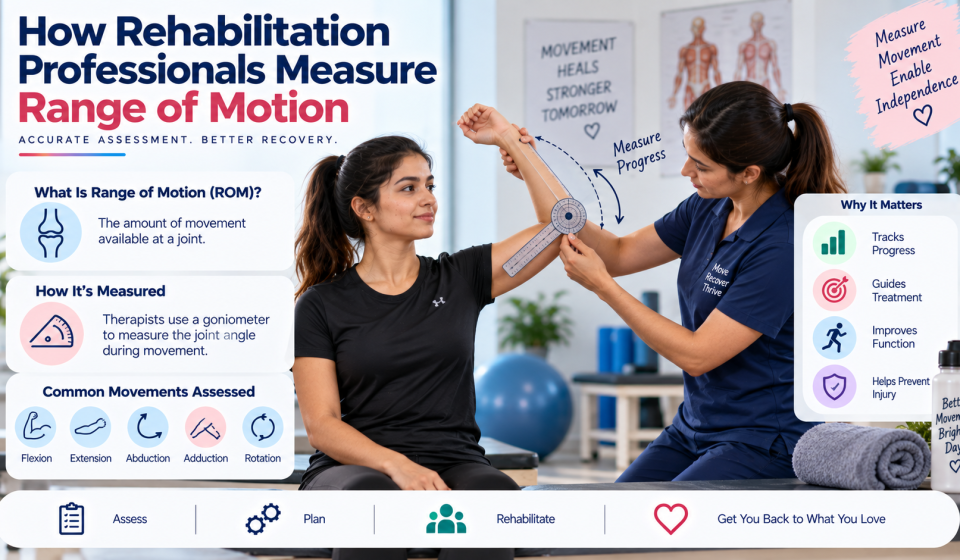
Range of motion refers to the amount of movement available at a joint.
For example, the elbow can bend and straighten, the knee can flex and extend, and the shoulder can move through several directions including flexion, extension, abduction, and rotation.
ROM can be described in degrees because the movement represents an angle.
A rehabilitation professional may record a measurement such as:
- Knee flexion: 120°
- Knee extension: 0°
- Shoulder flexion: 150°
- Elbow flexion: 140°
The exact values vary between joints and individuals. The purpose of measurement is not simply to compare someone with a textbook number. Professionals also consider the person’s symptoms, functional requirements, previous measurements, injury history, and overall movement ability.
Why Do Rehabilitation Professionals Measure ROM?
ROM measurement can serve several purposes during rehabilitation.
Establishing a Baseline
The first measurement provides a starting point.
For example, someone recovering after knee surgery may have limited knee flexion. Recording the initial measurement allows the rehabilitation professional to compare future measurements against that baseline.
Identifying Movement Restrictions
A measurable reduction in ROM may help identify a joint mobility limitation.
Monitoring Recovery
Repeated measurements can show whether movement is improving, remaining stable, or becoming more restricted.
Evaluating Treatment
ROM measurements can help determine whether interventions such as therapeutic exercise, mobility work, manual therapy, or other rehabilitation strategies are producing changes.
Supporting Functional Decisions
Improved ROM may be important for specific activities such as walking, stair climbing, reaching, dressing, or returning to sport.
Research describes ROM measurement as an important clinical outcome for identifying mobility limitations and evaluating changes during rehabilitation.
Active Range of Motion
Active range of motion, or AROM, is the movement a person performs using their own muscles.
For example, if a patient raises their arm overhead without assistance, the measured movement represents active shoulder ROM.
AROM provides information about several factors at the same time, including:
- Joint mobility
- Muscle strength
- Motor control
- Pain
- Coordination
- Confidence with movement
A person may have adequate passive movement but reduced active movement because of weakness, pain, or poor motor control.
Passive Range of Motion
Passive range of motion, or PROM, occurs when an examiner or external force moves the joint while the patient remains relaxed as much as possible.
For example, a rehabilitation professional may gently move a patient’s knee while the patient does not actively contract the muscles to produce the movement.
PROM can provide information about joint mobility that is less dependent on the person’s active muscle strength.
Comparing active and passive ROM can sometimes provide useful clinical information.
For example, if passive movement is considerably greater than active movement, weakness, pain, motor-control limitations, or other factors may contribute to the reduced active movement.
Research literature distinguishes active ROM, in which the individual produces movement through muscle contraction, from passive ROM, in which an examiner or external force produces the movement.
What Is a Goniometer?
A goniometer is an instrument used to measure joint angles.
A traditional universal goniometer usually has:
- A stationary arm
- A movable arm
- A central axis or fulcrum
- A degree scale
The professional positions the device according to specific anatomical landmarks and then records the joint angle.
Universal goniometers remain widely used because they are portable, relatively inexpensive, non-invasive, and practical in clinical settings.
How a Goniometer Is Used
The exact procedure differs according to the joint and movement being measured, but the general process includes several steps.
Step 1: Explain the Procedure
The professional explains what movement will be measured and positions the patient appropriately.
Step 2: Position the Patient
Correct positioning is important because body position can influence the measurement.
Step 3: Identify Anatomical Landmarks
The examiner identifies appropriate landmarks around the joint.
Step 4: Align the Goniometer
The center of the goniometer is positioned near the joint axis, while the arms are aligned with the relevant body segments.
Step 5: Perform the Movement
The patient may actively move the joint, or the professional may move it passively depending on the assessment.
Step 6: Record the Angle
The examiner reads the measurement in degrees and documents the result.
Step 7: Repeat When Appropriate
Repeated measurements may be used to improve consistency or monitor change.
Accurate landmark identification and standardized positioning are important because measurement procedures can introduce error. Research has shown that examiner proficiency and experience can influence the amount of random error during goniometric measurement.
Measuring ROM at Different Joints
Different joints require different positioning and measurement techniques.
Shoulder
Professionals may measure:
- Flexion
- Extension
- Abduction
- Internal rotation
- External rotation
Shoulder assessment can be more complex because the shoulder involves coordinated movement between multiple joints and body segments.
Elbow
Common measurements include:
- Flexion
- Extension
Research examining elbow goniometry has found generally high intra- and inter-rater reliability, although results can vary depending on the measurement technique and examiner.
Wrist
Wrist ROM may include:
- Flexion
- Extension
- Radial deviation
- Ulnar deviation
Hip
Professionals may assess:
- Flexion
- Extension
- Abduction
- Adduction
- Internal rotation
- External rotation
Knee
Common measurements include:
- Flexion
- Extension
Knee ROM is particularly important after orthopedic procedures and injuries because restrictions can affect walking, stairs, sitting, and other daily activities. Research has shown that different clinical devices can produce different levels of measurement error, making consistent technique important when monitoring change.
Ankle
Measurements may include:
- Dorsiflexion
- Plantarflexion
- Inversion
- Eversion
Ankle mobility can influence walking, balance, squatting, and other lower-limb activities.
Other Tools Used to Measure ROM
Although the universal goniometer is common, rehabilitation professionals have other options.
Digital Goniometers
Digital devices can display measurements electronically and may provide additional precision depending on the device.
Inclinometers
An inclinometer measures the angle of a body segment relative to gravity.
They may be useful for certain joints and movement patterns.
Research has found good reliability for some digital inclinometer applications, although results can differ depending on the movement and testing method.
Smartphone Applications
Some smartphone applications use the phone’s sensors to estimate joint angles.
These tools can be convenient, but their accuracy can vary depending on the application, joint, positioning, and measurement method. A systematic review found that smartphone-based tools can be clinically useful but should be interpreted with awareness of their limitations.
Photography
Photographic methods can also be used to measure certain joint angles.
Photography provides a permanent visual record that can sometimes help with repeat assessments.
Research has investigated photographic methods for knee ROM and found potential advantages in some circumstances.
Three-Dimensional Motion Analysis
Advanced rehabilitation or research environments may use three-dimensional motion-analysis systems.
These systems can capture movement dynamically using cameras, markers, sensors, or other technologies.
They are particularly useful when professionals want to understand movement during activities such as walking, jumping, or sporting movements rather than only measuring a joint in a stationary position.
Why Standardized Positioning Matters
Two professionals can measure the same person’s ROM and obtain different values if they use different positions or techniques.
Factors that can influence measurements include:
- Patient positioning
- Examiner positioning
- Anatomical landmark identification
- Goniometer alignment
- Movement speed
- Amount of force applied
- Patient effort
- Pain
- Muscle tension
- Joint stability
- Examiner experience
This is why rehabilitation professionals try to use standardized procedures whenever possible.
Research has shown that even commonly used goniometric measurements can contain random error, and greater examiner proficiency can reduce measurement variability.
Understanding Measurement Reliability
Reliability refers to how consistently a measurement can be repeated.
There are two important concepts.
Intra-Rater Reliability
This refers to how consistently the same examiner obtains measurements when the test is repeated.
Inter-Rater Reliability
This refers to how consistently different examiners obtain measurements from the same person.
High reliability is important because rehabilitation professionals often compare measurements across different appointments.
Research has reported high reliability for several goniometric applications, although reliability varies depending on the joint, movement, device, and testing procedure.
Measurement Error and Why Small Changes Matter
Not every change in a ROM measurement represents a true physical improvement.
For example, a measurement changing from 110° to 112° may be within the expected measurement error of the technique.
This is why professionals consider measurement reliability and the smallest meaningful or detectable change when interpreting results.
Research comparing different knee ROM measurement methods found that devices can have different minimum significant differences, emphasizing the importance of understanding measurement error when monitoring progress.
ROM Measurement and Pain
Pain can influence how far a person is willing or able to move.
If a patient stops movement because of pain, the recorded ROM may be lower than the person’s potential movement in a pain-free condition.
Rehabilitation professionals therefore consider:
- Pain intensity
- Location of pain
- When pain begins
- Whether pain limits movement
- Whether pain changes between active and passive testing
ROM should not be interpreted as an isolated number.
ROM and Functional Movement
A joint can have a measurable range of motion without a person being able to use that movement effectively during daily activities.
For example, someone may demonstrate adequate hip mobility while lying on an examination table but still struggle with a functional task such as climbing stairs.
This is why rehabilitation assessment often combines ROM measurements with:
- Strength testing
- Balance assessment
- Functional movement testing
- Gait assessment
- Coordination
- Pain assessment
- Activity-specific testing
The goal is to understand how mobility contributes to real-world function.
How ROM Measurements Help Track Rehabilitation Progress
ROM measurements can provide objective information throughout rehabilitation.
A typical progression may look like:
Initial assessment → Baseline ROM → Treatment → Reassessment → Comparison → Program adjustment
For example, after a knee injury, a patient may initially have restricted knee flexion. Over several weeks, measurements may show gradual improvement.
The rehabilitation professional can then combine this information with pain levels, strength, walking ability, and functional performance to determine whether the treatment plan should continue or change.
What Can Cause Reduced Range of Motion?
Reduced ROM can have many causes, including:
- Joint stiffness
- Pain
- Swelling
- Muscle tightness
- Weakness
- Previous injury
- Surgery
- Scar tissue
- Joint inflammation
- Neurological conditions
- Prolonged inactivity
- Protective movement patterns
Because different causes require different approaches, rehabilitation professionals do not usually treat a ROM number alone.
Why ROM Should Be Measured Consistently
Consistency is especially important when comparing measurements over time.
Professionals may try to maintain the same:
- Patient position
- Measurement tool
- Anatomical landmarks
- Movement direction
- Testing instructions
- Measurement technique
- Examiner, when possible
Using consistent procedures makes it easier to determine whether a change is likely to reflect actual progress rather than differences in measurement technique.
The Role of ROM in Rehabilitation Goals
ROM is often connected to functional goals.
For example, a rehabilitation goal may involve being able to:
- Walk comfortably
- Climb stairs
- Reach overhead
- Dress independently
- Pick up objects
- Sit and stand comfortably
- Return to work
- Resume sports activities
The amount of ROM required depends on the specific activity.
Therefore, rehabilitation professionals focus not only on whether a joint reaches a particular number but also on whether the available movement supports the person’s functional goals.
Source
PMC knee goniometry study
PMC elbow goniometry review
PMC measurement-error study
PMC goniometry reliability study
Conclusion
Range of motion measurement is an important part of rehabilitation because it provides objective information about joint mobility and helps professionals monitor changes during recovery. Rehabilitation professionals may use universal goniometers, digital goniometers, inclinometers, smartphone-based tools, photography, or advanced motion-analysis systems depending on the joint, clinical setting, and purpose of the assessment.
Accurate ROM measurement depends on more than the measuring device. Patient positioning, anatomical landmarks, examiner technique, movement type, pain, effort, and consistency can all influence the result. For this reason, ROM should be interpreted together with strength, balance, coordination, pain, and functional performance. When measurements are performed consistently and interpreted appropriately, they can provide valuable information for setting rehabilitation goals, evaluating progress, and supporting better movement and function.
FAQ
1. What does ROM mean in rehabilitation?
ROM means range of motion. It describes how far a joint can move through a particular direction or movement pattern.
2. What tool is commonly used to measure ROM?
A universal goniometer is one of the most commonly used clinical tools for measuring joint angles.
3. What is the difference between active and passive ROM?
Active ROM is produced by the person’s own muscles, while passive ROM occurs when an examiner or external force moves the joint.
4. Why do rehabilitation professionals measure ROM?
ROM measurements help establish a baseline, identify movement restrictions, monitor recovery, evaluate treatment, and assess changes in joint mobility.
5. Can ROM measurements be inaccurate?
Yes. Measurement error can occur because of positioning, anatomical landmark identification, examiner experience, equipment, pain, and other factors.
6. Is a goniometer better than a smartphone app?
Not necessarily in every situation. Different tools have different advantages and limitations, and accuracy depends on the joint and measurement technique.
7. Can ROM improve with rehabilitation?
ROM may improve when the underlying cause of restriction is appropriately addressed through rehabilitation. The amount of improvement depends on the condition and individual factors.
8. Does pain affect ROM measurement?
Yes. Pain can limit how far a person is willing or able to move, so professionals consider pain when interpreting ROM results.
9. Why is consistent measurement important?
Using a consistent technique makes it easier to determine whether changes between assessments represent actual progress rather than measurement differences.
10. Is normal ROM the same for everyone?
No. ROM can vary between individuals based on factors such as age, anatomy, activity level, injury history, and the specific joint being assessed.