How Muscle Imbalances Affect Movement Quality: Causes, Signs, Effects and Ways to Improve Muscle Balance

Discover how muscle imbalances can affect movement quality, posture, balance, coordination, strength, and everyday mobility. Learn the common causes, warning signs, assessment methods, and practical ways to improve muscle balance.
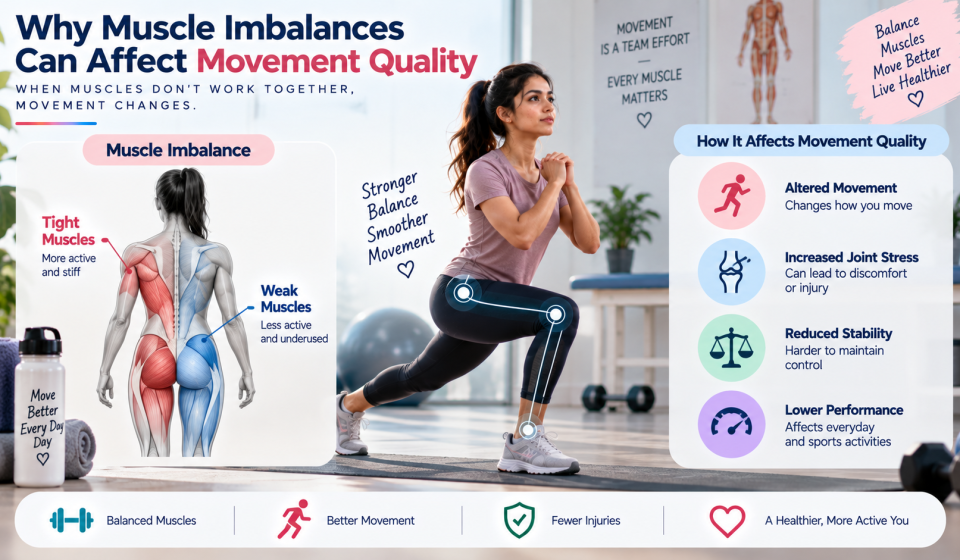
Muscle balance plays an important role in how efficiently and comfortably the body moves. Every movement involves multiple muscles working together to provide strength, stability, coordination, and control. When one muscle group becomes significantly stronger, weaker, tighter, or less coordinated than another, the body may adjust its movement strategy to complete the task. These changes can sometimes appear as poor posture, altered walking patterns, uneven loading, reduced stability, or inefficient movement.
Muscle imbalances can develop for many reasons, including previous injuries, repetitive activities, prolonged sitting, sports-specific training, inactivity, differences in limb dominance, and changes during rehabilitation. Not every difference between the left and right sides is automatically harmful, and research shows that the effects of strength asymmetry can vary depending on the person, movement, and activity. However, larger or functionally important differences may influence movement performance and should be considered as part of a broader movement assessment.
What Is a Muscle Imbalance?
A muscle imbalance occurs when muscles that normally contribute to a movement do not have an appropriate relationship in terms of strength, flexibility, endurance, activation, or control.
For example, the muscles on one side of the body may be stronger than those on the other side. Similarly, one muscle group may become overactive while another contributes less than expected.
Muscle imbalance can involve:
- Left-to-right strength differences
- Agonist and antagonist muscle differences
- Differences in flexibility or range of motion
- Reduced muscular endurance
- Poor neuromuscular coordination
- Uneven weight distribution
- Differences in joint stability
- Compensatory movement strategies
The important point is that muscle balance is not about making both sides of the body perfectly identical. Human movement naturally contains some asymmetry. The concern is whether a difference meaningfully affects function, comfort, performance, or movement control.
Why Movement Quality Matters
Movement quality describes how efficiently and effectively a person performs a movement.
Good movement quality generally involves appropriate coordination between different parts of the body, adequate strength and mobility, controlled joint movement, balance, and the ability to complete a task without unnecessary compensation.
Walking, squatting, climbing stairs, reaching, lifting, running, and getting up from a chair all require several muscles and joints to work together.
Research on human movement shows that movement is highly complex because muscles do not operate independently. Muscle forces interact with joint movements, balance, body position, and other muscles throughout the kinetic chain.
When one part of this system is weaker or less coordinated, another part may have to contribute differently.
How Muscle Imbalances Can Change Movement
One of the most noticeable effects of muscle imbalance is a change in movement strategy.
Suppose one leg is weaker than the other. During a squat, the person may unconsciously shift more body weight toward the stronger side. During walking, they may spend less time loading the weaker leg. During stairs, they may push harder through the stronger leg.
These adaptations may allow the person to complete the movement, but the movement itself may become less symmetrical or less efficient.
Studies examining movement asymmetry have found that differences between limbs can be associated with changes in certain physical performance measures, although the relationship is not always consistent.
Common Causes of Muscle Imbalances
Previous Injuries
After an injury, people often change how they move to protect a painful or recovering area.
For example, after a knee injury, someone may unconsciously place more weight on the opposite leg. Even after pain decreases, the altered movement pattern may continue until strength and confidence are restored.
Repetitive Activities
Repeatedly performing the same movement can place different demands on specific muscles.
Activities such as running, cycling, throwing, typing, or certain occupational tasks may repeatedly favor particular muscles or movement directions.
Prolonged Sitting
Long periods of sitting can reduce opportunities for regular movement and may contribute to changes in muscle strength, endurance, mobility, and movement habits.
However, muscle imbalance should not automatically be blamed on sitting alone. Movement behavior, exercise habits, individual anatomy, previous injuries, and overall physical activity also matter.
Sports and Training
Athletes often train specific movement patterns repeatedly.
A tennis player, for example, may develop highly specialized movement characteristics because the sport itself is asymmetric. Asymmetry is therefore not automatically a problem; it needs to be considered in the context of the individual’s sport and normal movement pattern.
Inactivity
Insufficient physical activity can reduce general strength and endurance. When physical capacity decreases, everyday movements may become more demanding and compensation may become more noticeable.
Muscle Imbalance and Posture
Muscle imbalance can also influence how the body is positioned during standing, sitting, and movement.
Posture depends on the interaction of muscles, joints, connective tissues, nervous-system control, and habitual movement patterns. A difference in muscle strength or control may influence how a person holds their pelvis, shoulders, trunk, or head.
However, posture should not be interpreted from one muscle in isolation.
A recent systematic review found that strengthening interventions may influence some aspects of spinal and lumbopelvic posture, while the evidence did not support stretching alone as a general treatment for “muscle imbalance.”
This highlights why individualized assessment is more useful than assuming that one tight muscle or one weak muscle explains every posture problem.
Muscle Imbalances and Walking
Walking requires coordinated contributions from both legs, the trunk, and the upper body.
Each leg performs different roles during different phases of the gait cycle, including supporting body weight, absorbing forces, producing propulsion, and helping maintain balance.
If one side produces less force or has reduced control, the person may modify step length, stance time, walking speed, or weight distribution.
Gait asymmetry can occur for many reasons, including injury, neurological conditions, amputation, and differences in body structure. Research indicates that gait asymmetry can influence the demands placed on the body and may be relevant during rehabilitation.
Muscle Imbalances and Balance
Balance is another area where muscle function matters.
The body constantly adjusts muscle activity to keep the center of mass controlled over the base of support. Weakness or reduced coordination in important muscle groups can make these adjustments more difficult.
For example, hip muscle strength is associated with aspects of balance and mobility, particularly in different adult populations.
This does not mean that strengthening one muscle automatically fixes balance. Balance is a whole-body skill involving sensory information, nervous-system control, vision, strength, joint mobility, and movement strategy.
Compensatory Movement Patterns
The body is highly adaptable.
When one muscle or joint is unable to contribute normally, another part of the body may compensate.
Examples may include:
- Shifting weight toward one side during squats
- Rotating the trunk during lifting
- Leaning while walking
- Using momentum instead of muscular control
- Changing foot placement during movement
- Avoiding a particular range of motion
- Using the stronger limb more frequently
Compensation is not necessarily bad. It can be a useful short-term strategy that allows a person to complete a task.
The concern arises when a compensation becomes persistent, inefficient, painful, or limiting.
Signs That Muscle Imbalance May Be Affecting Movement
Possible signs include:
- One side consistently feels stronger than the other
- Uneven weight distribution during exercises
- Difficulty maintaining balance
- Noticeable changes in walking
- One-sided fatigue during activity
- Repeated loss of control during single-leg movements
- Differences in range of motion
- Difficulty performing symmetrical exercises
- Changes in technique as fatigue develops
- Persistent discomfort during certain movements
These signs do not automatically prove that a muscle imbalance is present. A professional assessment may be needed to identify the actual cause.
How Professionals Assess Muscle Imbalances
A physical therapist, sports rehabilitation professional, or other qualified clinician may use several methods to evaluate movement.
Strength Testing
Strength may be compared between sides or between different muscle groups.
Testing can be performed manually or with specialized equipment, depending on the situation.
Range-of-Motion Assessment
Differences in joint mobility may affect how muscles contribute to movement.
Functional Movement Tests
Movements such as squatting, stepping, lunging, reaching, walking, and getting up from a chair can reveal differences that may not appear during isolated muscle testing.
Gait Analysis
Walking can be observed or measured to identify differences in step timing, loading, joint movement, and overall movement strategy.
Balance Testing
Single-leg balance and other dynamic balance tasks can provide information about stability and control.
A comprehensive assessment is generally more useful than relying on a single test because movement problems can have multiple contributing factors.
Can Muscle Imbalances Be Corrected?
Many movement-related strength differences can be addressed through an individualized rehabilitation or exercise program.
The exact approach depends on the underlying cause.
A program may include:
- Strengthening weaker muscle groups
- Unilateral exercises
- Mobility exercises when appropriate
- Balance training
- Neuromuscular control exercises
- Functional movement practice
- Gradual resistance progression
- Technique modification
- Gait retraining when indicated
Research suggests that exercise-based interventions can improve several aspects of functional movement capability, including measures involving asymmetry and movement patterns in untrained populations.
The goal is not always to eliminate every difference between the two sides. Instead, the focus should be on improving useful strength, control, confidence, function, and movement efficiency.
Why Unilateral Exercises Can Be Useful
Unilateral exercises train one side at a time.
Examples include:
- Split squats
- Step-ups
- Single-leg bridges
- Single-arm rows
- Single-leg balance exercises
- Single-arm presses
These exercises can make side-to-side differences easier to observe and may help an individual develop control on each side.
However, unilateral exercises should be selected according to the person’s goals, physical condition, and movement capacity.
The Importance of Gradual Progress
Trying to correct a muscle imbalance too quickly can create another problem.
If a weak muscle has not been trained for a long period, suddenly increasing resistance or exercise volume may exceed its current capacity.
A gradual approach allows the body to adapt.
Progress can involve increasing:
- Resistance
- Repetitions
- Range of motion
- Movement complexity
- Stability demands
- Exercise duration
- Functional challenge
Progress should be based on the individual’s response rather than an arbitrary target.
Muscle Imbalance Does Not Always Mean Injury Risk
It is important not to assume that every asymmetry causes injury.
Research on inter-limb strength asymmetry has found inconsistent evidence regarding injury and performance effects, and commonly used numerical thresholds for “abnormal” asymmetry are not always strongly supported by evidence.
Similarly, research examining movement-quality screening has not established that every observed movement fault can reliably predict future injury.
Therefore, muscle imbalance should be interpreted alongside pain, injury history, physical capacity, movement demands, training level, and functional goals.
When to Seek Professional Assessment
Consider professional guidance if you experience:
- Persistent pain
- Significant weakness on one side
- Repeated falls or loss of balance
- Major changes in walking
- Difficulty returning to normal activity after injury
- Repeated exercise-related problems
- Sudden loss of strength
- Progressive movement difficulties
A professional can help determine whether the issue is related to muscle strength, joint mobility, pain, neurological function, coordination, or another factor.
How to Support Better Movement Quality
You can support healthy movement by maintaining a balanced exercise routine that includes strength, mobility, balance, coordination, and cardiovascular activity.
Useful habits include:
- Avoid training only your strongest side
- Include different movement patterns
- Strengthen major muscle groups
- Practice controlled technique
- Take regular movement breaks
- Increase training gradually
- Pay attention to persistent changes in movement
- Allow appropriate recovery
- Seek professional assessment when needed
Movement quality improves through consistent practice and appropriate physical capacity, not through trying to make every movement perfectly symmetrical.
Source
https://pmc.ncbi.nlm.nih.gov/articles/PMC4060319
https://pmc.ncbi.nlm.nih.gov/articles/PMC3172944/
Conclusion
Muscle imbalances can influence movement quality when differences in strength, mobility, endurance, or coordination affect how the body performs a task. They may contribute to compensatory movement patterns, uneven loading, changes in balance, altered walking mechanics, or reduced exercise performance. However, not every asymmetry is abnormal or harmful, and research shows that the effects can differ depending on the movement and individual.
The best approach is to look at movement as a complete system rather than focusing on one muscle in isolation. Strength training, functional exercises, balance work, mobility, gradual progression, and professional assessment when necessary can all support better movement quality. The goal is not perfect symmetry—it is efficient, controlled, comfortable, and functional movement.
FAQ
1. What is a muscle imbalance?
A muscle imbalance is a difference in strength, flexibility, endurance, activation, or control between muscles or between the two sides of the body.
2. Can muscle imbalance affect walking?
Yes. Significant differences in strength or muscle function can contribute to changes in loading, step patterns, balance, and walking strategy.
3. Does muscle imbalance always cause pain?
No. A person can have strength or movement asymmetry without experiencing pain. Pain depends on many factors and should not be attributed to muscle imbalance automatically.
4. Can exercise improve muscle imbalance?
Exercise can improve strength and functional movement capacity when the program is appropriate for the individual’s needs. A professional can help identify which exercises are suitable.
5. Are left-right strength differences normal?
Some differences are normal, especially because people naturally have a dominant side. The importance of an asymmetry depends on its size, location, function, and individual context.
6. Can muscle imbalance affect posture?
It can contribute to changes in posture or movement strategy, but posture is influenced by many factors. One muscle should not automatically be considered the sole cause of a posture problem.
7. Are unilateral exercises useful for muscle imbalance?
They can be useful because they train each side independently and may make differences in strength or control easier to identify and address.
8. When should I see a physical therapist?
Consider professional assessment if you have persistent pain, noticeable weakness, significant changes in walking or balance, repeated injuries, or difficulty returning to normal activities.
9. Can muscle imbalance increase injury risk?
Possibly in some situations, but the scientific evidence is not consistent enough to say that every muscle imbalance predicts injury. Individual assessment is more useful than relying on a single percentage or threshold.
10. What is the main goal of correcting muscle imbalance?
The goal is not necessarily perfect symmetry. The main goal is to improve strength, coordination, stability, movement efficiency, confidence, and the ability to perform everyday or sport-specific activities safely.