Understanding Proprioception: How Your Body Knows Where It Is and Why It Matters for Movement

Learn what proprioception is, how it helps the body sense position and movement, and why proprioception is essential for balance, coordination, rehabilitation, sports performance, and everyday activities.
Have you ever closed your eyes and still known where your hands, feet, or legs are? You can usually touch your nose with your eyes closed, walk without constantly looking at your feet, or adjust your posture without consciously thinking about every muscle involved. These abilities are possible partly because of a sensory system called proprioception. Proprioception helps the brain understand the position, movement, and force of different parts of the body and plays an important role in coordinated human movement.
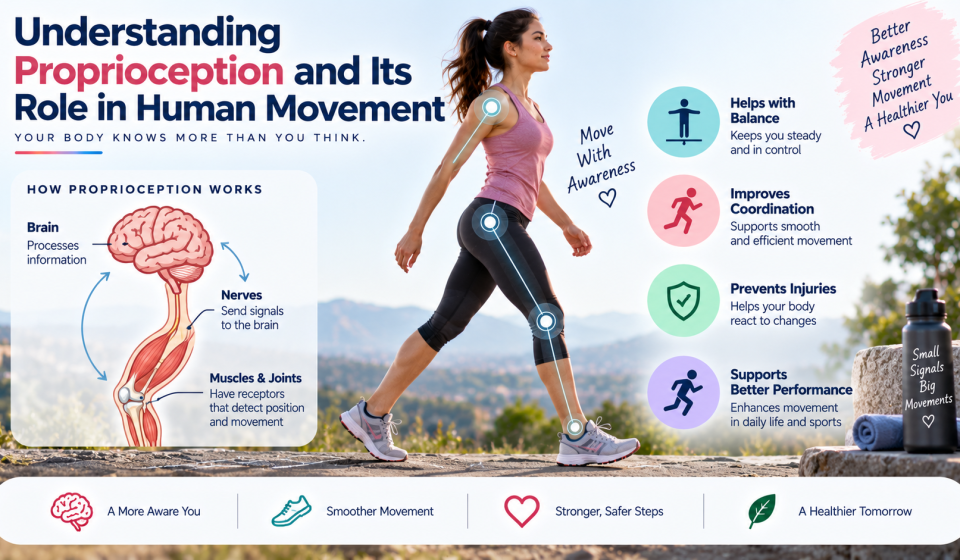
Proprioception works continuously in the background. Information from muscles, tendons, joints, skin, and other sensory receptors is processed by the nervous system and combined with information from other senses to help the body control movement. When proprioceptive information is reduced or disrupted, a person may experience difficulties with balance, coordination, movement accuracy, or functional activities. For this reason, proprioception is an important concept in physical rehabilitation, neurological recovery, sports training, and everyday physical function.
What Is Proprioception?
Proprioception is often described as the body’s ability to sense its own position and movement.
It allows the brain to receive information about what is happening inside the musculoskeletal system without requiring constant visual attention.
For example, when you bend your elbow, proprioceptive information helps your nervous system recognize that the joint is changing position. When you stand on one leg, proprioceptive signals contribute to the body’s understanding of limb position and movement, helping coordinate postural responses.
Modern research describes proprioception as a broader sensorimotor system involving information about joint position, movement, force, and effort.
How Does Proprioception Work?
Proprioception depends on specialized sensory receptors located throughout the body.
Important sources of proprioceptive information include:
- Muscle spindles
- Golgi tendon organs
- Joint receptors
- Skin receptors
- Sensory nerves
- Central nervous system processing
These receptors detect mechanical changes such as muscle length, muscle tension, joint movement, and pressure. The information travels through sensory pathways toward the nervous system, where it contributes to movement control.
The brain does not rely on proprioception alone. It combines proprioceptive information with visual and vestibular information to develop an ongoing understanding of body position and movement.
Proprioception and Kinesthesia
Proprioception and kinesthesia are closely related terms and are sometimes used interchangeably.
Kinesthesia generally refers to the perception of movement, while proprioception is commonly used more broadly to describe awareness of body position, movement, force, and the mechanical state of body parts.
The distinction can vary between research fields, which is one reason proprioception can sometimes be difficult to define precisely. Recent research emphasizes that proprioception includes several related sensory functions rather than representing a single isolated sensation.
Why Is Proprioception Important for Human Movement?
Almost every coordinated physical movement depends on sensory information.
When you walk, the nervous system needs information about the position of your feet and legs. When you reach for an object, your brain needs information about the position of your arm and hand. When you change direction, your body needs to quickly process information about movement and position.
Proprioception helps support:
- Balance
- Coordination
- Postural control
- Movement accuracy
- Joint stability
- Walking
- Sports performance
- Functional independence
- Motor learning
Research has established an important role for proprioceptive signals in neural control of movement, posture, and motor function.
The Role of Proprioception in Balance
Balance is not simply about standing still. It requires continuous adjustments to keep the body’s center of mass within a safe area of support.
The brain receives information from several systems, including vision, the vestibular system, and proprioceptive receptors.
For example, when you stand on an uneven surface, information from your feet, ankles, knees, hips, and muscles helps the nervous system detect changes in body position.
The nervous system can then adjust muscle activity to maintain stability.
Proprioception is therefore an important component of postural control, although balance depends on multiple sensory systems working together rather than proprioception alone.
Proprioception During Walking
Walking requires thousands of coordinated adjustments.
Every step involves changes in joint angles, muscle length, muscle force, pressure, and body position.
Proprioceptive information helps the nervous system monitor these changes and coordinate the next movement.
For example, information from the ankle and foot can contribute to understanding how the foot is positioned relative to the ground. Information from muscles and joints throughout the leg helps coordinate the movement of the knee and hip.
This ongoing feedback allows walking to become an efficient and largely automatic activity.
Proprioception and Movement Accuracy
Imagine reaching for a cup without looking directly at your hand.
Your brain uses information from your muscles and joints to estimate where your arm is positioned. This allows the hand to move toward the target with relatively little conscious effort.
Proprioception therefore contributes to movement accuracy.
When proprioceptive information is impaired, movements may become less precise or require greater visual attention.
What Happens When Proprioception Is Impaired?
Reduced proprioceptive function can affect movement in several ways.
A person may experience:
- Poor balance
- Difficulty coordinating movements
- Reduced movement accuracy
- Increased dependence on vision
- Difficulty judging joint position
- Changes in walking
- Reduced confidence during movement
- Greater difficulty performing certain functional activities
The effects depend on the location and severity of the sensory impairment and the underlying cause.
Proprioceptive problems can occur in neurological conditions as well as orthopedic injuries involving muscles, joints, ligaments, or other structures.
Proprioception After an Injury
Injuries involving joints, ligaments, muscles, and other tissues can affect the sensory information available to the nervous system.
For example, after an ankle or knee injury, a person may experience changes in joint position awareness or movement control.
This can influence how confidently the person places the foot, changes direction, or performs other movements.
Rehabilitation may therefore include exercises designed to improve movement control, balance, strength, and sensory awareness.
Proprioception and Rehabilitation
Proprioception has an important role in rehabilitation because successful recovery often requires more than simply rebuilding muscle strength.
A person may have adequate strength but still struggle with balance, coordination, or precise movement.
Rehabilitation professionals may use activities involving controlled movement, balance, weight shifting, joint-position tasks, and functional exercises to challenge the sensorimotor system.
However, it is important to understand that the term “proprioceptive training” is sometimes used broadly. Many exercises described as proprioceptive training also involve balance, strength, motor learning, and coordination. Current research emphasizes the need to distinguish these mechanisms when interpreting treatment effects.
Proprioception After Stroke
Stroke can affect sensory and motor systems, and proprioceptive impairment is common among stroke survivors.
When proprioceptive information is reduced, a person may have difficulty understanding the position of an affected limb without looking at it.
This can interfere with:
- Sitting balance
- Standing
- Walking
- Reaching
- Limb control
- Motor learning
- Functional independence
Research indicates that proprioceptive impairment can influence motor recovery and functional performance after stroke.
Rehabilitation may combine sensory retraining with task-specific motor practice to address both sensory and movement limitations.
Proprioception and Sports Performance
Athletes constantly adjust body position, speed, force, and direction.
Running, jumping, landing, changing direction, and maintaining balance all require rapid sensory and motor responses.
Good sensorimotor control can help athletes perform precise movements and respond to changing conditions.
Proprioceptive exercises are therefore frequently included in sports rehabilitation and training programs. Research has reported improvements in proprioceptive and motor outcomes following various training approaches, although the exact effects depend on the type of intervention and how proprioception is measured.
How Is Proprioception Tested?
There is no single test that measures every aspect of proprioception.
Researchers and clinicians may use different approaches depending on the body part and the sensory function being assessed.
Common assessment methods include:
Joint Position Reproduction
A person is asked to reproduce a particular joint position. The difference between the target and reproduced position can provide information about joint position sense.
Threshold to Detection of Passive Movement
This method measures how accurately a person detects very small passive movements of a joint.
Movement Discrimination
Some assessments evaluate the ability to distinguish between different movements or positions.
These approaches measure different aspects of proprioception, and each has advantages and limitations.
Can Proprioception Be Improved?
Research suggests that proprioceptive and motor performance can improve following appropriate training.
A systematic review of 70 studies found that proprioceptive training was associated with improvements in both proprioceptive and motor performance across healthy and clinical populations.
Another systematic review examining the learning dynamics of proprioception training found evidence that proprioceptive improvements can be specific to the type of training and may be retained after training.
However, there is no universal exercise program that improves proprioception for everyone.
The appropriate approach depends on the individual’s condition, goals, movement limitations, and rehabilitation needs.
Common Activities Used to Challenge Proprioception
Depending on a person’s ability and professional guidance, proprioceptive or sensorimotor exercises may involve:
- Single-leg standing
- Controlled weight shifting
- Balance exercises
- Joint-position exercises
- Controlled reaching
- Functional movement tasks
- Walking exercises
- Strength exercises
- Movement on different surfaces
- Coordination activities
Some exercises may be performed with reduced visual input to increase reliance on somatosensory information, but this should only be done when appropriate and safely supervised.
Proprioception and the Importance of Vision
Vision and proprioception work together.
When you look at your feet while standing or walking, vision provides information about where your body is positioned. When you close your eyes, your nervous system must rely more heavily on proprioceptive and vestibular information.
This demonstrates how the brain combines multiple sensory systems to control movement.
However, removing vision does not automatically create a pure proprioceptive exercise. Many balance tasks involve several sensory and motor mechanisms simultaneously.
Proprioception and Motor Learning
Learning a new physical skill requires the brain to receive information about movement and its results.
Whether learning to walk after an injury, improving athletic technique, or mastering a new physical task, sensory feedback helps the nervous system adjust future movements.
Proprioception contributes to this process by providing information about body position, movement, and force.
Repeated practice allows the nervous system to refine movement strategies and improve coordination.
Proprioception in Everyday Activities
You do not need to be an athlete to depend on proprioception.
Everyday examples include:
- Walking without looking at your feet
- Reaching for objects
- Climbing stairs
- Getting dressed
- Typing
- Picking up objects
- Standing from a chair
- Maintaining posture
- Carrying groceries
- Moving around obstacles
These activities require the nervous system to continuously estimate body position and adjust movement.
Factors That Can Affect Proprioception
Several factors can influence proprioceptive performance.
These may include:
- Injury
- Neurological conditions
- Joint problems
- Muscle fatigue
- Aging
- Reduced physical activity
- Pain
- Changes in sensory input
- Increased cognitive demands
Proprioceptive performance can also vary depending on the specific assessment method and the task being performed. Research has highlighted the complexity of measuring proprioception and the limitations of different testing approaches.
Why Proprioception Matters for Physical Independence
Maintaining the ability to move safely and confidently is important for independence.
Good sensorimotor control can help people perform daily activities without constantly relying on visual monitoring.
For older adults and people recovering from injury or neurological conditions, rehabilitation that addresses movement, balance, strength, and sensory function can be particularly valuable.
The goal is not simply to improve a laboratory measurement. The larger goal is to improve meaningful movement and functional ability.
Source
https://pmc.ncbi.nlm.nih.gov/articles/PMC13397984/
https://pmc.ncbi.nlm.nih.gov/articles/PMC9397687/
https://pubmed.ncbi.nlm.nih.gov/39492292/
Conclusion
Proprioception is an essential part of the body’s movement-control system. It allows the nervous system to receive information about body position, movement, force, and the mechanical state of different body parts. By working together with vision and the vestibular system, proprioception helps support balance, coordination, walking, movement accuracy, posture, sports performance, and everyday independence.
Proprioception is particularly important in rehabilitation because injuries and neurological conditions can interfere with the sensory information required for efficient movement. Appropriate sensorimotor and proprioceptive-focused training may help improve proprioceptive and motor performance, although the exact benefits depend on the individual and the type of intervention. Understanding proprioception therefore provides an important foundation for understanding how humans move, learn new movements, recover from physical problems, and maintain functional independence.
FAQ
1. What is proprioception in simple words?
Proprioception is the body’s ability to sense where its different parts are positioned and how they are moving without needing to constantly look at them.
2. Why is proprioception important?
Proprioception helps the nervous system control movement, balance, posture, coordination, and movement accuracy. It is involved in both everyday activities and athletic performance.
3. What body parts provide proprioceptive information?
Proprioceptive information comes from receptors located in muscles, tendons, joints, and other tissues. The nervous system processes this information to help understand body position and movement.
4. Can proprioception be improved?
Research suggests that certain training approaches can improve proprioceptive and motor performance. However, the appropriate training depends on the individual’s condition, goals, and functional limitations.
5. What exercises improve proprioception?
Depending on the individual, exercises may include balance training, controlled joint movements, weight shifting, functional movement tasks, coordination exercises, and other sensorimotor activities.
6. Is proprioception the same as balance?
No. Proprioception contributes to balance, but balance also depends on vision, the vestibular system, muscle control, and central nervous system processing.
7. Can an injury affect proprioception?
Yes. Injuries involving joints, ligaments, muscles, and other tissues can affect proprioceptive information and may contribute to changes in movement control.
8. Can stroke affect proprioception?
Yes. Proprioceptive impairment is common after stroke and can influence balance, gait, motor control, and functional independence.
9. How is proprioception tested?
Common methods include joint position reproduction, threshold-to-detection-of-passive-motion tests, and movement discrimination assessments. Different tests measure different aspects of proprioceptive function.
10. Why is proprioception important in rehabilitation?
Proprioception provides information that helps the nervous system control movement. Assessing and training relevant sensory and sensorimotor functions can therefore be useful when someone is recovering from an injury or neurological condition.