
Discover why balance assessment is important in physical rehabilitation, how therapists evaluate balance, common balance tests, and how assessment helps improve mobility, safety, independence, and recovery.
Balance is an essential part of everyday movement. Standing, walking, climbing stairs, turning, reaching, getting out of a chair, and moving across uneven surfaces all require the body to control its position. When balance is affected by injury, illness, weakness, neurological conditions, aging, reduced mobility, or other factors, everyday activities can become more difficult and the risk of falling may increase. This is why balance assessment is an important part of many physical rehabilitation programs.
Balance assessment allows rehabilitation professionals to understand how well a person can maintain and control their body position during different situations. Instead of relying only on whether someone appears steady while standing, therapists may assess static balance, dynamic balance, walking, functional movement, coordination, strength, and the body’s responses to changes in position. Research shows that different balance tests can provide useful information about fall risk and functional performance, although no single test can describe every aspect of balance.
What Is Balance in Physical Rehabilitation?
Balance is the ability to maintain or control the body’s position during stillness and movement.
It involves the interaction of several systems, including:
- Vision
- Inner-ear or vestibular information
- Proprioception
- Muscle strength
- Joint mobility
- Coordination
- Nervous-system control
- Attention and cognitive processing
Balance is therefore much more than simply standing without falling.
A person may have good static balance while standing but struggle when walking, turning, reaching, or stepping over an obstacle. This is why rehabilitation professionals often use several different types of assessment.
Why Is Balance Assessment Important?
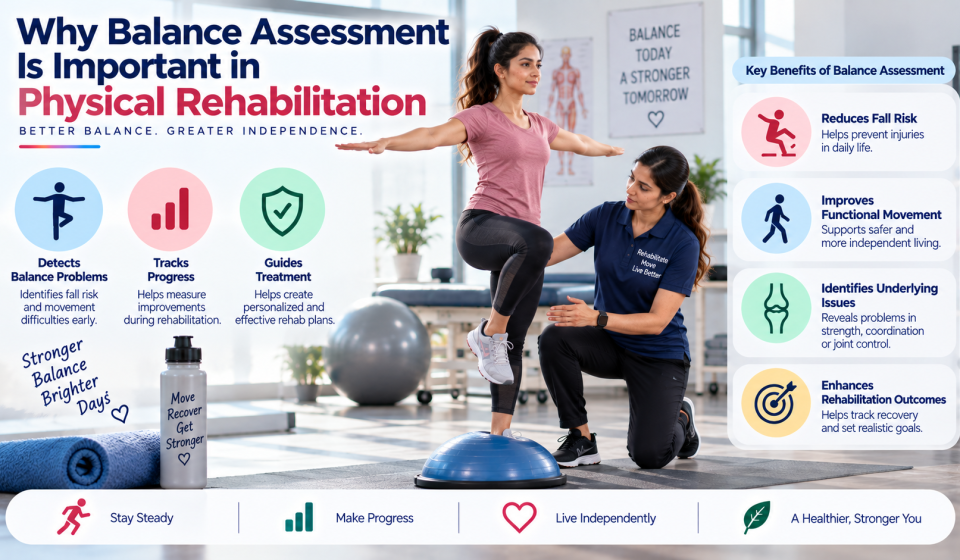
Balance assessment helps therapists identify specific difficulties rather than making general assumptions.
A person may report that they “feel unsteady,” but the underlying reason could involve weakness, reduced sensation, poor coordination, limited joint mobility, vestibular problems, changes in walking mechanics, or difficulty reacting to unexpected movement.
A structured assessment can help identify these differences and guide rehabilitation goals.
Identifying Fall Risk
One of the most important reasons for balance assessment is identifying people who may have an increased risk of falling.
Falls can lead to injuries, reduced confidence, activity limitations, and loss of independence. The World Health Organization identifies poor balance and limited mobility among important fall-related risk factors, particularly in older adults.
Balance tests can provide objective information that may help professionals decide whether additional fall-prevention strategies are appropriate.
A systematic review found that several balance tests can help distinguish older adults who have fallen from those who have not. The single-leg stance test was identified as one promising assessment, while measures of body sway may provide additional information.
Establishing a Rehabilitation Baseline
Before treatment begins, a therapist may perform a balance assessment to establish a baseline.
For example, a person recovering from a stroke may have difficulty standing independently. A person recovering from an ankle injury may have difficulty balancing on one leg. Someone with reduced mobility may have difficulty turning or changing direction.
Recording the initial performance gives the therapist a reference point.
Later assessments can then be compared with the baseline to determine whether functional abilities are changing.
Measuring Progress During Recovery
Rehabilitation is often a gradual process.
Balance assessment can help track changes over time.
A patient may initially need significant support to stand or walk. After several weeks of rehabilitation, they may be able to:
- Stand independently
- Maintain balance for longer
- Walk more confidently
- Turn more safely
- Step over obstacles
- Perform single-leg tasks
- Recover more effectively from small disturbances
These improvements may be difficult to describe accurately without objective assessment.
Static Balance Assessment
Static balance refers to maintaining a stable position while the body is relatively stationary.
Common examples include:
- Standing with feet apart
- Standing with feet together
- Semi-tandem standing
- Tandem standing
- Single-leg standing
The therapist may observe how long the person can maintain the position and whether they use excessive body movements or external support.
Static balance testing can be useful, but it represents only one part of overall balance ability.
Dynamic Balance Assessment
Dynamic balance involves maintaining control while the body is moving.
Examples include:
- Walking
- Turning
- Reaching
- Stepping
- Changing direction
- Moving from sitting to standing
- Walking around obstacles
- Stepping onto different surfaces
Dynamic balance is particularly important because many real-life activities require movement rather than standing still.
Functional Balance Assessment
Functional balance testing combines balance with everyday tasks.
A therapist may observe how a person:
- Gets out of a chair
- Walks a short distance
- Turns around
- Sits down
- Reaches for an object
- Steps onto a platform
- Changes walking direction
Functional assessments can provide information about how balance problems affect independence.
This is important because a person may perform well during a simple balance test but still struggle with daily activities.
Common Balance Tests Used in Rehabilitation
Rehabilitation professionals can choose different assessments depending on the person’s condition and goals.
Timed Up and Go Test
The Timed Up and Go, commonly called the TUG, involves standing from a chair, walking a short distance, turning, returning, and sitting down.
It provides information about functional mobility and movement speed.
Berg Balance Scale
The Berg Balance Scale evaluates balance through a series of functional tasks.
It can be useful for assessing changes in balance during rehabilitation.
Single-Leg Stance Test
This test measures how long a person can maintain balance while standing on one leg.
It can provide information about lower-limb balance and postural control.
Functional Reach Test
The person stands and reaches forward while maintaining their balance.
This can provide information about limits of stability during a controlled movement.
Four-Stage Balance Test
This type of assessment uses progressively challenging standing positions to evaluate balance control.
Dynamic Gait Assessments
Some assessments examine balance while walking and changing direction.
These can be especially useful for people whose balance problems become more noticeable during movement.
Balance Assessment After Injury
Injuries can change balance in several ways.
For example, after an ankle sprain, a person may experience pain, weakness, reduced confidence, or altered proprioception.
These changes can affect the ability to maintain balance.
Balance assessment can help a rehabilitation professional determine whether the injured side performs differently from the uninjured side.
The results can then be used to guide exercises such as:
- Strength training
- Single-leg balance
- Proprioceptive exercises
- Controlled stepping
- Functional movement training
Balance Assessment After Neurological Conditions
Neurological conditions can significantly affect balance and movement.
Examples include:
- Stroke
- Parkinson’s disease
- Multiple sclerosis
- Traumatic brain injury
- Spinal cord conditions
- Peripheral neuropathy
Balance problems may occur because of changes in muscle control, sensation, coordination, reaction time, or the ability of the nervous system to integrate sensory information.
A balance assessment helps the rehabilitation professional identify which activities are most difficult and which areas may require additional training.
Balance Assessment and Older Adults
Balance assessment is particularly important for older adults because changes in strength, mobility, vision, sensation, reaction time, and physical activity can influence fall risk.
The World Health Organization recommends that older adults include regular physical activity and specifically emphasizes multicomponent activities involving functional balance and strength on three or more days per week to enhance functional capacity and help prevent falls.
However, exercise recommendations should be individualized according to a person’s health, functional ability, and safety needs.
The Role of Strength in Balance
Muscle strength contributes to the ability to control body position.
For example, the muscles around the hips, knees, ankles, and trunk contribute to maintaining stability during standing and movement.
Weakness may make activities such as standing from a chair, climbing stairs, or recovering from a loss of balance more difficult.
This is why rehabilitation programs often combine balance exercises with strengthening exercises.
The Role of Proprioception
Proprioception helps the body recognize the position and movement of its limbs and joints.
For example, you can usually tell where your foot is positioned even when you cannot see it.
Reduced sensory information may affect balance, especially when visual information is limited.
Rehabilitation professionals may therefore include exercises that challenge proprioception and body awareness when appropriate.
Balance and Walking
Walking requires continuous adjustments in balance.
During each step, the body must transfer weight from one leg to another while controlling the trunk and lower limbs.
Walking balance can become more challenging when a person:
- Turns
- Walks quickly
- Changes direction
- Walks on uneven ground
- Steps over objects
- Walks while carrying something
- Moves in crowded environments
Because of this, balance assessment may include walking tasks rather than only standing tests.
Why One Balance Test Is Not Enough
Balance is a complex ability.
A person may perform well on one test but experience difficulty in another situation.
For example, someone may stand steadily with both feet on the floor but lose balance when:
- Standing on one leg
- Walking backward
- Turning quickly
- Reaching outside their base of support
- Performing a dual task
- Walking on an uneven surface
Research on balance testing supports the use of different assessment approaches because balance includes multiple components and different tests measure different abilities.
Balance Assessment and Rehabilitation Planning
Assessment results help therapists develop individualized rehabilitation programs.
For example:
Assessment finding: Difficulty maintaining single-leg balance.
Possible rehabilitation focus: Lower-limb strength, ankle control, proprioception, and progressive balance exercises.
Another person may demonstrate good standing balance but struggle during walking turns.
Their program may focus more on gait training, directional changes, stepping strategies, and dynamic balance.
This individualized approach helps ensure that exercises match the person’s actual functional limitations.
Reactive Balance Assessment
Reactive balance refers to the ability to respond when balance is unexpectedly disturbed.
For example, a person may need to take a quick step after being slightly pushed or after losing balance while walking.
Reactive balance is important because everyday environments are unpredictable.
A systematic review of reactive balance training found that such training reduced the likelihood and rate of falls among older adults and people with balance impairments compared with control interventions.
Because reactive exercises can be challenging, they should be introduced at an appropriate level and performed with suitable safety precautions.
Balance Assessment in Hospital Rehabilitation
Balance problems may also develop or become more noticeable during hospitalization because of illness, reduced activity, weakness, or changes in mobility.
Recent research examining balance-related interventions in hospitalized adults found improvements in several functional outcomes, although effects differed across measures and did not consistently reduce fall rates in the hospital setting.
This highlights an important point: balance rehabilitation should be individualized, and assessment should guide the selection of appropriate interventions.
How Balance Assessment Supports Independence
Good balance can contribute to independence in daily activities.
A person who can safely stand, walk, turn, reach, and transfer is generally better positioned to perform everyday tasks.
Balance assessment can identify limitations that might interfere with activities such as:
- Bathing
- Dressing
- Cooking
- Shopping
- Walking outdoors
- Using stairs
- Getting in and out of a vehicle
- Moving around the home
The goal of rehabilitation is therefore not simply to achieve a better test score. It is to improve meaningful function.
How Balance Can Improve Through Rehabilitation
Depending on the individual’s condition, rehabilitation may include:
- Static balance exercises
- Dynamic balance exercises
- Strength training
- Gait training
- Coordination exercises
- Proprioceptive training
- Functional movement practice
- Reactive balance training
- Task-specific exercises
Programs are usually progressed gradually.
As balance improves, a therapist may increase the difficulty by reducing support, changing the surface, adding movement, increasing speed, or introducing more complex tasks.
Safety During Balance Exercises
Balance exercises should be performed safely.
Someone with significant balance impairment should not attempt challenging exercises alone without appropriate guidance.
A rehabilitation professional may use:
- Parallel bars
- Stable support surfaces
- A chair
- A wall
- Gait belts
- Close supervision
- Assistive devices
The appropriate safety strategy depends on the person’s condition and level of risk.
Why Regular Reassessment Matters
Balance can change throughout rehabilitation.
Regular reassessment allows professionals to determine whether the person is improving and whether the exercise program needs to become more challenging.
It can also identify areas that remain difficult.
For example, a patient may improve static balance but continue to struggle with walking turns. The therapist can then adjust the program to focus more specifically on dynamic movement.
When Should Balance Be Professionally Assessed?
Professional balance assessment may be useful if someone experiences:
- Frequent falls
- Repeated near-falls
- Unexplained unsteadiness
- Difficulty walking
- New weakness
- Dizziness associated with movement
- Difficulty climbing stairs
- Problems standing from a chair
- Balance changes after an injury
- Balance problems after a neurological condition
- Reduced confidence with everyday movement
Early assessment can help identify contributing factors and guide appropriate rehabilitation.
Source
WHO physical activity guidance
WHO Falls fact sheet
WHO guidance for older adults
Conclusion
Balance assessment is an important part of physical rehabilitation because it helps professionals understand how effectively a person can control their body during standing, walking, transfers, reaching, turning, and other everyday activities. It can help identify potential fall risks, establish a rehabilitation baseline, measure progress, and guide individualized treatment.
Effective balance assessment goes beyond asking whether someone can stand without falling. Static balance, dynamic movement, walking, strength, proprioception, coordination, and functional performance can all provide valuable information. Rehabilitation professionals can use these findings to create appropriate exercise and movement programs that gradually improve physical capacity and confidence.
The ultimate goal of balance rehabilitation is not simply to achieve a better score on a test. It is to help people move more safely, confidently, and independently in real-life situations. With appropriate assessment, individualized exercise, gradual progression, and professional guidance when needed, balance training can become an important part of a successful rehabilitation program.
FAQ
1. What is a balance assessment?
A balance assessment is a structured evaluation used by rehabilitation professionals to determine how well a person can maintain and control their body position during standing and movement.
2. Why is balance assessment important in physical therapy?
It helps identify balance limitations, evaluate fall risk, establish a baseline, monitor progress, and guide individualized rehabilitation exercises.
3. What are common balance tests?
Common assessments include the Timed Up and Go, Berg Balance Scale, single-leg stance, Functional Reach Test, and various dynamic gait and balance tests.
4. Can balance assessment predict falls?
Some balance tests can help identify people at increased fall risk, but no single test can predict every fall. A broader assessment is often more useful.
5. Does balance depend only on muscle strength?
No. Balance also depends on vision, proprioception, vestibular information, coordination, joint mobility, reaction time, and nervous-system control.
6. Can physical rehabilitation improve balance?
Yes. Depending on the individual’s condition, rehabilitation may include balance training, strength exercises, gait training, coordination work, proprioceptive exercises, and functional activities.
7. Why is balance important for older adults?
Good balance can support mobility and independence and may help reduce fall risk. WHO recommends that older adults include activities emphasizing functional balance and strength as part of regular physical activity.
8. What is dynamic balance?
Dynamic balance is the ability to maintain control while moving, such as walking, turning, reaching, stepping, or changing direction.
9. What is reactive balance?
Reactive balance is the ability to respond effectively to an unexpected disturbance or sudden change in body position.
10. When should someone get a balance assessment?
A professional assessment may be appropriate after repeated falls, frequent loss of balance, new walking difficulties, significant weakness, neurological conditions, or balance changes following an injury.