How Rehabilitation Helps People Return to Everyday Activities: A Complete Guide to Recovery, Independence, and Better Quality of Life

Learn how rehabilitation helps people regain strength, mobility, independence, and confidence after injury, illness, surgery, or disability and return safely to everyday activities.
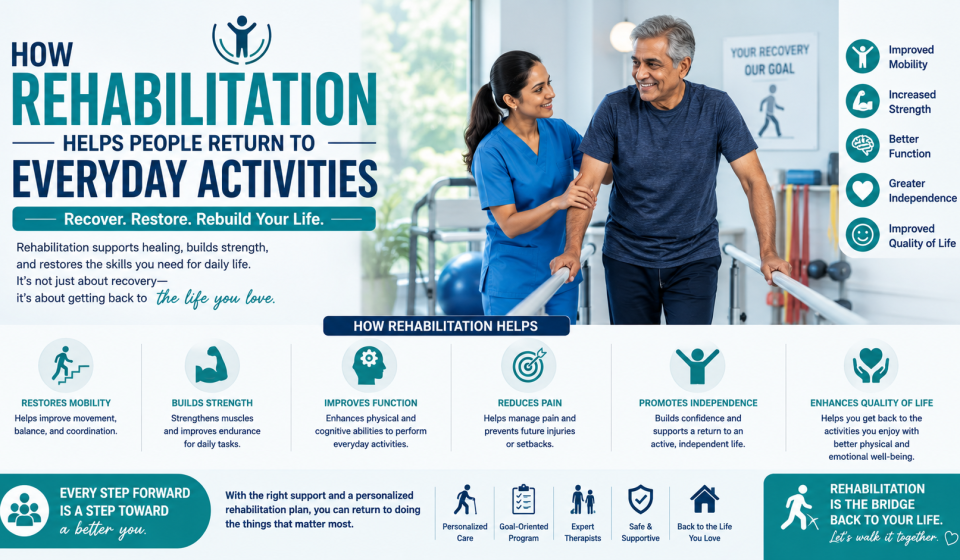
Returning to everyday activities can mean different things for different people. For one person, it may mean walking independently after an injury. For another, it may mean dressing, bathing, cooking, returning to work, communicating after a neurological condition, or safely participating in family and community life. Rehabilitation is therefore highly individualized and focuses on the person’s abilities, challenges, environment, and personal goals. According to MedlinePlus, rehabilitation can help people get back, keep, or improve abilities needed for daily life after disease, injury, or medical treatment.
What Is Rehabilitation?
Rehabilitation is a structured healthcare process designed to help a person improve functioning and reduce the impact of a health condition on everyday life.
It may be recommended after:
- An injury
- Major surgery
- A stroke
- A fracture
- A serious illness
- A neurological condition
- Heart or lung disease
- Cancer treatment
- Chronic pain
- A spinal cord injury
- An amputation
- Developmental conditions
- Age-related loss of function
Rehabilitation is not limited to people with permanent disabilities. It can also support people recovering from temporary health problems.
Why Rehabilitation Is Important
Medical treatment may address the underlying disease or injury, but treatment alone does not always restore everyday abilities immediately.
For example, surgery may repair an injured joint, but a person may still need rehabilitation to rebuild strength, flexibility, balance, confidence, and movement.
Rehabilitation bridges the gap between medical treatment and everyday life.
It focuses on questions such as:
- Can the person walk safely?
- Can they climb stairs?
- Can they dress independently?
- Can they return to work?
- Can they communicate effectively?
- Can they prepare meals?
- Can they participate in family activities?
The World Health Organization identifies rehabilitation as an essential health service alongside health promotion, disease prevention, treatment, and palliative care.
Rehabilitation Helps Restore Independence
One of the major goals of rehabilitation is independence.
After an illness or injury, a person may temporarily need help with activities they previously performed without assistance.
Rehabilitation can help people gradually regain abilities and learn safer ways to complete daily tasks.
Independence does not always mean performing every activity exactly as before.
Sometimes it means using:
- Assistive devices
- Modified techniques
- Environmental adaptations
- Supportive equipment
- New movement strategies
The goal is to maximize the person’s ability to participate in meaningful activities.
Physical Rehabilitation and Movement
Physical rehabilitation often focuses on movement, strength, balance, coordination, endurance, and physical function.
A physical therapist may develop exercises based on the person’s condition and goals.
Depending on the situation, rehabilitation may address:
- Muscle weakness
- Joint stiffness
- Balance problems
- Reduced flexibility
- Difficulty walking
- Poor coordination
- Reduced endurance
- Pain-related movement limitations
The exercises are generally progressed according to the individual’s condition and professional guidance.
Rehabilitation After Surgery
Surgery can correct or treat a medical problem, but recovery may continue after the procedure.
Depending on the surgery, rehabilitation may help restore:
- Strength
- Range of motion
- Balance
- Mobility
- Functional skills
- Confidence
The rehabilitation plan depends on the type of surgery, overall health, healing progress, and medical instructions.
Patients should follow the rehabilitation program recommended by their healthcare team rather than attempting to accelerate recovery independently.
Rehabilitation After an Injury
Injuries can affect muscles, bones, joints, nerves, and other body systems.
Rehabilitation may help a person gradually return to normal activities while addressing physical limitations.
For example, after a fracture, rehabilitation may focus on restoring movement and strength once appropriate healing has occurred.
After a sports injury, rehabilitation may also focus on movement patterns and gradual return to activity.
Rehabilitation After Stroke
Stroke can affect movement, balance, communication, swallowing, thinking, memory, and independence.
Rehabilitation may involve several professionals depending on the person’s needs.
A stroke rehabilitation program might include:
- Physical therapy
- Occupational therapy
- Speech and language therapy
- Cognitive rehabilitation
- Psychological support
The goal is to help the person regain as much function as possible and learn strategies for abilities that may remain affected.
Occupational Therapy and Everyday Activities
Occupational therapy is particularly important for returning to everyday activities.
Occupational therapists may help people improve their ability to perform tasks such as:
- Dressing
- Bathing
- Eating
- Cooking
- Writing
- Working
- Using household equipment
- Managing daily routines
MedlinePlus identifies occupational therapy as one of the rehabilitation approaches that can help people with daily activities.
Rehabilitation and Walking
Walking is an important goal for many people recovering from injury, surgery, stroke, or illness.
Rehabilitation may focus on:
- Leg strength
- Balance
- Coordination
- Gait patterns
- Safe transfers
- Endurance
- Use of walking aids
The aim is not simply to make someone walk farther. Safe and functional movement is often the priority.
Balance and Fall Prevention
Balance problems can increase the risk of falls.
Rehabilitation can help identify movement difficulties and develop exercises or strategies to improve balance.
For older adults, environmental modifications may also be recommended.
The WHO gives the example of modifying an older person’s home environment to improve safety and independence and reduce fall risk.
Rehabilitation and Daily Self-Care
Daily self-care activities can become challenging after illness or injury.
These activities include:
- Bathing
- Dressing
- Grooming
- Toileting
- Eating
- Moving from a bed to a chair
Rehabilitation can help individuals regain these skills or learn safer alternative techniques.
Small improvements in self-care can have a significant effect on confidence and quality of life.
Rehabilitation and Returning to Work
Returning to employment can be an important rehabilitation goal.
Work-related rehabilitation may focus on:
- Strength
- Endurance
- Job-specific movements
- Concentration
- Communication
- Workplace safety
- Adaptive equipment
- Gradual return-to-work planning
The exact approach depends on the person’s job and medical condition.
WHO notes that rehabilitation can help people engage in or return to work and employment while supporting independence.
Rehabilitation and Education
Children, teenagers, and adults may need rehabilitation to return to educational activities.
Depending on the condition, support may include:
- Communication strategies
- Cognitive training
- Mobility support
- Assistive technology
- Classroom adaptations
- Energy management
The goal is to help the individual participate in education as independently as possible.
Speech and Language Rehabilitation
Some conditions can affect speaking, understanding language, reading, writing, or swallowing.
Speech and language therapists can work with individuals to improve communication and swallowing-related abilities when appropriate.
This can be particularly important after neurological conditions such as stroke or brain injury.
Cognitive Rehabilitation
Physical abilities are not the only skills that may be affected by illness or injury.
Some people experience changes in:
- Memory
- Attention
- Planning
- Problem-solving
- Decision-making
Cognitive rehabilitation may help people develop strategies to improve or compensate for these difficulties.
MedlinePlus lists cognitive rehabilitation among the approaches that may be included in a rehabilitation plan.
Rehabilitation and Mental Well-Being
Recovery can be emotionally challenging.
People may experience:
- Frustration
- Anxiety
- Low confidence
- Stress
- Sadness
- Fear of reinjury
Psychological support may form part of a multidisciplinary rehabilitation program when appropriate.
Mental well-being can influence motivation, participation, and adjustment during recovery.
Rehabilitation and Chronic Conditions
Rehabilitation is not only for sudden injuries.
People living with chronic conditions may benefit from rehabilitation strategies that help them manage symptoms and maintain function.
Examples include:
- Chronic pain
- Cardiovascular disease
- Respiratory disease
- Neurological disorders
- Diabetes-related complications
- Cancer-related limitations
WHO notes that rehabilitation can help minimize, slow, or manage disabling effects associated with chronic health conditions.
Cardiac Rehabilitation
Cardiac rehabilitation is a structured approach for people recovering from certain heart-related conditions or procedures.
It can involve:
- Physical activity
- Education
- Risk-factor management
- Lifestyle guidance
- Psychological support
The goal is to help people safely improve physical function and make sustainable health changes.
MedlinePlus notes that cardiac rehabilitation may help an active person return to exercise after a heart attack.
Pulmonary Rehabilitation
People with certain lung conditions may experience difficulty breathing or reduced exercise capacity.
Pulmonary rehabilitation can include exercise training, education, and other strategies designed to improve functioning and quality of life.
MedlinePlus notes that pulmonary rehabilitation can help people with lung disease breathe better and improve quality of life.
Rehabilitation After Cancer Treatment
Cancer and its treatment can sometimes lead to fatigue, weakness, pain, mobility limitations, or other functional challenges.
Rehabilitation may help individuals manage these effects and work toward returning to meaningful activities.
The specific rehabilitation program depends on the person’s cancer treatment, symptoms, overall health, and goals.
Rehabilitation for Older Adults
Older adults may experience reduced strength, balance, mobility, or endurance due to illness, injury, or age-related changes.
Rehabilitation can help maintain or improve independence.
Goals may include:
- Walking safely
- Reducing fall risk
- Managing daily activities
- Improving strength
- Using assistive devices
- Maintaining participation in family and community activities
Rehabilitation can contribute to healthy aging by helping people remain active and independent.
Rehabilitation Is Person-Centred
A major feature of modern rehabilitation is that treatment is based on individual goals.
Two people with the same diagnosis may have completely different rehabilitation plans.
For example, one person may want to return to work while another may prioritize walking independently at home.
WHO describes rehabilitation as highly person-centred, with interventions targeted to individual goals and preferences.
Setting Realistic Rehabilitation Goals
Rehabilitation goals should be realistic, measurable, and meaningful.
Examples include:
- Walking to the bathroom independently
- Climbing a certain number of stairs safely
- Dressing without assistance
- Returning to a specific work task
- Preparing a simple meal
- Communicating more effectively
Clear goals can make progress easier to recognize.
Progress May Be Gradual
Recovery does not always happen in a straight line.
Some days may feel better than others.
Progress can depend on:
- Severity of the condition
- Age
- General health
- Motivation
- Sleep
- Nutrition
- Pain
- Complications
- Type of rehabilitation
- Consistency with the program
Comparing current abilities only with a previous baseline can sometimes be more useful than comparing recovery with another person’s experience.
The Importance of Consistency
Rehabilitation often involves repeated practice.
Consistency can help people develop strength, coordination, movement patterns, and functional skills.
Missing occasional sessions does not necessarily mean rehabilitation has failed, but regularly following professional recommendations can support progress.
Patients should communicate with their rehabilitation team if exercises become difficult, painful, or impractical.
Family Support During Rehabilitation
Family members and caregivers can play an important role.
They may help with:
- Transportation
- Home exercises
- Daily routines
- Encouragement
- Safety
- Communication with healthcare professionals
However, family support should encourage independence rather than unnecessarily taking over tasks the person can safely perform themselves.
Home-Based Rehabilitation
Some people receive rehabilitation at home.
Home-based rehabilitation can be useful when traveling to a clinic is difficult or when everyday activities need to be assessed in the person’s actual environment.
A rehabilitation professional may recommend modifications to:
- Bathrooms
- Bedrooms
- Kitchens
- Stairs
- Work areas
These changes can improve safety and independence.
Assistive Devices Can Support Independence
Assistive products can help people perform activities that are difficult because of physical, sensory, or cognitive limitations.
Examples may include:
- Walking aids
- Wheelchairs
- Prosthetic devices
- Orthotic devices
- Communication equipment
- Adaptive utensils
The appropriate device depends on the individual’s needs and should ideally be selected with professional guidance.
Rehabilitation and Pain Management
Pain can interfere with movement and daily activities.
Rehabilitation may include approaches to manage pain while improving function.
Depending on the condition, treatment may involve:
- Therapeutic exercise
- Movement education
- Activity modification
- Manual techniques
- Education
- Other professionally recommended strategies
Pain should not automatically be interpreted as a sign that all activity must stop. However, new, severe, or worsening pain should be discussed with an appropriate healthcare professional.
Rehabilitation Can Help Prevent Complications
Rehabilitation may also help prevent or reduce certain complications associated with limited mobility or chronic conditions.
Depending on the situation, rehabilitation may address:
- Weakness
- Stiffness
- Reduced mobility
- Balance problems
- Loss of independence
- Deconditioning
WHO notes that rehabilitation can help prevent, reduce, or manage complications associated with various health conditions.
Rehabilitation and Quality of Life
Returning to everyday activities is not only about physical ability.
It can influence:
- Confidence
- Social participation
- Independence
- Work
- Family roles
- Recreation
- Emotional well-being
Being able to participate in meaningful activities can make recovery feel more rewarding and purposeful.
Rehabilitation Is Not Only About Exercise
A common misconception is that rehabilitation simply means performing physical exercises.
In reality, rehabilitation can involve many different services.
Depending on the person’s needs, it may include:
- Physical therapy
- Occupational therapy
- Speech therapy
- Cognitive rehabilitation
- Psychological support
- Nutritional counseling
- Vocational rehabilitation
- Assistive technology
MedlinePlus describes rehabilitation as a combination of services selected according to a person’s abilities, needs, and goals.
How Rehabilitation Teams Work Together
Rehabilitation often involves a multidisciplinary team.
Professionals may include:
- Physiotherapists
- Occupational therapists
- Speech and language therapists
- Rehabilitation physicians
- Nurses
- Psychologists
- Audiologists
- Orthotists
- Prosthetists
Other healthcare professionals may also participate.
WHO emphasizes that rehabilitation can involve collaboration among multiple health professionals depending on the individual’s needs.
How to Make Rehabilitation More Effective
Patients can support their rehabilitation by:
- Understanding their goals
- Following professional instructions
- Practicing recommended activities
- Reporting new symptoms
- Attending scheduled appointments
- Asking questions
- Using assistive equipment correctly
- Maintaining adequate nutrition and rest
- Staying patient with gradual progress
It is important not to add intense exercises or change the rehabilitation plan without professional advice.
What If Progress Seems Slow?
Slow progress does not necessarily mean rehabilitation is unsuccessful.
Some conditions take longer to recover from than others.
If progress seems to stop or symptoms change, discuss the situation with the rehabilitation team.
The program may need to be adjusted based on current abilities and goals.
Returning to Everyday Activities Safely
The goal is usually not to rush back to normal activities.
A safe return may involve gradually increasing:
- Activity duration
- Strength demands
- Walking distance
- Work responsibilities
- Household tasks
- Recreational activities
The timeline depends on the condition and professional recommendations.
Rehabilitation After Hospitalization
A prolonged hospital stay can sometimes lead to weakness and reduced physical capacity.
Rehabilitation may help people regain:
- Mobility
- Strength
- Balance
- Endurance
- Self-care skills
WHO includes rehabilitation as an important part of recovery following critical illness and other major health events.
Rehabilitation and Family Roles
Returning to meaningful family roles can be an important recovery goal.
This may include:
- Caring for children
- Preparing meals
- Shopping
- Managing household activities
- Participating in family events
Rehabilitation can help individuals develop strategies to participate safely and independently.
Rehabilitation and Community Participation
Recovery is not complete simply because a person can perform exercises in a clinic.
The larger goal is often participation in real-life environments.
This may include:
- Going shopping
- Using public transportation
- Attending social events
- Returning to school
- Returning to work
- Participating in hobbies
WHO highlights rehabilitation’s role in enabling participation in education, work, recreation, and meaningful life roles.
The Economic Benefits of Rehabilitation
Rehabilitation can also have broader economic benefits.
By helping people regain independence and return to work when appropriate, rehabilitation may reduce dependence on caregivers and support participation in employment.
WHO notes that rehabilitation can help reduce hospital stays and readmissions in appropriate circumstances and support people’s return to work and independence.
When Should Rehabilitation Begin?
The timing depends on the health condition and medical situation.
In many circumstances, rehabilitation can be introduced early and continued alongside other treatments when clinically appropriate.
WHO emphasizes the importance of timely rehabilitation and notes that it may be appropriate alongside other health interventions.
Patients should follow the timing recommended by their healthcare team.
Rehabilitation Throughout Life
People of any age can need rehabilitation.
Children may require rehabilitation for developmental or congenital conditions.
Adults may need it after injuries, surgeries, strokes, or chronic illnesses.
Older adults may benefit from rehabilitation after falls, illness, or changes in mobility.
WHO states that rehabilitation can be needed by children, adults, and older people following injury, disease, illness, surgery, disability, or age-related decline in functioning.
Rehabilitation and Long-Term Independence
In some cases, rehabilitation may restore function close to the person’s previous level.
In other situations, complete recovery may not be possible.
Even then, rehabilitation can help optimize functioning through adaptive strategies, assistive products, environmental changes, and self-management.
The goal is to help the person live as independently and meaningfully as possible.
Common Misconceptions About Rehabilitation
Rehabilitation Is Only for Severe Disabilities
This is incorrect. Rehabilitation may benefit people after injuries, surgeries, illnesses, chronic conditions, or temporary losses of function.
Rehabilitation Means Only Physical Therapy
Physical therapy is one part of rehabilitation, but rehabilitation can include several other professional services.
Recovery Must Happen Quickly
Recovery timelines vary greatly. A slower recovery does not automatically mean treatment is ineffective.
Rehabilitation Is Only Needed After Surgery
Many conditions that do not involve surgery can also benefit from rehabilitation.
Rehabilitation Is Optional
WHO considers rehabilitation an essential health service, not simply an optional addition to medical care.
How Patients Can Prepare for Rehabilitation
Before beginning a rehabilitation program, ask:
- What are my main goals?
- What activities should I work toward?
- How often will I receive treatment?
- What should I practice at home?
- Which activities should I avoid?
- How will progress be measured?
- When should I report pain or other symptoms?
Understanding the plan can improve participation and confidence.
Questions to Ask a Rehabilitation Professional
Useful questions include:
- What is the main goal of my rehabilitation?
- Which activities should I practice?
- How often should I perform them?
- What improvements should I expect?
- How will we measure progress?
- When can I return to work or exercise?
- Do I need an assistive device?
- What symptoms should I report?
Clear communication helps ensure the rehabilitation plan matches the person’s needs.
The Role of Patience and Motivation
Rehabilitation can require time and repeated effort.
Motivation may naturally change throughout recovery.
Setting small, meaningful goals can make progress easier to recognize.
Celebrating improvements such as walking farther, dressing independently, or completing a household task can help maintain motivation.
Source
https://www.who.int/news
https://medlineplus
https://www.who.int
https://www.who.int/news
Conclusion
Rehabilitation plays an important role in helping people return to everyday activities after injury, illness, surgery, disability, or changes in physical and cognitive functioning. Rather than focusing only on treating a medical condition, rehabilitation focuses on what a person needs to do in real life, such as walking, dressing, communicating, working, studying, preparing meals, caring for family, or participating in community activities. The World Health Organization recognizes rehabilitation as an essential part of healthcare and emphasizes its role in improving functioning, reducing disability, and supporting independence.
Effective rehabilitation is highly personalized. Some people may benefit primarily from physical therapy, while others may need occupational therapy, speech and language therapy, cognitive rehabilitation, psychological support, assistive devices, or a combination of services. Progress can take time, and the right goals depend on the person’s health condition, abilities, environment, and priorities. With appropriate professional guidance, consistent participation, family support, and realistic goals, rehabilitation can help people regain important abilities, adapt to lasting challenges, and return to meaningful everyday activities with greater safety, independence, and confidence.
FAQ
1. What is the main purpose of rehabilitation?
The main purpose of rehabilitation is to help people regain, maintain, or improve functioning and reduce the impact of a health condition on everyday activities and independence.
2. Who can benefit from rehabilitation?
People of any age may benefit from rehabilitation after injury, surgery, illness, stroke, chronic disease, disability, or age-related changes in functioning.
3. Does rehabilitation only mean physical therapy?
No. Rehabilitation can include physical therapy, occupational therapy, speech and language therapy, cognitive rehabilitation, psychological support, nutritional counseling, vocational rehabilitation, and assistive technology.
4. Can rehabilitation help someone return to work?
Yes. Depending on the person’s condition and job, rehabilitation may help improve physical, cognitive, communication, or functional abilities needed for returning to employment.
5. Can rehabilitation help older adults remain independent?
Yes. Rehabilitation can help older adults improve mobility, safety, balance, and daily functioning and may include home modifications or assistive products when appropriate.
6. How long does rehabilitation take?
The duration varies according to the health condition, severity, goals, response to treatment, and individual circumstances. Some programs involve a limited number of sessions, while others continue for longer periods.
7. Can rehabilitation help after a stroke?
Yes. Stroke rehabilitation can address movement, balance, communication, swallowing, cognition, and daily activities depending on the person’s needs.
8. Can rehabilitation improve quality of life?
Yes. By improving function, independence, participation, and the ability to perform meaningful activities, rehabilitation can contribute to better quality of life.
9. Can rehabilitation be done at home?
Yes. Depending on the condition and available services, rehabilitation may take place at home, in outpatient clinics, hospitals, rehabilitation centers, schools, or workplaces.
10. Is rehabilitation safe?
Rehabilitation programs should be planned according to the person’s health condition and needs. Rehabilitation professionals select appropriate interventions and intensity and monitor safety.