What Is Gait Analysis and Why Is It Used in Rehabilitation? A Complete Guide to Walking Assessment and Recovery

Learn what gait analysis is, how walking patterns are assessed, what gait parameters are measured, and why gait analysis is important for rehabilitation, physical therapy, balance, mobility, and recovery.
Walking is one of the most important movements people perform every day. It allows us to travel independently, participate in work and social activities, exercise, and complete basic tasks such as shopping, climbing stairs, and moving around the home. Although walking may appear simple, it is actually a complex process that requires coordination between the brain, nervous system, muscles, bones, joints, balance systems, and sensory organs. When an injury, illness, neurological condition, or physical limitation changes the way a person walks, rehabilitation professionals may use gait analysis to understand what is happening and determine how movement can be improved.
Gait analysis is the systematic observation, measurement, and interpretation of walking patterns. It can range from a simple clinical assessment performed by a physiotherapist to advanced laboratory testing using cameras, force plates, sensors, and electromyography. The information obtained can help clinicians identify gait deviations, understand possible contributing factors, monitor changes during rehabilitation, and make more informed decisions about treatment.
What Is Gait Analysis?
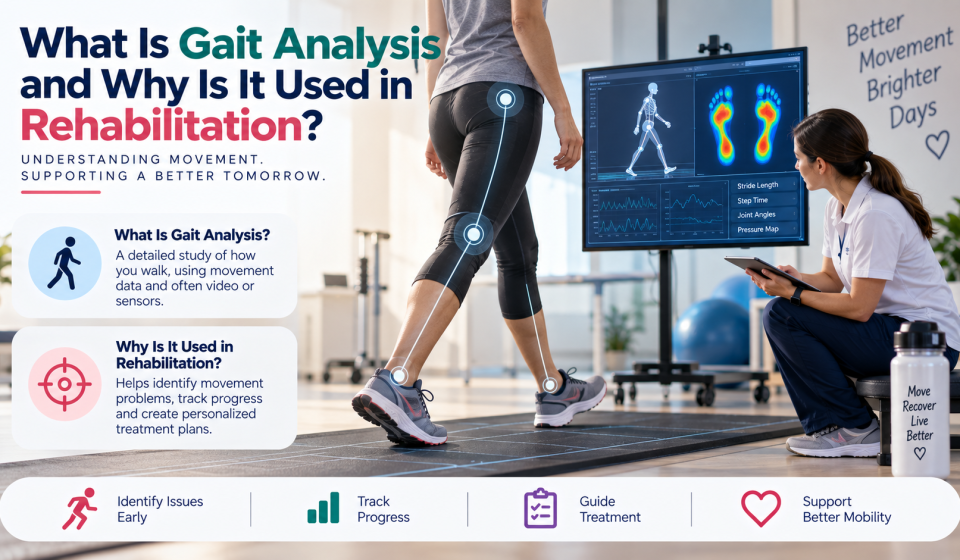
Gait analysis is the assessment of how a person walks. It involves observing and measuring different characteristics of walking and interpreting how various body parts work together during movement.
A basic gait assessment may involve watching a person walk across a room or along a walkway. A therapist may observe posture, step length, walking speed, balance, symmetry, foot placement, arm movement, and the movement of the hips, knees, and ankles.
More advanced gait analysis can use technology to collect detailed information about joint movement, forces, muscle activity, and other aspects of walking. Clinical gait analysis can include kinematic measurements, kinetic measurements, electromyography, foot-pressure measurements, and other assessments.
Why Is Gait Analysis Important in Rehabilitation?
The primary purpose of rehabilitation is to help a person achieve the highest possible level of safe and functional movement. Walking ability is an important part of physical independence, so understanding a person’s gait can help guide rehabilitation.
Gait analysis may help clinicians:
- Identify abnormal walking patterns
- Understand movement limitations
- Assess walking ability
- Evaluate balance and safety
- Identify possible contributors to gait problems
- Select appropriate rehabilitation interventions
- Monitor progress over time
- Evaluate treatment effectiveness
- Determine whether assistive or supportive devices may be useful
Clinical gait analysis can be used to assess the severity and nature of movement problems, monitor progress, and support treatment decisions.
Understanding the Normal Gait Cycle
To understand an abnormal walking pattern, rehabilitation professionals first need to understand normal gait.
The gait cycle refers to the sequence of movements that occurs during walking. It begins when one foot makes contact with the ground and continues until that same foot contacts the ground again.
Walking involves two broad phases:
Stance Phase
The stance phase occurs while the foot is in contact with the ground. During this phase, the body must support its weight, maintain stability, and move forward.
Swing Phase
The swing phase occurs when the foot is off the ground and moving forward to prepare for the next step.
The coordination between these phases allows a person to walk smoothly and efficiently.
What Does a Gait Assessment Look At?
Gait analysis can examine many different characteristics of walking. Some of the commonly assessed parameters include:
Walking Speed
Walking speed provides information about how quickly a person can move from one location to another.
A reduced walking speed may be associated with weakness, pain, balance limitations, neurological problems, reduced endurance, or other physical factors.
Step Length
Step length refers to the distance between the placement of one foot and the placement of the opposite foot.
Differences between the two sides may provide useful information about gait symmetry.
Stride Length
Stride length refers to the distance covered during a complete gait cycle.
Changes in stride length can occur because of pain, weakness, reduced mobility, balance problems, or neurological conditions.
Cadence
Cadence refers to the number of steps taken per minute.
A therapist may consider cadence along with walking speed, step length, and other gait characteristics to understand a person’s walking pattern.
Foot Placement
The position of the feet during walking can provide information about balance, stability, joint movement, and coordination.
Joint Movement
The hips, knees, and ankles need to move in coordinated patterns during walking. Abnormal or restricted movement at one joint can influence other parts of the body.
Qualitative vs. Instrumented Gait Analysis
Not every person requires a highly technical gait laboratory assessment.
Qualitative Gait Analysis
Qualitative assessment involves observing how a person walks. A physiotherapist may visually assess posture, symmetry, foot placement, joint movement, balance, and other characteristics.
This approach is commonly used in clinical rehabilitation because it is practical and can provide useful information without complex equipment.
Instrumented Gait Analysis
Instrumented gait analysis uses technology to collect quantitative information about walking.
Depending on the system, it may involve:
- Motion-capture cameras
- Reflective markers
- Force plates
- Pressure sensors
- Electromyography
- Wearable sensors
- Computer-based analysis
Advanced systems can measure movement and forces that may not be visible through observation alone.
How Does Gait Analysis Work?
The exact process depends on the type of assessment.
During a clinical gait assessment, a therapist may first discuss the person’s symptoms, medical history, injury, functional limitations, and goals.
The therapist may then observe the person walking at a comfortable pace.
Additional tasks may include:
- Walking at different speeds
- Turning
- Walking over a specific distance
- Standing from a chair
- Using stairs
- Walking with or without an assistive device
For advanced gait analysis, sensors or markers may be placed on specific body areas. Cameras and other equipment can then record movement while the person walks.
The collected information can be analyzed to understand how different parts of the body move during the gait cycle.
Conditions That May Affect Gait
Many different conditions can influence walking patterns.
Gait changes may occur following:
- Stroke
- Brain injury
- Spinal cord injury
- Cerebral palsy
- Multiple sclerosis
- Lower-limb amputation
- Joint injuries
- Orthopedic conditions
- Neuromuscular disorders
- Muscle weakness
- Balance disorders
- Pain-related movement problems
Gait analysis has established applications in several neurological and rehabilitation conditions, including cerebral palsy, stroke, traumatic brain injury, and lower-limb amputation.
Gait Analysis After a Stroke
Stroke can affect strength, coordination, balance, sensation, and motor control. As a result, a person may develop an uneven or inefficient walking pattern.
One leg may become weaker, the person may take shorter steps, or balance may become more difficult.
Gait assessment can help rehabilitation professionals understand these changes and develop targeted treatment strategies.
During rehabilitation, gait measurements can also help track whether walking ability is improving.
Gait Analysis in Neurological Rehabilitation
Neurological conditions can affect the systems responsible for controlling movement.
A person may experience changes in:
- Walking speed
- Step length
- Coordination
- Balance
- Muscle activation
- Joint movement
- Stability
Research in neurorehabilitation highlights the potential of gait analysis systems and wearable technologies to provide objective information about movement and support individualized gait and balance training.
How Gait Analysis Supports Treatment Planning
One of the most valuable uses of gait analysis is helping rehabilitation professionals understand which aspects of walking need attention.
For example, if a person has difficulty clearing the foot from the ground, the therapist may investigate ankle movement, muscle strength, coordination, or other contributing factors.
If a person has difficulty maintaining balance, the rehabilitation program may emphasize balance training, strength, coordination, and safe functional movement.
The goal is not simply to identify that someone’s gait is abnormal. The goal is to understand the movement problem well enough to make rehabilitation more targeted.
Gait Analysis and Assistive Devices
Some people require additional support to walk safely.
Depending on the individual’s needs, rehabilitation professionals may consider devices such as:
- Walking sticks
- Canes
- Crutches
- Walkers
- Orthotic devices
- Prosthetic devices
Gait assessment can help determine how a person moves with or without an assistive device and whether the device is supporting safe and effective movement.
The selection and use of an assistive device should be guided by a qualified healthcare professional rather than based solely on general recommendations.
Monitoring Rehabilitation Progress
Recovery is rarely a single event. Rehabilitation often involves gradual changes over weeks or months.
Gait analysis can provide information that allows clinicians to compare movement at different stages of rehabilitation.
For example, a person may show improvements in:
- Walking speed
- Step length
- Balance
- Symmetry
- Endurance
- Joint movement
- Functional walking ability
Repeated assessments can help determine whether an intervention is producing meaningful changes.
Clinical gait analysis is specifically used in rehabilitation to monitor progress and evaluate outcomes of interventions.
The Role of Technology in Modern Gait Analysis
Technology has significantly expanded the possibilities of gait assessment.
Wearable sensors can be used to collect movement information outside specialized laboratories. Motion-capture systems can provide detailed three-dimensional movement data, while force platforms can measure forces between the feet and the ground.
Newer approaches involving wearable sensors, digital systems, and computational analysis are increasingly being investigated for clinical and rehabilitation applications.
However, technology does not replace clinical judgment. Gait measurements need to be interpreted in the context of the individual’s symptoms, physical examination, goals, environment, and overall health.
Is Gait Analysis Painful?
Gait analysis itself is generally a noninvasive assessment. A person is usually asked to walk while a therapist observes or equipment records movement.
Some people may experience discomfort while walking if they have an injury or medical condition. In such cases, the assessment should be adapted to the person’s abilities and safety.
The purpose is to understand movement, not to force someone through painful activity.
What Happens After a Gait Analysis?
After the assessment, the rehabilitation professional reviews the findings and considers them alongside the person’s history and physical examination.
The results may help guide:
- Exercise selection
- Strengthening programs
- Balance training
- Mobility exercises
- Walking practice
- Assistive-device use
- Orthotic considerations
- Functional training
- Progress monitoring
The exact rehabilitation plan depends on the person’s diagnosis, goals, limitations, and overall condition.
Why Gait Analysis Is More Than Just Watching Someone Walk
At first glance, gait analysis may seem like simply observing a person walking. In reality, it can provide a structured way to understand complex movement.
A person’s walking pattern reflects the interaction between muscles, joints, nervous-system control, balance, sensory information, and environmental demands.
A careful assessment can help transform a general complaint such as “walking feels difficult” into more specific information about what is happening during movement.
This can make rehabilitation more individualized and goal-oriented.
When Might Someone Need a Gait Assessment?
A gait assessment may be useful when a person experiences:
- Difficulty walking
- Frequent balance problems
- Changes in walking after an injury
- Persistent walking asymmetry
- Reduced walking speed
- Difficulty using stairs
- Changes after neurological injury
- Problems with walking endurance
- New dependence on an assistive device
- Changes in walking during rehabilitation
A healthcare professional can determine whether a detailed gait analysis is appropriate based on the individual’s condition.
Source
https://pmc.ncbi.nlm.nih.gov
https://pubmed.ncbi.nlm.nih.gov
https://pmc.ncbi.nlm.nih.gov
https://www.hss.edu
Conclusion
Gait analysis is an important tool for understanding how a person walks and why walking may become difficult after injury, illness, neurological changes, or other physical limitations. From basic clinical observation to advanced instrumented testing, gait analysis can provide valuable information about walking speed, step length, cadence, balance, joint movement, muscle activity, and other aspects of mobility.
In rehabilitation, the information from gait analysis can support individualized treatment planning, monitor progress, evaluate treatment effectiveness, and help professionals make decisions about exercises, functional training, and supportive devices. Although technology can provide increasingly detailed measurements, the most useful assessment combines objective information with clinical examination and the individual’s goals.
FAQ
1. What is gait analysis?
Gait analysis is the systematic assessment of how a person walks. It can involve visual observation, measurements of walking parameters, video analysis, sensors, motion-capture systems, force plates, and other technologies.
2. Why is gait analysis used in rehabilitation?
It is used to understand walking problems, identify gait deviations, guide treatment decisions, monitor rehabilitation progress, and evaluate whether an intervention is improving functional walking ability.
3. Is gait analysis the same as physical therapy?
No. Gait analysis is an assessment process, while physical therapy is a broader rehabilitation profession and treatment approach. A physiotherapist may use gait analysis as part of a patient’s overall evaluation and rehabilitation plan.
4. What does a physiotherapist look for during gait analysis?
A therapist may examine walking speed, step length, stride length, cadence, posture, balance, symmetry, foot placement, joint movement, muscle control, and the use of assistive devices.
5. Can gait analysis detect walking abnormalities?
Gait analysis can identify and quantify many abnormal walking patterns and help clinicians investigate factors that may contribute to them. It is generally interpreted together with medical history and physical examination rather than used in isolation.
6. Is gait analysis painful?
Gait analysis itself is generally noninvasive and involves walking or performing functional movements. However, people with pain or injuries may experience discomfort during walking, so the assessment should be adapted to their condition.
7. Can gait analysis be used after a stroke?
Yes. Gait analysis can be used during stroke rehabilitation to assess walking patterns, balance, speed, coordination, and other functional characteristics and to help guide rehabilitation.
8. Can gait analysis help after a leg injury?
Yes. A gait assessment can help identify changes in walking caused by pain, weakness, reduced joint movement, or other limitations following an injury.
9. Does gait analysis require special equipment?
Not always. A basic clinical gait assessment may require only a suitable walking area and a trained professional. Advanced gait analysis may use cameras, force plates, sensors, pressure systems, or electromyography.
10. Can gait analysis track rehabilitation progress?
Yes. Repeated gait assessments can provide information about changes in walking performance over time and may help clinicians evaluate the effectiveness of rehabilitation interventions.