The Role of Gradual Load Progression in Physical Recovery: A Complete Guide to Safer and Stronger Rehabilitation

Learn how gradual load progression supports physical recovery by improving strength, mobility, endurance and function while helping the body safely adapt during rehabilitation.
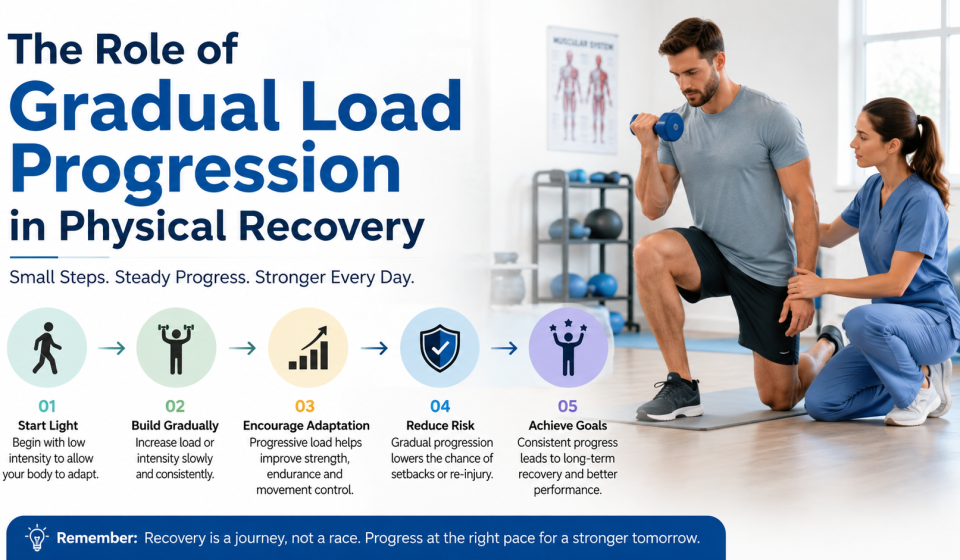
Physical recovery is a gradual process that requires the body to adapt to changing demands. After an injury, surgery, illness, prolonged inactivity or other physical limitation, the body may not immediately tolerate the same amount of movement or workload it handled before. Gradual load progression provides a structured way to increase physical demands as recovery develops. Instead of suddenly returning to high levels of activity, rehabilitation professionals can progressively increase the amount, intensity, duration or complexity of movement according to an individual’s condition and response.
The concept is important because recovery is not simply about doing more exercise. It is about finding an appropriate level of challenge that encourages adaptation without unnecessarily overwhelming the recovering body. The World Health Organization recommends that adults who are not meeting physical activity recommendations start with small amounts and gradually increase frequency, intensity and duration over time. This principle can also be applied broadly when planning a safe return to physical activity, although people recovering from specific injuries or medical conditions should follow individualized professional guidance.
What Is Gradual Load Progression?
Gradual load progression means systematically increasing the physical demands placed on the body over time.
The “load” does not only mean the amount of weight lifted.
It can include:
- Resistance
- Number of repetitions
- Exercise duration
- Walking distance
- Movement speed
- Frequency of exercise
- Number of sets
- Range of motion
- Balance demands
- Exercise complexity
- Weight-bearing demands
- Work-related activities
For example, someone recovering from a lower-limb injury might progress from short periods of supported standing to longer periods of independent standing, followed by controlled walking and eventually more demanding functional activities.
The exact progression depends on the person’s condition, goals and recovery status.
Why Load Progression Matters During Recovery
The human body adapts to physical demands.
If a person gradually exposes the body to appropriate levels of stress, muscles, bones, connective tissues and cardiovascular systems can adapt to those demands.
Progressive overload is also considered a fundamental principle in resistance-training programming because the body adapts to repeated exercise stress and may require an appropriate increase in stimulus to continue making progress.
However, rehabilitation is different from ordinary fitness training. The objective is not simply to lift more weight or exercise harder. The goal is to restore useful function while respecting the individual’s limitations.
Recovery Requires the Right Amount of Challenge
Too little activity may not provide enough stimulus for improvement.
Too much activity too quickly may make recovery more difficult.
The ideal approach is often to find a manageable level of challenge and increase it as the body demonstrates readiness.
This is why rehabilitation professionals may adjust exercises from session to session.
For example, if a person completes an exercise comfortably with good movement quality, the professional may increase repetitions, resistance, duration or complexity.
If symptoms increase significantly, the load may need to be modified.
Gradual Progression and Muscle Strength
Muscle strength can decline after injury, illness or periods of inactivity.
Reduced activity can mean muscles receive less stimulation than usual.
Appropriately progressed strengthening exercises can help restore the capacity needed for daily activities.
Strength progression may involve:
- Increasing repetitions
- Increasing resistance
- Adding another set
- Improving movement control
- Progressing from supported to unsupported exercises
- Moving from isolated exercises to functional movements
The American College of Sports Medicine recognizes progressive resistance training as an important approach for developing muscular strength and physical performance, with progression depending on training status, goals and physical capacity.
Progression Is Not Always About Adding Weight
A common misunderstanding is that progression always means lifting heavier weights.
In rehabilitation, progression can happen in many ways.
For example, a person may progress from:
- Two minutes of walking to five minutes
- Five repetitions to ten repetitions
- Supported standing to unsupported standing
- Slow movement to controlled faster movement
- Simple balance exercises to more challenging balance tasks
- Flat-surface walking to carefully managed uneven surfaces
The appropriate progression depends on the individual’s functional goals.
Improving Mobility Through Gradual Progression
Mobility may become restricted following injury, surgery or inactivity.
Rehabilitation may gradually increase movement demands as tolerated.
A mobility program might progress from gentle movements toward larger ranges of motion and eventually functional movements.
For example, someone recovering from a lower-body condition may gradually progress through:
- Gentle joint movement
- Supported weight-bearing
- Controlled standing
- Short-distance walking
- Longer walking
- Stair practice
- Functional movement
The sequence will vary depending on the condition and professional recommendations.
Building Endurance Gradually
Endurance is another important part of physical recovery.
After a period of inactivity, even ordinary activities can feel tiring.
Gradual progression can help rebuild tolerance for sustained activity.
A person might begin with short walking sessions and gradually increase duration.
Another person may start with brief cycling or low-impact aerobic activity before progressing toward longer sessions.
WHO recommends regular physical activity for adults and states that adults should gradually increase activity when they are not currently meeting recommended levels.
Gradual Load Progression and Bone Health
Appropriate weight-bearing and resistance activities can contribute to physical fitness and bone health.
However, the correct loading strategy depends heavily on the person’s condition.
Someone recovering from a fracture or orthopedic procedure may have specific restrictions regarding weight-bearing.
Therefore, load progression should not be based on general fitness advice alone.
Medical and rehabilitation guidance is particularly important when healing tissues have specific loading requirements.
Supporting Tendon and Soft-Tissue Recovery
Tendons and other connective tissues respond to mechanical loading.
Rehabilitation programs may use progressively challenging exercises to help restore capacity.
The progression may include changes in:
- Resistance
- Repetitions
- Exercise position
- Movement speed
- Range of motion
- Functional demand
The appropriate level varies according to the specific tissue, injury and stage of recovery.
A professional can determine when and how loading should be increased.
The Importance of Movement Quality
Increasing load should not automatically take priority over movement quality.
If an individual can only complete an exercise by significantly changing technique, compensating with another body part or losing control, the load may be too challenging.
Good progression considers:
- Technique
- Control
- Stability
- Coordination
- Pain response
- Fatigue
- Functional performance
The objective is to develop capacity while maintaining appropriate movement patterns.
Monitoring Symptoms During Progression
Monitoring the body’s response is an important part of rehabilitation.
A person may notice changes in:
- Pain
- Swelling
- Fatigue
- Stiffness
- Muscle soreness
- Movement quality
- Energy levels
- Exercise tolerance
Not every sensation means that exercise should stop.
However, significant, persistent or unusual symptoms should not be ignored.
Rehabilitation professionals can help determine whether a response is expected or whether the workload needs to be adjusted.
The Difference Between Normal Effort and Warning Signs
Exercise can naturally cause temporary fatigue and muscle effort.
However, symptoms such as severe pain, significant swelling, chest pain, fainting, severe shortness of breath or sudden loss of function require appropriate medical attention.
People recovering from surgery, serious injury or illness should follow their healthcare professional’s instructions regarding warning signs and activity restrictions.
How Rehabilitation Professionals Progress Load
A rehabilitation professional may consider several factors before increasing a person’s workload.
These can include:
- Current strength
- Range of motion
- Balance
- Pain
- Swelling
- Exercise tolerance
- Movement quality
- Functional performance
- Recovery stage
- Medical restrictions
- Personal goals
Progression is therefore individualized rather than based on a single universal formula.
Increasing Repetitions
One simple progression method is increasing repetitions.
For example, a person may begin with a manageable number of repetitions and gradually perform more as strength and endurance improve.
This approach can increase workload without immediately requiring heavier resistance.
However, the number of repetitions should be appropriate for the exercise and rehabilitation goal.
Increasing Resistance
Resistance can be increased when the current workload becomes manageable.
Resistance may come from:
- Body weight
- Resistance bands
- Weights
- Machines
- Cables
- Functional objects
The increase should be appropriate to the person’s current capacity.
For healthy adults following resistance-training programs, ACSM guidance has historically supported relatively small increases in load when individuals can exceed their target repetitions, while emphasizing that programming should depend on goals and training status.
Rehabilitation patients may require more individualized progression.
Increasing Exercise Duration
Duration can also be progressed.
For example:
A person may begin with five minutes of walking and gradually increase the duration as tolerance improves.
This type of progression can be particularly useful when rebuilding cardiovascular endurance or tolerance for daily activities.
Increasing Frequency
Another method is increasing how often an activity is performed.
However, more frequent training is not automatically better.
The body needs time to recover between demanding activities.
The appropriate frequency depends on:
- Exercise intensity
- Recovery capacity
- Injury status
- Health condition
- Training experience
- Professional recommendations
Increasing Functional Complexity
As recovery progresses, exercises may become more similar to real-life activities.
For example:
- Sitting to standing
- Step-ups
- Carrying objects
- Reaching while standing
- Walking while turning
- Controlled stair climbing
Functional progression helps connect improvements in strength and mobility with everyday independence.
Gradual Progression After Surgery
Surgical recovery often involves specific restrictions.
A patient may initially need protection of the healing area before gradually increasing activity.
The progression may involve:
- Protected movement
- Gentle exercises
- Controlled strengthening
- Functional movement
- Increased activity
- Return to specific activities
The exact timeline differs significantly depending on the surgery and individual health factors.
Patients should follow their surgeon’s and rehabilitation professional’s recommendations rather than comparing their recovery timeline with someone else’s.
Gradual Progression After Injury
Injury recovery can also require careful progression.
A person may need to regain:
- Range of motion
- Strength
- Stability
- Balance
- Coordination
- Endurance
- Confidence
Progressing these abilities gradually can help prepare the body for increasingly demanding activities.
The Role of Rest and Recovery
Progression does not mean constantly increasing workload.
Recovery periods are also important.
Rest allows the body to respond to training demands.
A rehabilitation program may alternate more demanding activities with lighter movement or recovery days.
Sleep, nutrition, hydration and stress management can also influence recovery.
A balanced rehabilitation plan therefore includes both appropriate loading and adequate recovery.
Why Recovery Is Not Always Linear
Physical recovery rarely follows a perfectly straight path.
A person may improve for several weeks and then experience a temporary setback.
Factors such as illness, poor sleep, stress, increased activity or changes in routine may affect performance.
A temporary decrease in capacity does not necessarily mean rehabilitation has failed.
Professionals can reassess the situation and modify the program when necessary.
Progression Based on Function
One of the most useful ways to measure recovery is through function.
Instead of asking only, “How much weight can you lift?” a rehabilitation professional may ask:
- Can you walk farther?
- Can you climb stairs more comfortably?
- Can you get out of a chair independently?
- Can you return to work tasks?
- Can you perform household activities?
- Can you participate in recreational activities?
Functional improvements can demonstrate meaningful recovery.
Gradual Progression and Confidence
Injury and illness can sometimes create fear about movement.
A person may worry that using the affected body part will cause another problem.
Appropriate gradual exposure to movement can help build confidence while restoring physical capacity.
The process should remain safe and individualized.
Why Patience Matters
Physical recovery takes time.
Trying to accelerate the process by dramatically increasing workload may not produce faster results.
Consistent, manageable progression is often more sustainable.
The goal is to build capacity step by step.
Creating a Sustainable Recovery Plan
A sustainable plan should consider:
- Current ability
- Recovery stage
- Functional goals
- Exercise tolerance
- Symptoms
- Medical restrictions
- Available equipment
- Lifestyle
- Recovery time
A plan that fits a person’s daily life is more likely to be followed consistently.
When Professional Guidance Is Important
Professional guidance is especially important after:
- Surgery
- Fractures
- Significant muscle or tendon injuries
- Neurological conditions
- Cardiovascular events
- Serious illness
- Major falls
- Persistent unexplained pain
A healthcare professional can determine what type and amount of activity is appropriate.
WHO also notes that people with chronic conditions or disabilities may need advice from a healthcare professional or physical activity specialist to determine suitable activity based on their abilities, limitations, medications and treatment plan.
Practical Principles for Gradual Load Progression
A few general principles can help explain the concept:
Start where you are: Begin with a workload appropriate for your current ability.
Increase gradually: Change one or more variables carefully rather than dramatically increasing everything at once.
Prioritize quality: Maintain appropriate movement control.
Monitor response: Pay attention to symptoms, fatigue and performance.
Allow recovery: Give the body sufficient time to adapt.
Focus on function: Connect exercise progress with meaningful daily activities.
Adjust when necessary: Recovery programs may need modification as circumstances change.
Source
WHO Physical Activity Guidelines
WHO Recommended Physical Activity Levels
ACSM Progression Models in Resistance Training
ACSM Resistance Training Prescription
Conclusion
Gradual load progression is an important principle in physical recovery because the body needs appropriate exposure to physical demands in order to rebuild capacity. Whether someone is recovering from an injury, surgery, illness or prolonged inactivity, returning immediately to previous activity levels may not always be appropriate. A progressive approach allows physical demands to increase according to the individual’s current abilities and response.
Load progression can involve much more than increasing weight. Rehabilitation professionals may gradually increase repetitions, duration, resistance, walking distance, movement complexity, balance demands or functional activities. The right progression depends on the individual’s medical condition, recovery stage, goals and physical capacity.
The principle of gradual progression is also reflected in public health recommendations. WHO advises adults who are not meeting activity recommendations to start with small amounts and gradually increase frequency, intensity and duration. This approach recognizes that building physical capacity is a process rather than an immediate change.
An effective recovery program also considers movement quality, symptoms, fatigue and recovery time. Increasing workload without considering these factors may make a program unnecessarily difficult. Rehabilitation professionals can monitor performance and adjust exercises as the individual progresses.
Most importantly, physical recovery should be measured by meaningful improvements in function. Walking farther, climbing stairs, getting up from a chair, performing household activities, returning to work or participating in hobbies can all represent important progress.
Gradual load progression does not mean avoiding challenge. Instead, it means using the right challenge at the right stage of recovery. With appropriate progression, patience, monitoring and professional guidance when needed, individuals can work toward rebuilding strength, mobility, endurance, confidence and independence.
FAQ
1. What is gradual load progression?
Gradual load progression is the controlled increase of physical demands during recovery. The load may be increased through resistance, repetitions, duration, frequency, distance or movement complexity.
2. Why is gradual progression important during physical recovery?
It gives the body time to adapt to increasing demands while allowing rehabilitation professionals to monitor performance and symptoms.
3. Does gradual load progression mean increasing weight?
Not necessarily. Progression can involve increasing repetitions, exercise duration, walking distance, range of motion, balance demands or functional complexity.
4. Can gradual progression improve muscle strength?
Yes. Progressive strengthening provides an appropriate stimulus for muscles to adapt and can contribute to improvements in strength and physical performance.
5. How quickly should exercise loads increase?
There is no single progression rate that is appropriate for everyone. The rate depends on the person’s health condition, recovery stage, exercise tolerance and goals.
6. Can progressing too quickly be harmful?
Increasing physical demands too quickly may exceed the body’s current capacity and can contribute to excessive soreness, symptom aggravation or setbacks. Individualized guidance is particularly important after injury or surgery.
7. What factors can be progressed besides weight?
Rehabilitation professionals may progress repetitions, sets, duration, frequency, walking distance, range of motion, speed, balance challenges and functional complexity.
8. Is soreness normal during recovery?
Some muscle soreness can occur after exercise, but severe, persistent or unusual pain should not automatically be considered normal. Discuss concerning symptoms with an appropriate healthcare professional.
9. Why is movement quality important?
Good movement quality can help ensure that exercises are performed with appropriate control. Increasing load while movement becomes poorly controlled may not be appropriate.
10. Can walking distance be gradually increased?
Yes. Walking duration or distance can be increased progressively when appropriate, particularly when rebuilding endurance and functional mobility.
11. Is rest part of load progression?
Yes. Recovery periods are important because adaptation requires time. A rehabilitation program should balance physical loading with adequate recovery.
12. Can recovery progress differently from one person to another?
Yes. Recovery depends on factors such as injury severity, health status, age, physical condition, sleep, nutrition, treatment and individual response.
13. How does gradual progression help after surgery?
After surgery, tissues may require protection before activity can increase. A structured progression can help restore movement and function while respecting medical restrictions.
14. Can gradual progression help after an injury?
It can be an important part of rehabilitation, helping restore strength, mobility, balance, endurance and functional capacity according to the injury and professional guidance.
15. What does WHO recommend about increasing physical activity?
WHO recommends that adults who are not meeting physical activity recommendations start with small amounts and gradually increase frequency, intensity and duration over time.
16. How much physical activity should healthy adults generally aim for?
WHO recommends adults perform 150–300 minutes of moderate-intensity aerobic activity per week, or 75–150 minutes of vigorous activity, or an equivalent combination, along with muscle-strengthening activities on at least two days per week.
17. Should everyone follow the same recovery progression?
No. Rehabilitation should be individualized. A progression suitable for a healthy athlete may not be appropriate for someone recovering from surgery, chronic disease or a significant injury.
18. When should I ask a healthcare professional for guidance?
Professional guidance is especially important after surgery, major injury, fracture, serious illness or when symptoms are persistent, severe or unexplained.
19. Can gradual progression improve confidence?
Yes. Carefully increasing movement demands can help individuals regain physical capacity and become more confident with activities they previously avoided.
20. What is the main goal of gradual load progression?
The main goal is to progressively rebuild physical capacity so a person can safely return to meaningful activities and improve strength, mobility, endurance, independence and overall function.