
Learn why balancing rest and activity during rehabilitation is essential for recovery, including how proper exercise, rest, gradual progression and recovery support better physical function.
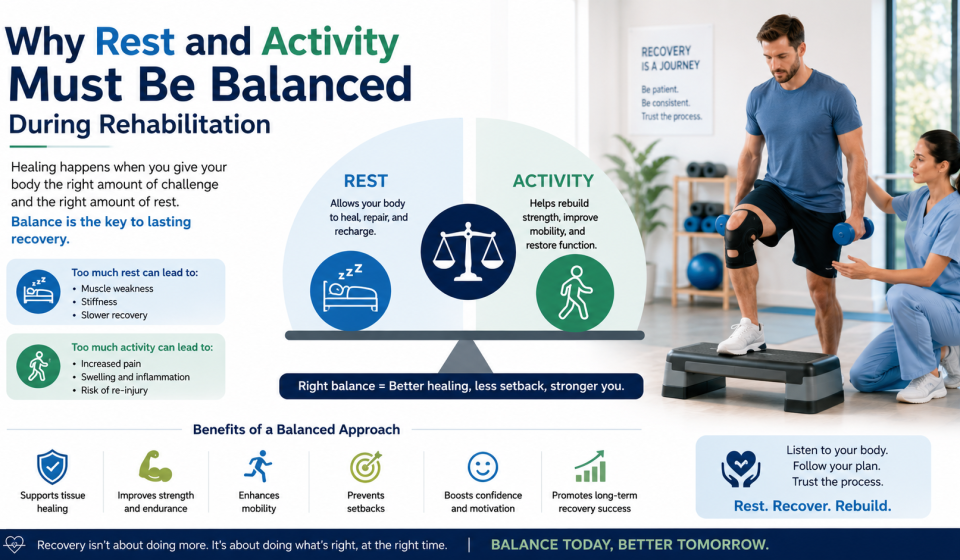
Rehabilitation is a gradual process in which the body works to regain movement, strength, endurance, balance and independence after an injury, surgery, illness or other health condition. While physical activity is an important part of many rehabilitation programs, recovery is not simply about exercising as much as possible. The body also needs appropriate periods of rest to adapt to physical demands and recover between activities. Finding the right balance between activity and rest can help support steady progress and reduce the risk of doing too much too soon.
Too little activity may limit opportunities to rebuild physical capacity, while excessive activity without adequate recovery may increase fatigue or aggravate symptoms. The World Health Organization recommends that people who are not meeting physical activity recommendations start with small amounts and gradually increase frequency, intensity and duration over time. For people living with chronic conditions or disabilities, WHO also emphasizes that activity should be appropriate to individual abilities, functional limitations and treatment plans. (ncbi.nlm.nih.gov)
What Is Rehabilitation?
Rehabilitation is a healthcare process designed to help people improve or maintain functioning and independence.
It may be needed after:
- Injuries
- Surgery
- Illness
- Stroke
- Neurological conditions
- Musculoskeletal problems
- Chronic diseases
- Serious medical conditions
- Age-related functional decline
According to the World Health Organization, rehabilitation aims to optimize functioning and reduce disability so people can participate as independently as possible in everyday activities, work, education, recreation and meaningful life roles. (who.int)
Physical activity can be one part of rehabilitation, but rehabilitation may also involve education, environmental modifications, assistive products, communication training and other interventions.
Why Activity Is Important During Rehabilitation
Physical activity gives the body opportunities to rebuild capacity.
Depending on the person’s condition, appropriate activity may help improve:
- Muscle strength
- Joint mobility
- Balance
- Coordination
- Endurance
- Walking ability
- Functional independence
- Confidence with movement
Regular physical activity is also associated with benefits for cardiovascular health, mental health, cognitive health and sleep. WHO recommends regular physical activity for adults and notes that some activity is better than none. (ncbi.nlm.nih.gov)
However, rehabilitation activity needs to be matched to the individual’s current condition.
Why Rest Is Equally Important
Rest is not simply the absence of exercise.
It is an important part of recovery because the body needs time to respond to physical demands.
During rehabilitation, rest may help a person manage:
- Muscle fatigue
- General tiredness
- Exercise-related soreness
- Temporary increases in symptoms
- Mental fatigue
- Reduced energy
- Recovery between sessions
Rest can occur between individual exercises, between therapy sessions or as part of a full night’s sleep.
The amount of rest needed varies from person to person.
The Problem With Doing Too Much Too Soon
One of the most common challenges during recovery is trying to progress too quickly.
A person may feel better and decide to immediately return to previous activity levels.
For example, someone recovering from an injury might increase walking distance dramatically because a shorter walk felt comfortable.
However, the body’s current capacity may not yet match its previous capacity.
Doing too much may contribute to increased soreness, fatigue or other symptoms.
A rehabilitation professional can help determine when and how activity should progress.
The Problem With Too Little Activity
The opposite problem can also occur.
A person may become afraid of movement after an injury or illness and avoid physical activity completely.
Too much inactivity can reduce opportunities to maintain or rebuild physical capacity.
WHO recommends limiting sedentary time and notes that replacing sedentary behavior with physical activity of any intensity provides health benefits. (ncbi.nlm.nih.gov)
The goal is therefore not complete rest.
The goal is appropriate activity combined with appropriate recovery.
Understanding the Balance Between Activity and Rest
A balanced rehabilitation program considers both physical demand and recovery capacity.
The right balance depends on:
- Type of injury or condition
- Severity of symptoms
- Current strength
- Fitness level
- Age
- Sleep quality
- Medical restrictions
- Treatment stage
- Exercise tolerance
- Personal goals
Someone in the early stages of recovery may need more rest and lower-intensity activity.
As recovery progresses, activity may gradually increase.
Gradual Progression Supports Recovery
Rehabilitation programs often use gradual progression.
Instead of suddenly increasing workload, professionals may slowly adjust:
- Exercise duration
- Number of repetitions
- Resistance
- Walking distance
- Frequency
- Movement complexity
- Balance demands
WHO recommends that adults who are currently inactive start with small amounts and gradually increase frequency, intensity and duration. (ncbi.nlm.nih.gov)
This principle can help make physical activity more manageable.
Rest Between Exercises
Rest does not only mean taking an entire day off.
Short recovery periods can be included during a rehabilitation session.
For example, a person may perform several repetitions of an exercise and then rest before completing the next set.
The length of the rest period depends on:
- Exercise intensity
- Fitness level
- Medical condition
- Fatigue
- Rehabilitation goals
A rehabilitation professional can determine appropriate rest intervals.
Rest Between Rehabilitation Sessions
The body may also need time between therapy sessions.
If a person participates in challenging rehabilitation exercises, performing the same high-demand activity continuously may not be appropriate.
Rest days or lower-intensity days may allow recovery while still keeping the person active.
A weekly plan might include:
- Rehabilitation exercises
- Walking
- Light mobility work
- Rest periods
- Functional activities
- Sleep and recovery
The exact schedule should be individualized.
The Role of Sleep in Recovery
Sleep is an important part of overall recovery.
During sleep, the body and brain have opportunities to recover from daily demands.
Poor sleep can make a person feel more tired and may make physical activity feel more difficult.
Physical activity itself can also support sleep. WHO identifies sleep among the health outcomes associated with physical activity. (ncbi.nlm.nih.gov)
A rehabilitation plan should therefore consider both exercise and healthy sleep habits.
Recognizing Signs of Excessive Activity
People in rehabilitation should pay attention to how their bodies respond to activity.
Possible signs that the workload may be too high can include:
- Persistent or increasing pain
- Significant swelling
- Excessive fatigue
- Reduced ability to perform normal activities
- Worsening movement quality
- Reduced exercise tolerance
- Symptoms that persist or repeatedly worsen after activity
These signs do not automatically mean that all exercise should stop.
Instead, they may indicate that the activity level needs reassessment.
Understanding Normal Exercise Fatigue
Some fatigue during rehabilitation can be expected.
Muscles may feel tired after strengthening exercises, and a person may need a short recovery period.
However, there is an important difference between manageable exercise fatigue and concerning symptoms.
Severe pain, chest pain, fainting, serious breathing difficulty or sudden neurological symptoms require prompt medical attention.
People recovering from surgery or serious illness should follow the warning signs and activity restrictions provided by their healthcare team.
Active Recovery
Rest and activity do not always have to be opposites.
Active recovery involves lower-intensity movement performed between more demanding activities.
Examples can include:
- Gentle walking
- Comfortable mobility exercises
- Light stretching when appropriate
- Easy range-of-motion exercises
- Low-intensity daily activities
The appropriate form of active recovery depends on the person’s condition.
Rest Days Do Not Mean Complete Inactivity
A rest day may simply mean reducing the intensity or volume of physical activity.
For example, someone who performs strengthening exercises several days per week may use another day for gentle walking or mobility exercises.
However, individuals with specific medical restrictions should follow professional recommendations rather than creating their own recovery schedule.
How Rehabilitation Professionals Monitor Activity
Rehabilitation professionals can assess how an individual responds to treatment.
They may monitor:
- Pain
- Swelling
- Strength
- Mobility
- Balance
- Endurance
- Movement quality
- Functional performance
- Fatigue
- Ability to complete daily activities
This information can help determine whether the rehabilitation program should continue, progress or temporarily be modified.
Activity Should Match the Recovery Stage
The appropriate amount of activity can change throughout rehabilitation.
Early Recovery
The focus may be on protecting healing tissues, controlling symptoms and maintaining safe movement.
Middle Recovery
Activity may gradually increase as strength, mobility and tolerance improve.
Later Recovery
Exercises may become more challenging and more closely related to work, sports, household tasks or other personal goals.
Return to Normal Activities
The final stage may involve preparing for the physical demands of normal life.
The timeline varies widely depending on the condition.
The Importance of Listening to Your Body
Self-awareness can help during rehabilitation.
People should pay attention to changes in:
- Pain
- Fatigue
- Energy
- Swelling
- Stiffness
- Movement
- Exercise tolerance
However, “listening to your body” does not mean avoiding every uncomfortable sensation.
Rehabilitation can involve appropriate physical challenge.
The goal is to understand patterns and communicate changes with the rehabilitation professional.
Why Individualized Rehabilitation Matters
There is no universal rest-and-activity schedule that works for everyone.
For example, a healthy person returning to exercise after a short break has different needs from someone recovering from surgery.
Similarly, an older adult with multiple health conditions may require a different approach from a competitive athlete.
WHO recommends that people with chronic conditions or disabilities engage in physical activity according to their abilities and consider professional guidance when determining appropriate types and amounts of activity. (ncbi.nlm.nih.gov)
Nutrition and Hydration Also Support Recovery
Rest and activity are important, but recovery also depends on other lifestyle factors.
Adequate nutrition and hydration can support normal body function during rehabilitation.
A person’s nutritional needs may be different after surgery, serious illness or injury.
Anyone with specific dietary requirements should discuss them with an appropriate healthcare professional.
Managing Daily Activities
Rehabilitation does not happen only during therapy sessions.
Daily activities can contribute to the overall physical workload.
For example:
- Walking around the house
- Shopping
- Cleaning
- Cooking
- Caring for children
- Commuting
- Working
A person may feel that a rehabilitation session was easy but then become exhausted after combining it with a demanding day.
Considering the total daily workload can help create a more balanced recovery plan.
Balancing Work and Rehabilitation
Returning to work can increase physical or mental demands.
Someone with a physically demanding job may need a gradual return to duties.
Even office work can involve prolonged sitting, concentration and commuting.
Rehabilitation professionals may help identify ways to modify activities and gradually increase workload.
WHO describes rehabilitation as supporting participation in work and other meaningful life roles, not simply treating physical symptoms. (who.int)
Managing Fear of Movement
Some people become worried that movement will cause further injury.
This can lead to excessive inactivity.
Appropriate rehabilitation can help people gradually regain confidence in movement.
Exercises can be progressed in a controlled manner so that the person becomes more comfortable with increasingly demanding activities.
Professional guidance can be particularly useful when fear of movement is preventing normal activity.
Recovery Is Not Always Linear
A common misconception is that rehabilitation should improve every day.
In reality, recovery can involve good days and difficult days.
Symptoms may fluctuate because of:
- Sleep
- Stress
- Activity levels
- Illness
- Work demands
- Travel
- Changes in routine
A temporary setback does not necessarily mean that rehabilitation has failed.
The program can be adjusted according to the person’s current condition.
Practical Ways to Balance Rest and Activity
A few practical strategies can help:
Follow your rehabilitation plan: Use the recommendations provided by your healthcare team.
Increase activity gradually: Avoid sudden increases in workload.
Schedule recovery: Include adequate rest between demanding activities.
Monitor symptoms: Track changes in pain, swelling and fatigue.
Prioritize sleep: Maintain a consistent sleep routine whenever possible.
Break up prolonged sitting: Use light movement when appropriate.
Communicate changes: Tell your rehabilitation professional about significant changes in symptoms or function.
Focus on consistency: Sustainable progress is usually more useful than occasional intense effort.
When to Contact a Healthcare Professional
Contact your healthcare professional if you experience symptoms that are severe, sudden, persistent or significantly different from your usual recovery pattern.
Urgent medical attention may be necessary for symptoms such as:
- Chest pain
- Severe difficulty breathing
- Fainting
- Sudden weakness
- Sudden confusion
- Severe unexplained pain
- Major loss of function
The appropriate response depends on the situation.
Source
WHO Rehabilitation Fact Sheet
WHO Physical Activity Guidelines
WHO Physical Activity Recommendations
WHO Guidelines Executive Summary
Conclusion
Rest and activity are not competing parts of rehabilitation; they are complementary parts of the recovery process. Appropriate physical activity provides the body with opportunities to rebuild strength, mobility, endurance, balance and functional capacity, while adequate rest gives the body time to recover and adapt to those demands.
The right balance depends on the individual’s condition, recovery stage, symptoms, activity level, medical restrictions and personal goals. A person recovering from a major injury or surgery may require more carefully controlled activity than someone returning to exercise after a short period of inactivity. This is why rehabilitation programs should be individualized rather than based on a single recovery formula.
Gradual progression is an important part of maintaining this balance. WHO recommends that inactive adults begin with small amounts of activity and gradually increase frequency, intensity and duration. People with chronic conditions or disabilities may also benefit from professional advice to determine the type and amount of activity appropriate to their abilities and treatment plan. (ncbi.nlm.nih.gov)
Rest should also be viewed as an active component of recovery rather than a sign of weakness or lack of progress. Adequate sleep, recovery periods between exercises and appropriate lower-intensity activities can help individuals manage the demands of rehabilitation. At the same time, excessive inactivity may reduce opportunities to rebuild physical capacity, which is why complete avoidance of movement is not always the best approach.
Successful rehabilitation is therefore about finding the appropriate level of challenge and allowing sufficient time for recovery. Monitoring symptoms, communicating with healthcare professionals and adjusting activity as recovery changes can help create a safer and more sustainable process.
Ultimately, the goal of rehabilitation is not simply to exercise more or rest more. It is to restore meaningful function and independence. By balancing activity with appropriate recovery, individuals can gradually work toward walking, working, exercising, participating in daily activities and returning to the parts of life that matter most to them.
FAQ
1. Why is rest important during rehabilitation?
Rest gives the body time to recover and adapt to physical demands. It can also help manage fatigue and allow recovery between rehabilitation sessions.
2. Is complete rest better than activity after an injury?
Not necessarily. The appropriate amount of activity depends on the injury or medical condition. Many rehabilitation programs use controlled movement and gradual progression rather than complete inactivity.
3. Can too much activity slow recovery?
Doing too much too quickly may increase fatigue or aggravate symptoms. Activity should generally be increased gradually and according to professional guidance.
4. Can too little activity affect recovery?
Yes. Excessive inactivity can reduce opportunities to maintain or rebuild strength, mobility and endurance.
5. How can I tell if I am doing too much?
Persistent or increasing pain, significant swelling, unusual fatigue, worsening function or repeated symptom flare-ups may indicate that your activity level needs reassessment.
6. What is active recovery?
Active recovery refers to lower-intensity movement performed during recovery periods. Examples may include gentle walking or appropriate mobility exercises.
7. How much rest do I need between rehabilitation exercises?
There is no universal amount. Rest periods depend on the exercise, intensity, condition, fitness level and individual response.
8. Is sleep important during physical rehabilitation?
Yes. Adequate sleep is an important part of overall recovery, and physical activity is also associated with improved sleep outcomes. (ncbi.nlm.nih.gov)
9. Should I exercise every day during rehabilitation?
Not necessarily. Some people may benefit from daily light activity, while others may require recovery days between more demanding sessions. Follow your individualized rehabilitation plan.
10. Can I continue normal household activities during rehabilitation?
It depends on your condition and restrictions. Household activities may contribute to your overall daily physical workload, so they should be considered when planning rehabilitation activity.
11. Why should activity increase gradually?
Gradual progression allows the body to adapt to increasing demands. WHO specifically recommends starting with small amounts and gradually increasing frequency, intensity and duration for people who are not meeting activity recommendations. (ncbi.nlm.nih.gov)
12. Does rest mean staying in bed?
No. Depending on the condition, rest may mean reducing exercise intensity, taking breaks or allowing recovery between sessions. Some people may benefit from appropriate light movement.
13. Can rehabilitation improve independence?
Yes. Rehabilitation aims to optimize functioning and reduce disability so people can be as independent as possible in everyday activities and meaningful life roles. (who.int)
14. Should I increase exercise when I feel better?
Feeling better can be a positive sign, but increases should still be gradual. A rehabilitation professional can help determine whether your body is ready for additional workload.
15. What should I do if symptoms become worse after exercise?
If symptoms are significant, persistent or unusual, contact your healthcare professional or rehabilitation provider for advice. Do not assume that worsening symptoms should simply be pushed through.
16. Can stress affect rehabilitation recovery?
Stress can influence energy, sleep, motivation and the ability to participate in rehabilitation. Managing stress and maintaining adequate recovery can support a balanced routine.
17. Does rehabilitation only involve exercise?
No. WHO describes rehabilitation as a broad set of interventions that can include exercise, education, environmental modifications, assistive products, task adaptations and other approaches designed to improve functioning. (who.int)
18. Is rehabilitation the same for everyone?
No. Rehabilitation is individualized according to a person’s health condition, functional limitations, environment, goals and response to treatment.
19. When should I seek urgent medical help?
Seek urgent medical attention for serious symptoms such as chest pain, severe difficulty breathing, fainting, sudden weakness, sudden confusion or other potentially emergency symptoms.
20. What is the main goal of balancing rest and activity?
The goal is to provide enough physical challenge to support recovery while allowing enough rest for the body to adapt. A balanced approach can support gradual improvements in strength, mobility, endurance, function and independence.