
Learn how rehabilitation professionals assess functional limitations, including mobility, strength, balance, endurance, daily activities and participation, to create personalized rehabilitation plans.
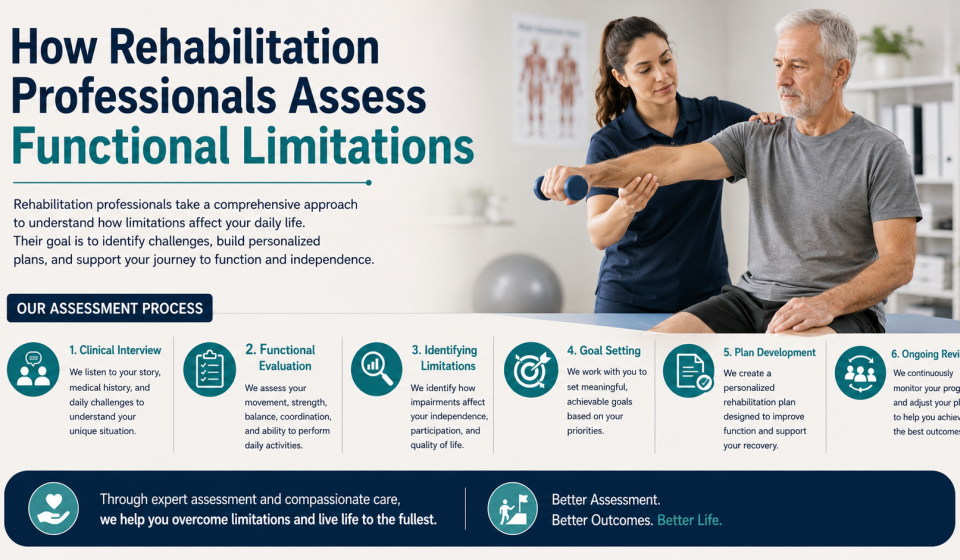
Functional limitations can make everyday activities more difficult after an injury, illness, surgery, neurological condition, chronic disease or age-related changes. Tasks that once felt simple, such as walking, climbing stairs, getting out of a chair, dressing, lifting an object or returning to work, may become challenging. Rehabilitation professionals assess these limitations to understand how a person’s health condition affects movement, independence and participation in daily life. The assessment provides important information that can guide rehabilitation goals and treatment planning.
Rehabilitation is not focused only on identifying a medical condition. It also looks at how that condition affects a person’s ability to function in their real-life environment. The World Health Organization describes rehabilitation as a set of interventions designed to optimize functioning and reduce disability, helping people remain as independent as possible and participate in work, education, recreation and other meaningful activities. A functional assessment therefore considers the individual as a whole, including physical abilities, daily activities, personal goals and environmental factors.
What Are Functional Limitations?
Functional limitations are difficulties performing physical, cognitive or everyday activities because of a health condition, injury or other factors.
Examples may include:
- Difficulty walking
- Reduced ability to climb stairs
- Trouble standing for long periods
- Difficulty getting out of a chair
- Reduced balance
- Limited joint movement
- Reduced muscle strength
- Difficulty carrying objects
- Problems with coordination
- Difficulty completing household activities
- Reduced ability to work
- Difficulty participating in social or recreational activities
The type and severity of limitation can vary significantly from person to person.
Two people with the same medical diagnosis may have very different functional abilities. This is one reason rehabilitation assessments need to be individualized.
Who Assesses Functional Limitations?
Different rehabilitation professionals may participate in functional assessment depending on a person’s needs.
These may include:
- Physical therapists
- Occupational therapists
- Rehabilitation physicians
- Speech and language therapists
- Audiologists
- Rehabilitation nurses
- Psychologists
- Prosthetists and orthotists
- Other members of a multidisciplinary rehabilitation team
WHO notes that rehabilitation often requires collaboration among different professional disciplines because individuals may have multiple and interconnected functional needs.
The Initial Patient Interview
The assessment commonly begins with a conversation.
A rehabilitation professional may ask about:
- Current symptoms
- Medical history
- Previous injuries
- Surgeries
- Current medications
- Daily activities
- Work requirements
- Exercise habits
- Home environment
- Previous level of function
- Current difficulties
- Personal goals
This information helps the professional understand the individual’s situation before physical testing begins.
The American Physical Therapy Association describes the initial physical therapy examination as including history, systems review, physical examination, tests and measures, evaluation and development of a plan of care.
Understanding the Person’s Main Concerns
A good functional assessment does not focus only on what a professional observes.
The individual’s own concerns are important.
For example, a person may say:
“I can walk, but I cannot walk far enough to reach my workplace.”
Another person might say:
“I can climb stairs, but I cannot carry my child upstairs.”
These statements provide important information about how a limitation affects real life.
Rehabilitation professionals use this information to connect clinical findings with meaningful activities.
Assessing Range of Motion
Range of motion describes how far a joint or body segment can move.
A rehabilitation professional may assess movement at areas such as:
- Shoulder
- Elbow
- Wrist
- Hip
- Knee
- Ankle
- Spine
Limited range of motion can interfere with everyday activities.
For example, restricted shoulder movement may make it difficult to reach overhead, while limited ankle movement may affect walking or stair climbing.
The specific measurements used depend on the person’s condition and rehabilitation goals.
Assessing Muscle Strength
Muscle strength is another important part of functional assessment.
Professionals may assess whether specific muscle groups can generate enough force for necessary activities.
Strength can influence:
- Walking
- Standing
- Lifting
- Carrying
- Stair climbing
- Transfers
- Balance
- Household activities
The assessment may involve manual testing, functional tasks or other standardized measures.
APTA notes that physical examination may include assessment of gross strength and other musculoskeletal characteristics, with tests selected according to the individual’s presentation and needs.
Evaluating Balance
Balance is essential for safe movement.
A rehabilitation professional may evaluate balance while a person is:
- Standing
- Walking
- Turning
- Reaching
- Changing direction
- Moving from sitting to standing
- Performing specific functional tasks
Balance assessment may help identify whether a person has difficulty maintaining stability during everyday movement.
For some individuals, poor balance can increase the risk of falls and limit independence.
Assessing Walking and Mobility
Walking assessment is particularly important for people experiencing mobility limitations.
The professional may observe:
- Walking speed
- Step pattern
- Foot placement
- Symmetry
- Use of assistive devices
- Turning ability
- Ability to change surfaces
- Ability to walk different distances
The goal is not simply to determine whether someone can walk.
The professional may also want to understand how safely, efficiently and independently the person can walk.
APTA identifies gait, locomotion, transfers and transitions as areas that may be assessed when examining neuromuscular function.
Evaluating Transfers
Transfers are movements between different positions or surfaces.
Examples include:
- Bed to chair
- Chair to standing
- Toilet transfers
- Getting in and out of a vehicle
Transfer ability is an important indicator of functional independence.
A person may have sufficient strength to stand but still require assistance because of balance, coordination, pain or difficulty following movement sequences.
Assessing Endurance
Endurance refers to the ability to maintain physical activity over time.
Rehabilitation professionals may consider how long a person can:
- Walk
- Stand
- Perform repeated movements
- Complete household tasks
- Participate in work activities
Endurance can be affected by many factors, including cardiovascular fitness, respiratory limitations, muscle weakness, pain and deconditioning.
The assessment is adjusted according to the person’s condition and safety requirements.
Evaluating Functional Activities
Functional assessment goes beyond individual body movements.
Professionals may examine activities such as:
- Dressing
- Bathing
- Eating
- Cooking
- Cleaning
- Shopping
- Using stairs
- Getting into a car
- Working
- Participating in hobbies
These activities provide information about how physical limitations affect everyday independence.
APTA’s Functional Assessment Standardized Items, for example, evaluates areas such as self-care, mobility, instrumental activities of daily living and the need for assistance.
Standardized Functional Tests
Rehabilitation professionals may use standardized tests and outcome measures.
These tools can help quantify functional ability and track changes over time.
Depending on the condition, assessments may measure:
- Walking ability
- Balance
- Strength
- Mobility
- Functional independence
- Endurance
- Ability to perform daily activities
APTA recommends using standardized tests and measures to objectify examination findings when appropriate.
The exact test selected depends on the individual’s age, condition, stage of recovery, environment and goals.
Assessing Activities of Daily Living
Activities of daily living, often called ADLs, include basic tasks needed for personal independence.
Examples include:
- Dressing
- Bathing
- Toileting
- Eating
- Grooming
- Moving around the home
Difficulty with these tasks can indicate a meaningful functional limitation.
Professionals may determine whether the person can complete the task independently, needs supervision or requires physical assistance.
Assessing Instrumental Activities of Daily Living
Instrumental activities of daily living are more complex tasks associated with independent living.
They may include:
- Preparing meals
- Shopping
- Managing household tasks
- Using transportation
- Managing medications
- Handling finances
- Communicating with others
These tasks can provide additional information about a person’s ability to live independently.
Considering the Home Environment
The environment can influence functional ability.
A person may have difficulty at home because of:
- Stairs
- Narrow spaces
- Uneven flooring
- Poor lighting
- Lack of bathroom supports
- Difficult furniture arrangements
Rehabilitation professionals may consider these factors when developing recommendations.
WHO explains that rehabilitation can include adapting environments, using assistive products and modifying tasks to help people perform activities more safely and independently.
Assessing Assistive Device Needs
Some people require equipment to improve safety or independence.
Examples include:
- Canes
- Walkers
- Wheelchairs
- Orthotic devices
- Prosthetic devices
- Bathroom equipment
Professionals may assess whether a device is appropriate and whether the individual can use it safely.
The correct device and fit depend on the person’s specific functional needs.
Understanding Pain and Its Functional Impact
Pain can influence movement and daily activities.
A rehabilitation professional may ask:
- Where is the pain?
- When does it occur?
- What activities increase it?
- What activities reduce it?
- Does it affect sleep?
- Does it affect walking or exercise?
- Does it prevent specific activities?
Pain is considered alongside physical findings rather than being viewed separately from function.
Considering Cognitive and Communication Factors
Physical ability is only one part of functional independence.
Some individuals may experience limitations involving:
- Memory
- Attention
- Communication
- Understanding instructions
- Problem-solving
- Motor learning
These factors can influence how safely a person performs activities.
A comprehensive rehabilitation assessment may therefore consider cognitive, communication and learning factors when relevant. APTA includes communication ability, cognition, language and learning preferences among areas that may be considered during examination.
Considering Emotional and Social Factors
Emotional and social factors may also influence rehabilitation.
Examples include:
- Confidence
- Motivation
- Fear of movement
- Family support
- Social environment
- Work demands
- Access to transportation
- Ability to attend therapy
These factors can affect participation in rehabilitation and should be considered when developing realistic goals.
Identifying Activity Limitations and Participation Restrictions
Rehabilitation professionals often distinguish between an impairment and its effect on activity.
For example:
A person may have reduced knee strength as an impairment.
That weakness may contribute to difficulty climbing stairs, which is an activity limitation.
The inability to return to a job requiring frequent stair climbing may represent a participation restriction.
APTA explains that examination and evaluation consider body structures and functions, activity limitations and participation restrictions.
Setting Functional Goals
Assessment findings are used to develop meaningful goals.
Instead of setting only general goals such as “improve strength,” a rehabilitation professional may establish functional goals such as:
- Walk independently for a specified distance
- Climb a certain number of stairs
- Stand long enough to prepare a meal
- Get out of a chair without assistance
- Return to a specific work activity
- Perform personal care independently
APTA recommends that rehabilitation goals be objective, measurable and related to the individual’s functional needs.
Reassessment During Rehabilitation
Functional assessment does not necessarily happen only once.
Rehabilitation is an ongoing process.
Professionals may repeat selected assessments to determine whether:
- Strength has improved
- Mobility has increased
- Balance has improved
- Walking has become safer
- Assistance needs have decreased
- Functional goals are being reached
APTA describes evaluation as continuing throughout the episode of care so that the professional can monitor response to interventions and progress toward goals.
How Assessment Helps Personalize Rehabilitation
Every person has different needs.
A rehabilitation plan should reflect:
- Current functional ability
- Medical condition
- Personal goals
- Home environment
- Work demands
- Family support
- Recovery stage
- Safety considerations
The assessment provides the information needed to make rehabilitation more individualized.
Why Functional Assessment Matters
Functional assessment helps shift attention from a diagnosis alone to the person’s ability to live and participate.
Two people can have the same diagnosis but different levels of independence.
One may return quickly to work, while another may need assistance with basic activities.
Understanding these differences helps rehabilitation professionals develop more appropriate goals and interventions.
What Patients Can Expect During an Assessment
A rehabilitation assessment may involve conversation, observation, physical examination and specific functional tests.
Patients may be asked to:
- Walk
- Stand
- Sit
- Rise from a chair
- Move a joint
- Perform balance activities
- Complete functional tasks
- Describe symptoms
- Explain daily challenges
The assessment should be adapted to the person’s condition and safety.
How Patients Can Prepare
Patients can make an assessment more useful by preparing information about:
- Current symptoms
- Medical history
- Medications
- Previous treatments
- Daily limitations
- Work responsibilities
- Home challenges
- Personal rehabilitation goals
It can also be helpful to think about the activities that matter most personally.
For example, a person may want to return to gardening, caring for children, walking independently or returning to work.
These goals can help guide the assessment and rehabilitation plan.
Source
WHO Rehabilitation Overview
APTA Initial Examination
APTA Functional Assessment
PM&R Functional Assessment
Conclusion
Rehabilitation professionals assess functional limitations by looking beyond a person’s diagnosis and examining how a health condition affects movement, independence and participation in everyday life. The assessment may include a detailed health history, physical examination, strength testing, range-of-motion measurements, balance assessment, walking analysis, endurance evaluation and functional activities. The exact approach depends on the individual’s condition, age, recovery stage, environment and personal goals.
A major advantage of functional assessment is that it connects clinical findings with real-life activities. A person may have muscle weakness, limited joint movement or poor balance, but the most important question is often how those limitations affect daily life. Difficulty getting out of a chair, climbing stairs, preparing food, walking to work or performing personal care can provide meaningful information about a person’s functional status.
Rehabilitation assessments can also help professionals establish measurable goals and monitor progress. As treatment continues, selected tests and measures may be repeated to determine whether function is improving and whether the rehabilitation plan needs to be adjusted. APTA describes rehabilitation evaluation as an ongoing process that can involve changes to goals and the plan of care based on the individual’s response and progress.
Functional assessment is also person-centered. The activities that matter most to one individual may be completely different from those that matter to another. A successful rehabilitation plan therefore considers personal priorities, home circumstances, work requirements and social participation alongside physical abilities.
Ultimately, the purpose of functional assessment is not simply to record limitations. It is to understand what a person can do, what they find difficult, what support they need and what functional improvements are meaningful to them. By combining clinical information with real-world goals, rehabilitation professionals can develop more individualized strategies to support safer movement, greater independence and improved participation in everyday life.
FAQ
1. What is a functional assessment in rehabilitation?
A functional assessment evaluates how well a person can perform physical and everyday activities and identifies limitations that may affect independence, work or participation.
2. Who performs functional assessments?
Depending on the person’s needs, functional assessments may be performed by physical therapists, occupational therapists, rehabilitation physicians and other rehabilitation professionals.
3. What does a rehabilitation professional assess?
Assessment may include strength, range of motion, balance, walking, coordination, endurance, transfers, daily activities, cognition, communication and environmental factors.
4. Why is functional assessment important?
It helps professionals understand how a health condition affects real-life activities and provides information for creating personalized rehabilitation goals and treatment plans.
5. Is functional assessment the same for everyone?
No. The assessment is adapted to the person’s age, condition, recovery stage, functional needs, environment and personal goals.
6. Does a functional assessment include strength testing?
Yes. Strength may be assessed when weakness could contribute to an activity limitation or movement problem.
7. How is balance assessed?
A professional may observe standing, walking, turning, transfers or specific balance tasks depending on the individual’s condition.
8. Why do rehabilitation professionals assess walking?
Walking assessment can identify problems with speed, stability, coordination, gait pattern, endurance or the safe use of assistive devices.
9. Are daily activities part of rehabilitation assessment?
Yes. Activities such as dressing, bathing, cooking, walking, shopping and household tasks can help professionals understand functional independence.
10. What are standardized functional tests?
They are structured tests or measurement tools used to quantify aspects of function and help track changes over time. APTA provides resources covering multiple standardized functional measures.
11. Can rehabilitation assessments be repeated?
Yes. Reassessment can help determine whether the person’s function is improving and whether goals or the rehabilitation plan need to be modified.
12. What is the difference between impairment and activity limitation?
An impairment refers to a problem involving body function or structure, while an activity limitation refers to difficulty performing a task. For example, reduced muscle strength may contribute to difficulty climbing stairs.
13. Does the home environment matter during rehabilitation assessment?
Yes. Stairs, bathroom arrangements, flooring, space and other environmental factors can affect a person’s ability to function safely and independently.
14. Can rehabilitation professionals assess the need for assistive devices?
Depending on their professional scope and role, rehabilitation professionals may assess functional needs and recommend or train individuals in the use of appropriate assistive equipment.
15. Are personal goals considered during functional assessment?
Yes. Personal goals are an important part of person-centered rehabilitation. Goals may involve returning to work, walking independently, caring for family or participating in hobbies.
16. Can functional assessment measure independence?
Yes. Some functional assessment tools are specifically designed to measure the amount of assistance a person needs for everyday activities.
17. What should I tell a rehabilitation professional during an assessment?
Explain your symptoms, daily difficulties, previous medical history, medications, work requirements, home challenges and the activities you most want to regain.
18. Can functional limitations change over time?
Yes. Functional ability can improve, decline or change depending on recovery, treatment, activity levels, medical conditions and other factors.
19. Does rehabilitation only focus on physical movement?
No. Rehabilitation can address movement as well as communication, cognition, self-care, environmental barriers, participation and other factors affecting independence.
20. What is the main purpose of a rehabilitation functional assessment?
The main purpose is to understand how a person’s condition affects their ability to perform meaningful activities and to use that information to guide safe, individualized rehabilitation and measurable goals.