The Power of Small Steps: Why Gradual Progress Is Essential for Safe and Successful Physical Recovery

Discover why gradual progress during physical recovery matters, how pacing supports rehabilitation, and how small, consistent improvements can help rebuild strength, mobility, confidence, and independence.
Physical recovery is rarely an overnight process. Whether someone is recovering from an injury, surgery, illness, stroke, chronic condition, or a period of reduced mobility, the body often needs time to rebuild strength, flexibility, balance, coordination, and endurance. Trying to return to normal activity too quickly may place unnecessary stress on the body, while a gradual and structured approach allows physical abilities to improve according to the person’s condition and tolerance. Rehabilitation is designed to help people regain abilities and independence, with goals that vary according to the cause and severity of the problem.
Gradual progress does not mean doing nothing or moving forward slowly without purpose. It means increasing activity, exercise, or daily tasks in manageable stages. The World Health Organization recommends that adults who are not meeting physical activity targets start with small amounts and gradually increase frequency, intensity, and duration over time. This approach can make recovery more sustainable while helping people build confidence and reduce the risk of doing too much too soon.
What Does Gradual Progress During Recovery Mean?
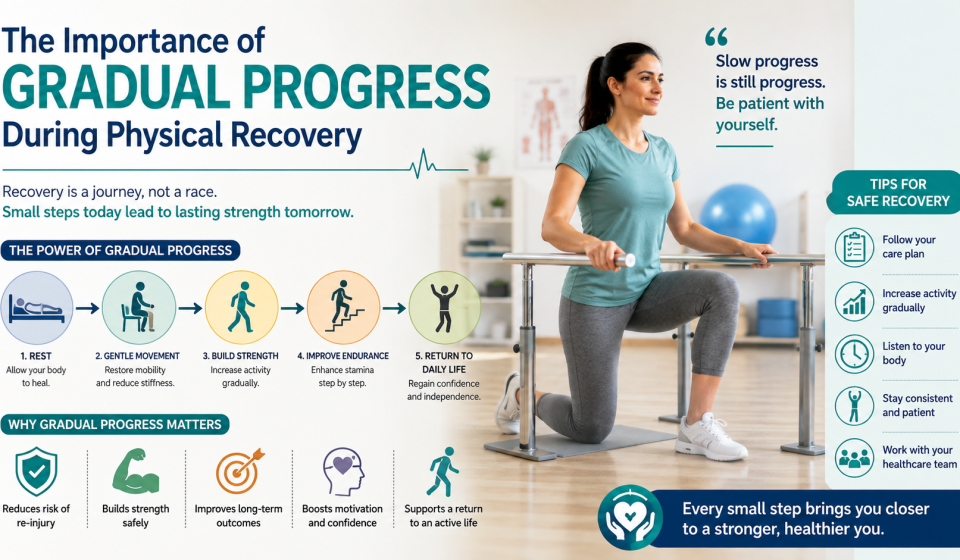
Gradual progress means increasing physical activity step by step as the body becomes more capable of handling it.
Depending on the recovery plan, progress may involve:
- Increasing walking time
- Adding repetitions to an exercise
- Increasing range of motion
- Improving balance
- Increasing resistance
- Performing activities with less assistance
- Returning gradually to work
- Increasing endurance
- Improving coordination
- Returning slowly to sports or hobbies
The exact progression is different for every person.
A rehabilitation professional may adjust the program according to symptoms, strength, mobility, endurance, medical condition, and response to exercise.
Why Recovery Takes Time
The human body needs time to adapt after injury, illness, surgery, or inactivity.
During periods of reduced activity, muscles can become weaker and endurance can decline. Joint movement may become limited, and everyday tasks can feel more difficult.
Recovery may involve rebuilding several abilities at the same time.
These can include:
- Muscle strength
- Cardiovascular endurance
- Flexibility
- Balance
- Coordination
- Mobility
- Confidence
- Functional independence
Because these abilities do not always return at the same speed, recovery should be approached as a process rather than a single event.
Gradual Progress Helps Build Strength
Strength development is progressive.
As the body adapts to an exercise, the amount of challenge can eventually be increased.
The National Institute of Diabetes and Digestive and Kidney Diseases explains that gradual increases in weight, repetitions, sets, or exercise frequency can contribute to stronger muscles over time.
This principle is particularly relevant during rehabilitation because the goal is not simply to make muscles work harder. The goal is to improve function safely and appropriately.
Starting With Manageable Activity
One of the most important principles of recovery is starting with an amount of activity that can be tolerated.
For some people, this may mean:
- Short walks
- Gentle movements
- Basic stretching
- Simple balance exercises
- Assisted movements
- Light strengthening
- Everyday activities performed with support
For someone with significant physical limitations, even a small improvement can be meaningful.
The appropriate starting point depends on the individual’s health and rehabilitation plan.
Small Improvements Can Produce Meaningful Results
Progress does not always look dramatic.
A person recovering from an injury may initially improve by walking for a few additional minutes.
Another person may be able to stand without assistance for a longer period.
Someone recovering after surgery may move more comfortably.
A person undergoing rehabilitation after a neurological condition may improve coordination or complete an everyday task with less assistance.
These small changes can represent meaningful improvements in function.
Why Doing Too Much Too Quickly Can Be a Problem
The desire to recover quickly is understandable.
However, pushing beyond the body’s current ability may increase discomfort, fatigue, or the risk of aggravating an injury or condition.
MedlinePlus advises people recovering from a hamstring strain to increase physical activity slowly and warns against pushing too hard or too fast because the injury can recur or worsen.
This illustrates an important recovery principle: more activity is not automatically better.
The right amount of activity depends on the individual’s condition and tolerance.
Recovery Should Be Individualized
There is no universal recovery schedule.
Two people with the same type of injury may progress at different speeds.
Factors that can affect recovery include:
- Age
- Overall fitness
- Severity of injury
- Type of surgery
- Existing health conditions
- Pain
- Sleep
- Nutrition
- Medication
- Previous physical activity
- Motivation
- Access to rehabilitation
- Response to treatment
Exercise progression should therefore be personalized.
An official statement on exercise progression in cardiac rehabilitation emphasizes that exercise prescriptions should be developed specifically for individual patients because people differ significantly in their health status and responses.
The Importance of Following a Rehabilitation Plan
A rehabilitation plan provides structure.
Depending on the condition, it may include:
- Exercises
- Mobility training
- Strength training
- Balance work
- Functional activities
- Education
- Home exercises
- Rest periods
- Follow-up assessments
Following the recommended plan can help a person understand what activities are appropriate at each stage.
Patients should discuss changes to their rehabilitation program with their healthcare or rehabilitation team.
Gradual Progress and Physical Therapy
Physical therapists often help patients improve movement and function through structured rehabilitation.
A therapy program may progress from easier movements to more challenging activities.
For example, a patient may progress from:
Assisted movement → Independent movement → Strengthening → Functional activity → More demanding activity
The exact sequence varies depending on the condition.
The goal is to improve function while considering safety and individual ability.
Progressing From Basic to Functional Movements
Recovery is not only about exercising individual muscles.
People also need to regain the ability to perform everyday tasks.
Functional rehabilitation may involve:
- Sitting
- Standing
- Walking
- Climbing stairs
- Reaching
- Carrying objects
- Getting in and out of a chair
- Dressing
- Household activities
- Work-related tasks
These activities can gradually become more challenging as strength and confidence improve.
Why Mobility Matters During Recovery
Mobility is an important part of independence.
Being able to move safely can affect:
- Personal care
- Work
- Household activities
- Social participation
- Exercise
- Quality of life
Rehabilitation aims to help people regain abilities and independence, although the specific goals depend on the person’s condition.
Gradual mobility training can help individuals work toward these goals step by step.
Building Endurance Gradually
Endurance can decrease after illness, surgery, injury, or prolonged inactivity.
Someone who previously walked for an hour may initially tolerate only a short period of activity.
Instead of immediately trying to return to the previous level, the person may gradually increase duration according to their rehabilitation plan.
MedlinePlus recommends building activity levels slowly and notes that regular practice can help people become stronger, faster, or more flexible.
Gradual Progress in Walking
Walking is often an important part of recovery.
Depending on the condition, a person may progress from:
- Standing
- Taking assisted steps
- Walking short distances
- Walking longer distances
- Increasing walking frequency
- Improving walking speed
- Returning to normal daily walking
Some people may need mobility aids such as a walker or cane during earlier stages.
The goal is not necessarily to eliminate support immediately but to use appropriate assistance while function improves.
Gradual Strength Training
Strength training can be an important part of rehabilitation.
However, resistance should be appropriate for the person’s current ability.
Progression may involve:
- More repetitions
- Slightly greater resistance
- Additional sets
- Longer holds
- Improved movement control
- More challenging exercises
The progression should be based on the individual’s response and professional guidance.
Gradual Improvement in Flexibility
Flexibility can also improve progressively.
Gentle range-of-motion exercises may help maintain or improve joint movement when appropriately prescribed.
As movement improves, exercises may become more challenging.
Patients should avoid forcing painful movements or making major changes to their rehabilitation program without professional guidance.
Balance Recovery Takes Practice
Balance problems can make everyday activities more difficult and increase the risk of falls.
Balance training may begin with simple, supported exercises.
Over time, the person may progress toward more challenging movements.
The difficulty should match the person’s current abilities.
Safety is especially important when balance is limited.
The Role of Rest in Gradual Recovery
Progress does not mean exercising continuously.
Rest and recovery are important parts of physical rehabilitation.
The body needs time to respond to physical stress.
A balanced rehabilitation plan may include:
- Exercise
- Rest
- Sleep
- Nutrition
- Hydration
- Recovery periods
Doing more exercise without allowing adequate recovery may make it harder to maintain consistency.
Learning to Recognize Body Responses
During recovery, people may notice different physical responses to activity.
These can include:
- Muscle fatigue
- Temporary soreness
- Increased energy
- Improved mobility
- Increased stiffness
- Pain
- Swelling
- Excessive fatigue
Not every symptom has the same meaning.
Patients should discuss concerning or persistent symptoms with their healthcare professional rather than trying to determine the cause themselves.
The Importance of Pacing
Pacing means managing activity so that a person can participate without repeatedly exceeding their current tolerance.
This can involve:
- Breaking tasks into smaller parts
- Taking planned rest periods
- Alternating difficult and easier activities
- Avoiding sudden increases in workload
- Increasing activity gradually
Pacing can be particularly useful for people whose symptoms fluctuate.
Gradual Progress After Surgery
Recovery after surgery often follows a staged process.
Depending on the procedure, patients may initially have restrictions involving:
- Lifting
- Walking
- Driving
- Exercise
- Bending
- Work
- Sports
These restrictions exist because tissues and body systems may need time to recover.
Patients should follow the specific instructions provided by their surgical and rehabilitation team.
Gradual Progress After an Injury
Injury recovery often requires a controlled return to movement.
For example, after a muscle strain, a person may begin with light activity once appropriate and then gradually increase movement as healing and strength improve.
MedlinePlus recommends slowly increasing activity during recovery from a hamstring strain and following the exercises provided by a healthcare professional.
Returning to Sports Gradually
Athletes may feel pressure to return to sports quickly.
However, returning at full intensity immediately may not be appropriate.
MedlinePlus recommends starting slowly when returning to sports after a back injury, beginning at a lower intensity and paying attention to how the body responds before gradually increasing activity.
A gradual return may include:
Light activity → Sport-specific movement → Moderate training → Higher intensity → Full participation
The actual progression should be individualized.
Gradual Progress After Neurological Conditions
Neurological conditions can affect:
- Strength
- Balance
- Coordination
- Walking
- Speech
- Daily activities
- Muscle control
Rehabilitation may therefore involve carefully structured progress.
WHO rehabilitation materials describe progressive movement sequences in stroke rehabilitation, moving from simpler activities toward more complex functional movements.
The specific approach depends on the person’s neurological condition and rehabilitation team.
Cardiac Rehabilitation Requires Careful Progression
People participating in cardiac rehabilitation need individualized exercise plans.
MedlinePlus notes that cardiac rehabilitation programs assess a person’s health before exercise and that activity is started slowly and increased over time under the guidance of the rehabilitation team.
This highlights why recovery should not be based on generic exercise advice when a person has a significant medical condition.
Gradual Progress Can Improve Confidence
Physical recovery is also psychological.
After an injury or illness, people may become afraid of movement because they associate activity with pain or reinjury.
Small, successful steps can help rebuild confidence.
For example, successfully completing a short walk can make the next activity feel more achievable.
Confidence can support continued participation in rehabilitation.
Setting Realistic Recovery Goals
Recovery goals should be specific and achievable.
Instead of saying:
“I want to become completely normal immediately.”
A more practical goal might be:
“I want to walk independently for 10 minutes according to my rehabilitation plan.”
Other examples include:
- Stand independently
- Walk to the kitchen
- Climb a small number of stairs
- Complete a home exercise routine
- Return to a specific work task
- Perform personal care independently
Goals should be adapted as abilities change.
Measuring Progress Beyond Pain
Pain is only one possible indicator of recovery.
Other measures can include:
- Walking distance
- Walking speed
- Range of motion
- Strength
- Balance
- Number of repetitions
- Ability to perform daily activities
- Independence
- Endurance
A person may improve function even when discomfort has not completely disappeared.
Healthcare professionals can select appropriate measures for the condition.
Why Consistency Matters
Consistent, manageable activity can be more sustainable than occasional intense efforts.
MedlinePlus recommends regular practice and explains that even small amounts of exercise can be useful before gradually working toward higher activity levels.
Consistency allows the body and mind to adapt over time.
The Role of Motivation
Motivation can fluctuate during long recoveries.
People may feel encouraged after a good day and frustrated after a difficult one.
Breaking recovery into smaller milestones can make progress easier to recognize.
For example:
Week 1: Complete basic exercises.
Week 2: Improve repetitions.
Week 3: Increase walking time.
Week 4: Perform a daily task more independently.
The exact timeline should never be assumed because recovery rates vary.
Nutrition and Hydration During Recovery
Physical recovery also depends on general health.
Adequate nutrition and hydration support normal body functions and can contribute to overall recovery.
Depending on the condition, a healthcare professional may recommend specific nutritional strategies.
People recovering from major illness or surgery may benefit from individualized nutritional guidance.
Sleep and Recovery
Sleep is another important part of recovery.
Poor sleep can affect:
- Energy
- Concentration
- Mood
- Exercise tolerance
- Daily functioning
A consistent sleep routine can support overall well-being while a person follows their rehabilitation plan.
Why Comparing Your Recovery With Others Can Be Harmful
People often compare their progress with friends, athletes, family members, or stories found online.
This can create unrealistic expectations.
Recovery depends on individual circumstances.
Someone may recover quickly from one injury while another person with a similar diagnosis may require more time.
The goal should be appropriate personal progress rather than matching someone else’s timeline.
Technology Can Help Track Progress
Depending on the rehabilitation program, technology may help track:
- Steps
- Walking distance
- Exercise sessions
- Heart rate
- Activity duration
- Mobility goals
However, technology should complement professional guidance.
A wearable device cannot determine whether a particular exercise is appropriate for a specific injury or medical condition.
When Progress Needs to Be Adjusted
Sometimes a rehabilitation program needs to become easier temporarily.
This may happen when:
- Symptoms increase
- Fatigue becomes excessive
- A new health issue develops
- A person is unable to complete the planned exercises
- Recovery is slower than expected
Adjusting the program is not failure.
It is part of individualized rehabilitation.
Why Restoring Function Is More Important Than Speed
The ultimate goal of rehabilitation is usually not to recover as quickly as possible.
It is to regain meaningful function safely.
MedlinePlus describes rehabilitation as helping people regain abilities and independence after medical conditions or injuries.
A slower but sustainable recovery may be more valuable than a rapid return followed by setbacks.
The Importance of Professional Guidance
People recovering from significant injuries, surgery, neurological conditions, heart conditions, or other medical problems should follow the recommendations of their healthcare team.
Healthcare professionals can determine:
- Appropriate exercises
- Activity limits
- Progression
- Safety precautions
- Recovery goals
- Follow-up requirements
The right progression for one person may be inappropriate for another.
How Families Can Support Gradual Recovery
Family members and caregivers can help by:
- Encouraging consistency
- Supporting appointments
- Helping with safe activities
- Respecting rest periods
- Celebrating small improvements
- Avoiding unnecessary pressure
- Following professional recommendations
Emotional support can be especially valuable during long rehabilitation periods.
How to Stay Patient During Recovery
Patience is a practical recovery skill.
A person can focus on:
- Today’s goal
- This week’s improvement
- Functional milestones
- Consistency
- Small achievements
Instead of asking, “Why am I not fully recovered yet?”, it may be more useful to ask, “What can I do today that supports my recovery plan?”
A Simple Framework for Gradual Progress
A general framework can look like this:
Step 1: Assess
Understand your current abilities and limitations.
Step 2: Start small
Begin with an appropriate level of activity.
Step 3: Practice consistently
Repeat approved exercises or activities regularly.
Step 4: Monitor your response
Pay attention to how your body responds.
Step 5: Progress gradually
Increase duration, frequency, resistance, or complexity when appropriate.
Step 6: Rest when needed
Allow adequate recovery between challenging activities.
Step 7: Review progress
Discuss changes with your rehabilitation team.
Step 8: Adjust goals
Set new goals as your abilities improve.
The Long-Term Benefits of Gradual Progress
Gradual progression can help create a foundation for long-term physical activity.
Instead of treating recovery as a short-term project, people can develop sustainable habits.
These may include:
- Regular walking
- Strength exercises
- Flexibility work
- Balance activities
- Healthy movement patterns
- Safe participation in hobbies
- Regular follow-up care
The aim is to move from recovery toward long-term function and health.
Source
https://medlineplus.gov
https://medlineplus.gov
https://www.ncbi.nlm
https://medlineplus.gov
Conclusion
Gradual progress is one of the most important principles of physical recovery because the body often needs time to rebuild strength, mobility, endurance, balance, coordination, and confidence. Rehabilitation is not simply about returning to normal activity as quickly as possible. Its broader purpose is to help people regain abilities and independence in a way that matches their individual condition and goals.
Starting with manageable activity and gradually increasing the challenge can make physical progress more sustainable. The WHO recommends that adults who are not meeting activity recommendations begin with small amounts and gradually increase frequency, intensity, and duration over time. Regular practice, appropriate rest, professional guidance, and realistic goals can all contribute to a healthier recovery process.
Every person’s recovery journey is different. A small improvement in walking, movement, strength, balance, or independence can represent meaningful progress. Instead of focusing only on how quickly recovery happens, it is better to focus on safe, consistent, and measurable improvement. When gradual progress is combined with appropriate rehabilitation guidance, patients can work toward restoring function while building confidence for a more active and independent future.
FAQ
1. Why is gradual progress important during physical recovery?
Gradual progress allows the body to adapt to increasing physical demands while reducing the risk of doing too much too quickly. The appropriate pace depends on the individual’s condition and rehabilitation plan.
2. Can exercising too much slow recovery?
It can be problematic to exceed your current physical tolerance, particularly after an injury or medical procedure. Some conditions may worsen when activity is increased too quickly. Follow the activity recommendations provided by your healthcare professional.
3. How should I start exercising during recovery?
Start with the amount and type of activity recommended by your healthcare or rehabilitation team. For some people, this may begin with gentle movement or short periods of walking.
4. How quickly should I increase exercise?
There is no single progression schedule for everyone. Exercise progression should consider your health, fitness, symptoms, current ability, and rehabilitation goals. Professional guidance is especially important after major injury, surgery, or illness.
5. Is slow progress normal?
Yes. Recovery speed varies considerably between individuals. Factors such as the severity of the condition, overall health, age, sleep, nutrition, and previous fitness can influence recovery.
6. Does gradual progress help build strength?
Yes. Progressive increases in resistance, repetitions, sets, or exercise frequency can help muscles become stronger over time.
7. Why is rest important during recovery?
Rest gives the body time to recover between physical demands. A rehabilitation program generally needs an appropriate balance between activity and recovery.
8. Can walking be part of physical recovery?
Walking can be an important component of recovery for many people, but whether it is appropriate and how much should be done depends on the person’s condition and professional recommendations.
9. How can I tell if I am progressing?
Progress can be measured through improvements in strength, walking distance, balance, range of motion, endurance, mobility, or ability to perform daily activities.
10. Should I increase exercise if I feel better?
Feeling better can be encouraging, but it does not necessarily mean that you should immediately increase exercise. Follow your rehabilitation plan and discuss progression with your healthcare professional.
11. What if my symptoms become worse after exercise?
Stop and follow the advice provided by your healthcare team. Persistent, severe, or concerning symptoms should be discussed with a healthcare professional. Seek urgent medical attention for symptoms that may indicate an emergency.
12. Why should recovery goals be personalized?
People have different health conditions, fitness levels, injuries, medical histories, and functional limitations. Individualized goals allow rehabilitation to reflect the person’s actual needs.
13. Is physical therapy always necessary during recovery?
Not every minor injury or health situation requires formal physical therapy. However, professional rehabilitation may be recommended for significant injuries, surgery, neurological conditions, mobility limitations, or other situations where structured recovery is appropriate.
14. Can gradual progress help prevent reinjury?
A controlled return to activity may reduce the risk associated with suddenly returning to high-intensity activity. For example, MedlinePlus advises gradual increases when recovering from a hamstring strain.
15. How can I stay motivated during a long recovery?
Focus on small milestones, track improvements, celebrate functional achievements, maintain consistency, and work with your healthcare team to adjust goals when necessary.
16. Should I compare my recovery with someone else’s?
No. Recovery varies significantly between individuals. Comparing yourself with another person can create unrealistic expectations and unnecessary frustration.
17. Can gradual recovery apply to athletes?
Yes. Athletes often need a structured progression from lower-intensity activity to sport-specific movements and eventually full participation. A gradual return can help the athlete assess tolerance before increasing intensity.
18. What is the main goal of rehabilitation?
The overall goal of rehabilitation is to help people regain abilities and independence, although specific goals depend on the individual’s condition and circumstances.
19. Can technology help monitor recovery?
Wearable devices and apps may help track activity, steps, or exercise duration, but they should not replace professional assessment or rehabilitation guidance.
20. What is the most important principle of physical recovery?
The most important principle is to follow an appropriate, individualized recovery plan and progress at a pace that is safe and sustainable for your condition.