How Functional Exercises Support Everyday Independence: A Complete Guide to Strength, Mobility and Daily Living

Discover how functional exercises improve strength, balance, mobility, coordination, and everyday independence. Learn how practical exercises can make daily activities easier and support safer, more confident living.
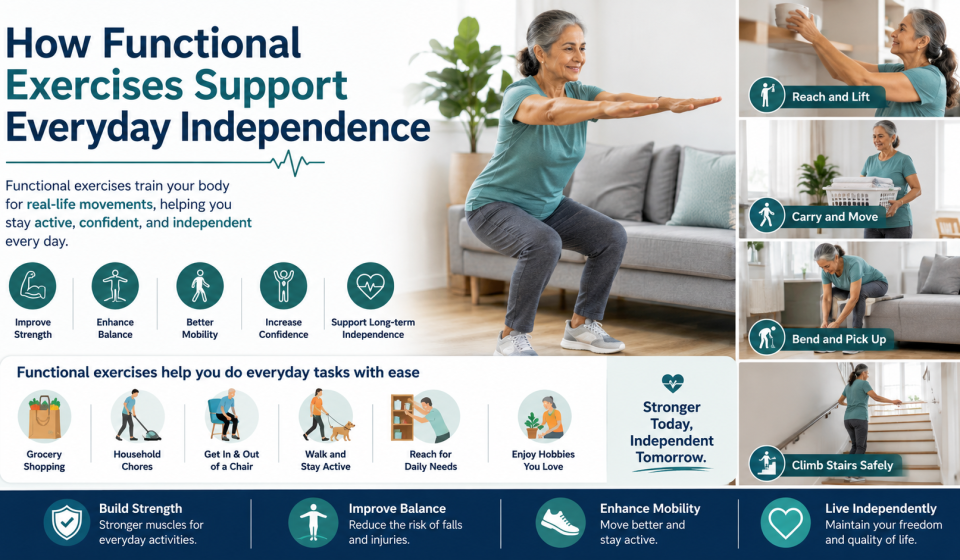
Functional exercises are becoming increasingly important for people who want to maintain mobility, strength, and independence throughout life. Unlike exercises that focus only on isolated muscles, functional exercises are designed around movements that people commonly use in everyday life, such as standing from a chair, climbing stairs, reaching for objects, carrying groceries, walking, bending, and maintaining balance. By practicing these movement patterns, individuals can build physical abilities that directly support daily activities and overall quality of life.
Everyday independence depends on more than simply being physically active. A person needs sufficient muscle strength, balance, flexibility, coordination, endurance, and confidence to perform routine tasks safely. Regular physical activity can improve physical function and make activities of daily living easier, while strength and balance exercises can support independent living and reduce the risk of falls. The Centers for Disease Control and Prevention (CDC) and National Institute on Aging (NIA) both highlight the connection between physical activity, functional ability, and independence, particularly among older adults.
What Are Functional Exercises?
Functional exercises are movements that train the body to perform activities similar to those used in everyday life.
Examples include:
- Squatting
- Sitting and standing
- Stepping
- Walking
- Reaching
- Bending
- Lifting
- Carrying
- Pushing
- Pulling
- Rotating
- Balancing
The main goal is not simply to make a particular muscle stronger. Instead, functional exercise aims to improve how different muscles and body systems work together during practical movements.
For example, a squat can help strengthen the muscles needed to stand up from a chair. Step-up exercises can develop strength and coordination needed for climbing stairs. Carrying exercises can prepare the body for tasks such as carrying shopping bags or household items.
Why Everyday Independence Matters
Independence allows people to participate in daily activities without unnecessary assistance.
Simple tasks such as:
- Getting out of bed
- Dressing
- Preparing meals
- Walking around the home
- Taking a shower
- Climbing stairs
- Shopping
- Cleaning
- Carrying objects
- Getting into or out of a vehicle
can require a combination of strength, balance, flexibility, and coordination.
When physical ability decreases, these tasks may become more difficult. Functional exercises can help maintain the physical abilities needed to perform them.
The NIA notes that physical activity can improve physical function, making everyday tasks such as household chores, getting into or out of a bed or chair, and moving around the neighborhood easier.
Functional Exercise vs Traditional Exercise
Traditional exercise may focus on specific fitness goals, such as increasing muscle size, improving cardiovascular endurance, or developing flexibility.
Functional exercise takes a slightly different approach.
Instead of asking only:
“Which muscle am I training?”
functional training also asks:
“Which everyday movement am I improving?”
For example, a leg extension primarily targets the muscles that straighten the knee, while a sit-to-stand movement involves multiple muscles and joints working together in a movement that directly resembles an everyday task.
Both types of exercise can be valuable, but functional exercises have a particularly practical connection to daily activities.
How Functional Exercises Improve Leg Strength
Strong legs are essential for independence.
Many everyday movements require leg strength, including:
- Standing
- Walking
- Climbing stairs
- Getting out of a chair
- Getting into a car
- Maintaining balance
- Carrying objects while walking
Functional exercises such as squats, sit-to-stands, step-ups, and supported lunges can help develop lower-body strength.
Stronger legs can make common movements feel more manageable.
The Importance of Sit-to-Stand Exercises
The sit-to-stand movement is one of the simplest examples of functional exercise.
A person repeatedly moves from a seated position to standing and then returns to sitting.
This movement involves:
- Thigh muscles
- Hip muscles
- Core muscles
- Balance
- Coordination
It closely resembles a movement people perform many times throughout the day.
A person who struggles to rise from a chair may benefit from appropriately modified strength and functional training under professional guidance.
Functional Exercises and Balance
Balance is essential for safe movement.
Everyday situations often require the body to adjust quickly.
For example, a person may need to:
- Step over an object
- Turn around
- Walk on an uneven surface
- Reach for something
- Change direction
- Move from sitting to standing
Balance exercises can improve the body’s ability to control these movements.
The CDC recommends that older adults include balance activities as part of regular physical activity, along with aerobic and muscle-strengthening activities.
Functional Exercise and Fall Prevention
Falls can affect mobility, confidence, and independence.
Improving strength and balance can help reduce fall risk.
The CDC states that physical activity among older adults can reduce the risk of falling, while multicomponent activities that include strength and balance can improve physical function.
Functional exercises can train the body to respond to everyday challenges rather than only performing movements in a controlled exercise environment.
Building Stronger Core Muscles
The core includes muscles around the abdomen, back, pelvis, and hips.
A strong core supports many everyday movements.
For example, the core contributes to:
- Standing upright
- Walking
- Bending
- Lifting
- Turning
- Carrying
- Reaching
Functional exercises often involve the core naturally because the body must stabilize itself while moving.
Exercises should be selected according to individual ability and health status.
Functional Exercises for Better Mobility
Mobility refers to the ability to move the body effectively.
Good mobility can make activities such as walking, reaching, bending, and changing positions easier.
Functional mobility exercises may include:
- Controlled walking
- Step-ups
- Sit-to-stands
- Supported squats
- Gentle reaching
- Direction changes
- Heel-to-toe walking
- Controlled stepping
Improved mobility can help people remain active and participate in daily activities.
The Role of Flexibility
Strength alone is not enough for functional independence.
Flexibility allows joints and muscles to move through appropriate ranges of motion.
Limited flexibility can make activities such as:
- Putting on shoes
- Reaching overhead
- Turning around
- Bending down
- Getting dressed
more challenging.
Functional exercise programs often combine mobility and flexibility work with strength and balance training.
Functional Exercises and Coordination
Coordination allows different parts of the body to work together.
Everyday activities often involve several movements simultaneously.
For example, carrying groceries while walking requires:
- Leg movement
- Arm control
- Grip strength
- Balance
- Postural control
- Visual awareness
Functional exercises can involve multiple body parts at once and therefore provide opportunities to practice coordinated movement.
Improving Grip and Carrying Ability
Grip strength is often overlooked when discussing independence.
However, many daily activities require the hands to hold, carry, pull, or manipulate objects.
Examples include:
- Carrying grocery bags
- Opening containers
- Holding cooking utensils
- Carrying laundry
- Moving household items
- Using tools
Appropriately designed resistance exercises can help strengthen the hands, forearms, and upper body.
Functional Exercise and Stair Climbing
Stair climbing requires significant lower-body strength, balance, coordination, and cardiovascular ability.
Step-up exercises can mimic some aspects of stair climbing.
A basic step-up involves stepping onto a stable platform and returning to the starting position.
However, people with balance problems or medical conditions should choose exercises appropriate for their abilities and may benefit from professional guidance.
Functional Exercise and Walking
Walking is one of the most important everyday activities.
It is used for:
- Moving around the home
- Going shopping
- Visiting friends
- Traveling
- Going to work
- Participating in community activities
Functional exercise can support walking by improving leg strength, balance, coordination, and endurance.
The CDC recommends aerobic activity alongside muscle-strengthening and balance activities for older adults.
Functional Exercises Can Support Confidence
Physical ability and confidence are closely connected.
When someone feels physically capable, they may be more willing to participate in activities.
Someone who has difficulty climbing stairs may begin avoiding stairs.
Someone who feels unstable while walking may reduce outdoor activities.
Appropriate exercise can gradually improve physical capacity and confidence.
This does not mean that exercise eliminates every limitation, but it can help individuals work toward their personal functional goals.
Functional Training After Reduced Activity
Periods of inactivity can occur because of illness, injury, hospitalization, travel, or lifestyle changes.
After a period of inactivity, strength and endurance may decline.
Returning to activity should generally be gradual and appropriate to the individual’s health and physical condition.
The CDC advises people who have taken a break from activity to restart at a lower level and gradually work back toward their previous activity level.
Functional Exercises for Older Adults
Functional exercise can be especially valuable for older adults because maintaining independence is often a major health goal.
The CDC recommends that adults aged 65 and older include aerobic activity, muscle-strengthening activities, and balance activities each week.
The NIA also highlights physical activity as a way to maintain functional ability and independent living.
A functional exercise program for an older adult might include:
- Sit-to-stands
- Supported squats
- Step-ups
- Walking
- Balance exercises
- Light resistance training
- Reaching exercises
- Carrying light objects
The exact exercises should depend on the person’s ability, health conditions, and goals.
Functional Exercise for People With Disabilities
Functional exercise is not limited to people without disabilities.
People living with disabilities may also benefit from physical activity adapted to their abilities.
The CDC notes that people with chronic health conditions or disabilities can be physically active and that regular physical activity can support daily living activities and independence.
Exercise may need to be modified.
Examples include:
- Seated exercises
- Supported standing exercises
- Resistance-band exercises
- Wheelchair-based movements
- Assisted balance activities
- Adapted walking
- Water-based activities
A healthcare professional or qualified exercise professional can help determine appropriate modifications.
Functional Exercise for People With Chronic Conditions
Chronic conditions do not automatically mean that exercise should be avoided.
The CDC states that people with chronic health conditions and disabilities can benefit from physical activity, although activity may need to be adjusted to individual abilities and health circumstances.
People with chronic conditions should discuss exercise limitations with their healthcare professional when appropriate.
Home-Based Functional Exercises
Functional exercises can often be performed at home with minimal equipment.
Examples include:
Chair Sit-to-Stand
Stand up from a stable chair and slowly sit back down.
This movement trains the muscles used for everyday transfers.
Supported Heel Raises
Hold a stable surface and gently raise the heels before lowering them.
This can help strengthen the lower legs.
Step-Ups
Use a stable, secure step and carefully step up and down.
This should only be performed if appropriate for the individual’s balance and ability.
Wall Push-Ups
Stand facing a wall and perform controlled push movements.
This can help strengthen the upper body.
Supported Balance Practice
Hold a stable surface while practicing controlled weight shifting or other balance movements recommended by a professional.
Safety should always come first.
Why Progression Matters
Functional exercise should not necessarily remain at the same difficulty level forever.
As strength and confidence improve, exercises may gradually become more challenging.
Progression might involve:
- More repetitions
- Slightly greater resistance
- More controlled movement
- Increased duration
- More complex movement patterns
- Reduced support when safe
Progression should be gradual rather than sudden.
Why Technique Is Important
Correct technique matters because functional exercises involve multiple joints and muscles.
Poor technique may reduce the effectiveness of an exercise or increase strain.
Important principles include:
- Controlled movement
- Stable positioning
- Appropriate range of motion
- Proper breathing
- Suitable resistance
- Safe environment
People who are unsure about technique should consider working with a qualified professional.
Functional Exercise and Daily Household Tasks
Household activities can themselves involve functional movement.
Examples include:
- Carrying groceries
- Gardening
- Cleaning
- Laundry
- Cooking
- Walking while shopping
- Moving light objects
The CDC notes that activities such as gardening, carrying groceries, and household activities can contribute to physical activity.
However, household activity should not automatically replace a structured exercise program when specific strength, balance, or rehabilitation goals exist.
Functional Exercise and Quality of Life
Physical independence can influence quality of life.
When people can perform everyday activities more comfortably, they may have greater opportunities to:
- Socialize
- Travel
- Participate in hobbies
- Work
- Shop independently
- Spend time outdoors
- Help family members
Physical activity also has broader health benefits, including benefits related to cardiovascular health, mental health, sleep, and chronic disease prevention.
Functional Exercise and Mental Well-Being
Physical activity can support mental well-being.
The CDC reports that regular physical activity provides benefits related to brain health and can reduce the risk of depression among older adults.
Being physically active may also provide opportunities for social interaction and participation in enjoyable activities.
Creating a Functional Exercise Routine
A practical routine should focus on movements that matter to the individual.
Start by identifying challenging daily activities.
For example:
- “I struggle to get up from a chair.”
- “I have difficulty climbing stairs.”
- “I feel unsteady when turning.”
- “Carrying groceries is difficult.”
- “I get tired while walking.”
The exercise program can then focus on the physical abilities related to those tasks.
A Simple Functional Fitness Framework
A balanced program can include:
Strength: Sit-to-stands, squats, resistance exercises
Balance: Supported balance activities, controlled stepping
Mobility: Gentle joint movement and stretching
Endurance: Walking or other appropriate aerobic activity
Coordination: Controlled multi-step movements
Functional practice: Activities that resemble personal daily tasks
This approach can make exercise more meaningful and practical.
How Often Should Functional Exercises Be Done?
The appropriate frequency depends on the person’s health, fitness, age, goals, and exercise program.
For adults aged 65 and older, the CDC recommends at least two days each week of muscle-strengthening activity and regular balance activities, alongside aerobic activity.
WHO guidelines also recommend regular physical activity and emphasize multicomponent activity involving functional balance and strength for older adults.
People who are inactive should start gradually rather than trying to complete a demanding program immediately.
Functional Exercise Should Be Personalized
There is no single functional exercise routine that works for everyone.
A healthy young adult may need a different program from:
- An older adult
- Someone recovering from an injury
- Someone with arthritis
- Someone with a neurological condition
- Someone with limited mobility
- Someone recovering from surgery
Exercise selection should reflect individual needs.
Safety Considerations
Functional exercise should be performed in a safe environment.
Helpful precautions include:
- Use stable equipment
- Keep the exercise area clear
- Wear appropriate footwear
- Start with manageable movements
- Avoid sudden increases in intensity
- Use support when necessary
- Stop if something feels unsafe
- Follow professional recommendations when recovering from illness or injury
People with medical conditions should discuss appropriate activity levels with their healthcare provider when necessary.
When Professional Guidance May Help
A physical therapist, physiotherapist, or qualified exercise professional may be helpful when a person has:
- Significant mobility limitations
- Recurrent falls
- Severe weakness
- Recent surgery
- Major injury
- Neurological conditions
- Balance problems
- Chronic health conditions affecting exercise
Professional assessment can help identify specific functional limitations and appropriate exercises.
Measuring Functional Progress
Progress does not always have to be measured by weight or appearance.
Functional progress can include:
- Standing from a chair more easily
- Walking farther
- Climbing stairs with greater confidence
- Carrying groceries more comfortably
- Maintaining balance longer
- Performing household tasks independently
- Needing less assistance
- Recovering more quickly after activity
These improvements can be meaningful indicators of increased independence.
Why Small Improvements Matter
Functional progress often develops gradually.
An individual may not notice major changes every day.
However, small improvements can accumulate.
For example:
Being able to stand for a little longer can eventually make cooking easier.
Walking slightly farther can increase community mobility.
Improved balance can make turning and changing direction more comfortable.
Small gains can contribute to greater independence over time.
Functional Exercises and Long-Term Independence
Maintaining independence is not only about being able to exercise.
The larger goal is being able to participate in life.
Functional exercises can help maintain physical abilities needed for everyday activities.
Regular physical activity is associated with longer independent living and better physical function, particularly among older adults.
The Importance of Consistency
Functional exercise works best as part of a consistent lifestyle.
A short, manageable routine performed regularly may be more sustainable than an intense routine performed occasionally.
Consistency can help maintain:
- Strength
- Balance
- Mobility
- Endurance
- Coordination
- Confidence
The goal should be sustainable movement rather than temporary effort.
Source
https://www.cdc.gov/physical
https://www.nia.nih.gov/health
https://www.cdc.gov/physical
Conclusion
Functional exercises are valuable because they connect physical fitness with real-life movement. Instead of focusing only on isolated muscles or traditional fitness measurements, functional training helps develop the strength, balance, mobility, coordination, and endurance needed for everyday activities. Movements such as sitting and standing, stepping, walking, reaching, lifting, and carrying can directly relate to tasks people perform at home, at work, and in the community.
Maintaining these abilities can be especially important as people age. The CDC reports that regular physical activity can help older adults live independently longer, while the National Institute on Aging explains that physical activity can improve physical function and make daily tasks easier.
A successful functional exercise program should be personalized, gradual, safe, and consistent. People should select activities that match their abilities and goals rather than comparing themselves with others. Individuals with significant health conditions, injuries, balance problems, or mobility limitations may benefit from professional guidance before beginning or changing an exercise program.
Ultimately, the purpose of functional exercise is not simply to become stronger in the gym. It is to make everyday movement easier and help people continue doing the activities that matter to them. Whether the goal is getting out of a chair, climbing stairs, carrying groceries, walking around the neighborhood, or participating in hobbies, functional fitness can be an important part of maintaining confidence, mobility, and independence.
FAQ
1. What are functional exercises?
Functional exercises are movements designed to improve physical abilities used in everyday activities, such as standing, walking, lifting, carrying, reaching, bending, and maintaining balance.
2. How do functional exercises support independence?
They can improve strength, balance, mobility, coordination, and endurance, which may make everyday tasks easier to perform without assistance.
3. What is an example of a functional exercise?
A sit-to-stand exercise is a simple example because it closely resembles the everyday movement of getting up from a chair.
4. Can functional exercises help older adults?
Yes. Regular physical activity can support physical function and independent living among older adults. The CDC recommends a combination of aerobic, muscle-strengthening, and balance activities for adults aged 65 and older.
5. Can functional exercises reduce fall risk?
Strength and balance activities can help improve physical function and reduce the risk of falls, particularly among older adults.
6. Can functional exercises be done at home?
Yes. Many functional exercises can be performed at home using simple equipment such as a stable chair, resistance bands, or household objects when appropriate.
7. Are functional exercises suitable for people with disabilities?
Physical activity can benefit people with disabilities, but exercises may need to be adapted according to individual abilities and health conditions.
8. Can people with chronic conditions do functional exercises?
Many people with chronic health conditions can be physically active. However, the exercise program may need to be adjusted to individual health needs and abilities.
9. How often should functional exercises be performed?
Frequency depends on the individual’s goals and health. For older adults, CDC recommendations include muscle-strengthening activities at least two days per week and regular balance activities along with aerobic activity.
10. What muscles do functional exercises work?
Functional exercises can work multiple muscle groups at the same time, including the legs, hips, back, abdomen, shoulders, arms, and core.
11. Can functional exercise improve walking?
It can support walking ability by developing strength, balance, coordination, mobility, and endurance. The CDC’s physical activity guidance recognizes improvements in walking, gait, balance, strength, and activities of daily living as potential benefits of physical activity.
12. Can functional exercises improve balance?
Yes. Balance-focused exercises can help improve the body’s ability to control movement and maintain stability.
13. Why is leg strength important for independence?
Leg strength is needed for many everyday tasks, including standing, walking, climbing stairs, getting out of a chair, and maintaining balance.
14. Can functional exercise improve quality of life?
Regular physical activity can improve physical function and support participation in everyday activities, which can contribute to independence and quality of life.
15. Should beginners start with difficult functional exercises?
No. Beginners should generally start with movements appropriate for their current abilities and gradually increase difficulty as they become stronger and more comfortable.
16. Is professional guidance necessary?
Not everyone requires professional supervision, but professional guidance can be especially useful for people with significant mobility limitations, balance problems, injuries, recent surgery, or medical conditions affecting exercise.
17. Can household activities count as physical activity?
Yes. Activities such as gardening, carrying groceries, and some household chores can contribute to physical activity. However, specific functional or rehabilitation goals may still require structured exercises.
18. How can I measure functional improvement?
Look for improvements in everyday abilities, such as standing more easily, walking farther, climbing stairs, carrying objects, maintaining balance, or performing household tasks with less assistance.
19. Is consistency more important than intensity?
For long-term functional ability, a sustainable routine that can be performed consistently is generally more practical than occasional high-intensity exercise.
20. What is the main goal of functional exercise?
The main goal is to improve physical abilities that support meaningful everyday activities, helping people move more safely, confidently, and independently.