How Recovery Goals Change During Different Rehabilitation Stages: A Complete Guide to Progress, Independence, and Long-Term Recovery

Learn how rehabilitation goals change from early recovery to long-term independence, including mobility, strength, daily activities, confidence, work, and quality of life.
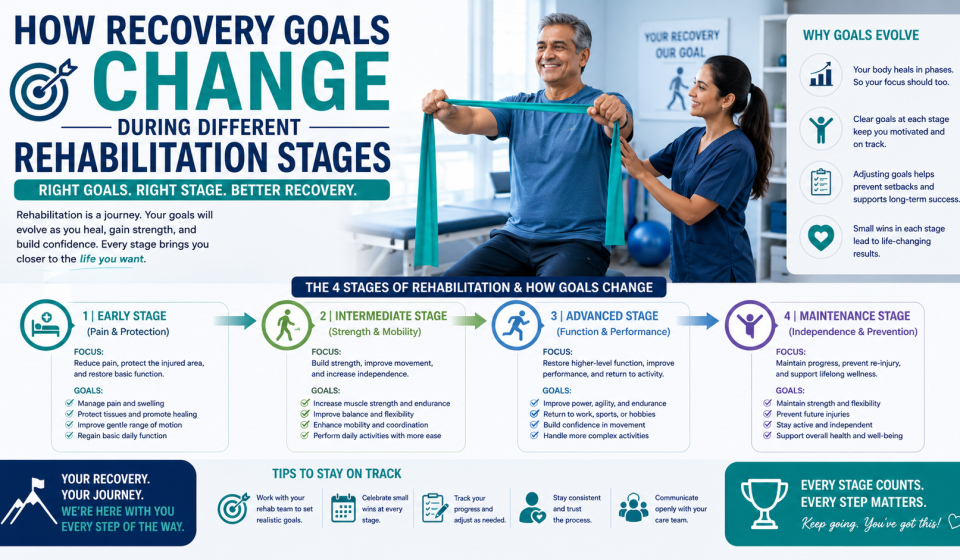
Understanding how recovery goals change can make the rehabilitation process easier to understand for patients and families. A goal that seems small at the beginning, such as sitting independently or transferring safely from a bed to a chair, can become the foundation for larger goals such as walking, preparing meals, returning to school, going back to work, or participating in community activities. Rehabilitation is person-centred, which means goals are developed around an individual’s abilities, needs, preferences, environment, and priorities.
What Are Rehabilitation Recovery Goals?
Recovery goals are specific outcomes that a person and their rehabilitation team work toward during treatment.
Goals may relate to:
- Movement
- Strength
- Balance
- Pain management
- Communication
- Self-care
- Cognitive skills
- Emotional well-being
- Work
- Education
- Family responsibilities
- Social participation
- Independence
The exact goals depend on the person’s condition and circumstances.
A person recovering from a broken leg may prioritize walking, while someone recovering from a stroke may have goals involving movement, speech, memory, and self-care.
Why Rehabilitation Goals Change Over Time
Recovery is not usually a single event.
As a person improves, their abilities and challenges can change.
For example, someone may initially require assistance to stand. Later, they may be able to stand independently but still have difficulty walking outside. Eventually, they may be able to walk but need to rebuild endurance before returning to work.
Because the person’s needs change, rehabilitation goals should also be reviewed and adjusted.
WHO explains that rehabilitation professionals assess functioning, establish goals together with the individual, design appropriate interventions, and evaluate whether those goals are being achieved.
Stage 1: Initial Assessment and Stabilization
The first stage of rehabilitation often begins after the person’s medical condition has been assessed and stabilized.
At this stage, the primary goals may include:
- Understanding the person’s functional limitations
- Identifying immediate safety concerns
- Preventing complications
- Maintaining basic movement where appropriate
- Managing symptoms
- Establishing realistic short-term goals
- Determining what assistance is required
The focus is generally on what the person can safely do now rather than immediately returning to their previous lifestyle.
Early Recovery Goals
Early recovery goals are often simple but extremely important.
Examples may include:
- Sitting safely
- Changing position in bed
- Standing with assistance
- Transferring between surfaces
- Beginning gentle movement
- Managing basic self-care
- Improving breathing when appropriate
- Communicating basic needs
- Maintaining safe positioning
These goals may appear modest, but they can create the foundation for later independence.
Preventing Complications
Another important early rehabilitation goal is preventing complications associated with reduced movement or impaired functioning.
Depending on the condition, rehabilitation may address:
- Muscle weakness
- Joint stiffness
- Loss of mobility
- Balance problems
- Reduced endurance
- Pressure-related complications
- Reduced independence
WHO notes that rehabilitation may include interventions such as exercise training, environmental modification, education, assistive products, and other approaches according to individual needs.
Stage 2: Building Basic Function
Once a person becomes medically stable and can participate more actively, rehabilitation often begins focusing more strongly on functional improvement.
Goals may include:
- Improving strength
- Increasing range of motion
- Improving balance
- Practicing transfers
- Beginning or improving walking
- Developing coordination
- Improving communication
- Performing basic self-care
The goal is to help the person become more capable of participating in everyday activities.
From Assisted Movement to Independent Movement
One major change during rehabilitation is the gradual reduction of assistance.
A person may progress from:
- Complete assistance
- Significant assistance
- Partial assistance
- Supervision
- Independent performance
The pace varies considerably.
Progress should be measured according to the person’s own abilities rather than compared directly with another patient.
Stage 3: Improving Activities of Daily Living
As physical or cognitive abilities improve, rehabilitation goals often become more practical.
Activities of daily living may include:
- Dressing
- Bathing
- Grooming
- Eating
- Toileting
- Moving around the home
- Preparing simple meals
Occupational therapy can be particularly important at this stage because it focuses on helping people participate in meaningful everyday activities.
WHO emphasizes that rehabilitation can help people become more independent in everyday activities and participate in meaningful life roles.
Improving Mobility
Mobility goals can gradually become more challenging.
A person may move from:
- Sitting
- Standing
- Transferring
- Taking a few steps
- Walking short distances
- Walking longer distances
- Managing stairs
- Moving safely outdoors
The goal is not always simply to increase walking distance.
Safe and functional movement is often more important than speed or distance alone.
Stage 4: Building Strength and Endurance
Once basic movement becomes easier, rehabilitation may focus more on physical capacity.
Goals can include:
- Increasing muscle strength
- Improving cardiovascular endurance
- Improving balance
- Increasing walking tolerance
- Reducing fatigue during daily activities
- Performing household tasks
This stage can help prepare people for more demanding activities.
Why Endurance Becomes More Important
Someone may be able to walk independently but still become exhausted after a short period.
In such cases, walking ability alone does not represent complete functional recovery.
Rehabilitation goals may therefore shift toward:
- Walking farther
- Standing longer
- Completing multiple household tasks
- Managing activity without excessive fatigue
- Participating in longer daily routines
This demonstrates why rehabilitation goals need to evolve as function improves.
Stage 5: Returning to Real-Life Activities
Later rehabilitation increasingly focuses on activities that matter in the person’s actual life.
Goals might include:
- Shopping
- Cooking
- Using public transportation
- Attending social events
- Caring for family
- Returning to school
- Returning to work
- Participating in hobbies
This stage connects clinical improvements with real-world independence.
Returning Home Safely
For many people, returning home is an important rehabilitation milestone.
However, returning home safely requires more than being medically stable.
The rehabilitation team may consider:
- Mobility
- Transfers
- Bathroom safety
- Stairs
- Ability to prepare food
- Ability to manage medications
- Availability of family support
- Need for assistive equipment
Home modifications may sometimes be recommended.
WHO specifically notes that modifying a person’s environment can improve safety and independence and reduce risks such as falls.
Stage 6: Returning to Work or Education
For working-age adults and students, rehabilitation goals may eventually focus on returning to professional or educational responsibilities.
Work-related goals may include:
- Improving physical endurance
- Practicing job-specific movements
- Improving concentration
- Developing communication skills
- Managing fatigue
- Using adaptive equipment
- Gradually increasing work responsibilities
Returning to work may happen gradually rather than all at once.
WHO recognizes rehabilitation’s role in helping people participate in or return to work and employment.
Cognitive Recovery Goals
Not all rehabilitation goals are physical.
Some health conditions can affect:
- Memory
- Attention
- Planning
- Problem-solving
- Decision-making
- Concentration
Cognitive rehabilitation may therefore become an important part of recovery.
Early goals might involve following simple instructions, while later goals may involve managing schedules, completing work tasks, or safely handling complex activities.
Communication Goals
People recovering from certain neurological conditions may experience communication difficulties.
Early goals may focus on:
- Expressing basic needs
- Understanding simple instructions
- Producing words
- Improving speech clarity
Later goals may focus on:
- Holding conversations
- Communicating at work
- Participating socially
- Using communication devices when appropriate
Emotional and Psychological Goals
Recovery is not only physical.
A person may experience:
- Frustration
- Anxiety
- Fear
- Reduced confidence
- Sadness
- Stress
- Concern about the future
Psychological support may therefore become part of the rehabilitation process.
A later-stage goal might be rebuilding confidence in everyday activities rather than simply improving physical measurements.
Stage 7: Community Participation
One of the most meaningful later-stage goals is participation in the community.
This may include:
- Meeting friends
- Visiting family
- Shopping independently
- Attending events
- Using public transportation
- Returning to hobbies
- Participating in recreational activities
WHO explains that rehabilitation can support participation in education, work, recreation, and other meaningful roles.
Stage 8: Long-Term Independence
Long-term rehabilitation goals often focus on maintaining function.
Instead of asking only, “How much have I recovered?” the focus may become:
“How can I maintain my abilities and continue participating in everyday life?”
Long-term goals can include:
- Maintaining strength
- Preventing falls
- Continuing exercise
- Managing a chronic condition
- Using assistive equipment effectively
- Maintaining independence
- Preventing avoidable complications
Maintenance Goals Are Still Recovery Goals
Rehabilitation does not necessarily end when formal therapy sessions decrease.
Some people require ongoing strategies to maintain their progress.
These may include:
- Home exercises
- Regular physical activity
- Adaptive techniques
- Healthy lifestyle habits
- Follow-up appointments
- Assistive devices
Maintaining progress can be just as important as achieving the initial improvement.
How Goals Become More Specific
Rehabilitation goals often become more specific as a person progresses.
An early goal might be:
“Stand safely with assistance.”
A later goal could be:
“Stand independently for several minutes.”
An even later goal might be:
“Stand long enough to prepare a meal safely.”
The final goal is more connected to the person’s actual life.
Short-Term and Long-Term Goals
Rehabilitation commonly uses both short-term and long-term goals.
Short-term goals may focus on skills that can be developed in a relatively short period.
Long-term goals focus on broader functional outcomes.
For example:
Short-term goal:
Improve standing balance.
Long-term goal:
Walk safely around the home without assistance.
This structure helps make large recovery objectives more manageable.
Why Measuring Progress Matters
Measuring progress helps rehabilitation professionals determine whether an intervention is working.
Measurements may involve:
- Walking distance
- Strength
- Balance
- Range of motion
- Ability to complete daily activities
- Communication ability
- Cognitive performance
- Level of assistance required
However, numerical measurements are only part of the picture.
Being able to return to a meaningful activity can be a major achievement even if a specific physical measurement changes only slightly.
Goals Should Reflect the Person’s Priorities
A rehabilitation plan should not focus only on what professionals consider important.
The person’s own priorities matter.
For one person, walking independently may be the most important goal.
For another, the priority may be being able to play with children, return to work, cook independently, or participate in a favorite hobby.
WHO describes rehabilitation as highly person-centred, with interventions targeted to individual goals and preferences.
Family Goals Can Change Too
Family members may initially focus on safety and basic care.
As the person improves, family goals may shift toward:
- Encouraging independence
- Supporting community participation
- Helping with return to work
- Supporting exercise
- Reducing unnecessary dependence
Families can be valuable partners, but support should be balanced with the individual’s ability to perform tasks independently when safe.
The Role of Assistive Devices
Assistive devices can change what is possible during rehabilitation.
Examples include:
- Walking aids
- Wheelchairs
- Orthotic devices
- Prosthetic devices
- Communication equipment
- Adaptive utensils
Using an assistive device does not necessarily mean rehabilitation has failed.
Sometimes the device is what allows a person to achieve greater independence.
WHO includes assistive products and environmental modifications among rehabilitation approaches.
When Recovery Does Not Follow a Straight Line
Recovery can include periods of rapid improvement, slow progress, or temporary setbacks.
A person may improve in one area while experiencing difficulty in another.
For example, walking may improve while fatigue remains significant.
This does not necessarily mean rehabilitation has failed.
Goals may need to be adjusted based on current abilities and circumstances.
Adapting Goals After a Setback
A setback can require temporary changes to the rehabilitation plan.
The team may:
- Reduce exercise intensity
- Modify activities
- Focus on symptom management
- Introduce new strategies
- Reassess equipment
- Adjust timelines
The objective is to continue making safe progress rather than forcing the original plan.
Rehabilitation After Surgery
After surgery, goals may change as healing progresses.
Early goals may focus on:
- Pain management
- Safe movement
- Basic mobility
- Following medical precautions
Later goals may include:
- Restoring strength
- Improving range of motion
- Returning to household activities
- Resuming work
- Returning to recreational activities
The timeline varies depending on the procedure and individual recovery.
Rehabilitation After Stroke
Stroke rehabilitation often involves multiple areas of functioning.
Goals may include:
- Improving movement
- Improving balance
- Communication
- Swallowing
- Cognitive skills
- Self-care
- Walking
- Community participation
The goals may evolve substantially as abilities change.
Rehabilitation After Serious Illness
People recovering from serious illness may initially focus on basic endurance and daily function.
Later goals can include:
- Increasing activity tolerance
- Returning to household responsibilities
- Improving confidence
- Returning to work
- Resuming social activities
WHO notes that rehabilitation can be needed after acute or chronic health conditions and can support recovery and participation.
Rehabilitation for Older Adults
For older adults, rehabilitation may focus strongly on independence and safety.
Goals can include:
- Safe walking
- Fall prevention
- Self-care
- Home safety
- Strength
- Balance
- Community participation
Long-term goals may emphasize maintaining independence and preventing further functional decline.
The Role of the Rehabilitation Team
Different professionals may contribute to rehabilitation goals.
Depending on the person’s needs, the team may include:
- Physical therapists
- Occupational therapists
- Speech and language therapists
- Rehabilitation physicians
- Nurses
- Psychologists
- Prosthetists
- Orthotists
- Other healthcare professionals
WHO describes rehabilitation as a multidisciplinary service that may involve several types of health workers.
How Patients Can Participate in Goal Setting
Patients can actively contribute by explaining what activities matter most to them.
Useful questions include:
- What activities do I want to regain?
- What is most important for my independence?
- What are my biggest daily challenges?
- What would make me feel that I am improving?
- What activities do I want to return to?
- What barriers are preventing progress?
This information can help the rehabilitation team develop meaningful goals.
Setting Realistic Expectations
Recovery goals should be challenging enough to encourage progress but realistic enough to remain achievable.
Unrealistic expectations can create frustration.
Realistic goals allow people to recognize incremental improvements.
A goal such as “walk independently around the house” may be more useful than simply saying “get better.”
The Importance of Patience
Rehabilitation often requires repeated practice.
Progress may not always be visible from one day to the next.
Comparing progress over several weeks or months can provide a clearer picture.
Small improvements can accumulate into significant functional changes.
Why Independence Is More Than Physical Ability
Independence is not simply about muscle strength.
It may involve:
- Decision-making
- Confidence
- Communication
- Safety awareness
- Environmental support
- Assistive technology
- Ability to organize daily tasks
Rehabilitation therefore considers the person as a whole.
The Final Stage: Maintaining Meaningful Function
The final stage of rehabilitation is not necessarily about achieving perfect physical performance.
For many people, success means reaching a level of function that allows them to live as independently and meaningfully as possible.
This may include:
- Managing personal care
- Living safely at home
- Working
- Studying
- Spending time with family
- Participating socially
- Enjoying hobbies
The ultimate goal is meaningful participation in life.
Source
https://www.who.int/news
https://www.who.int/news
https://www.who.int
https://www.who.int/europe
Conclusion
Recovery goals naturally change during different stages of rehabilitation because a person’s abilities, challenges, and priorities change over time. Early rehabilitation may focus on safety, medical stability, basic movement, preventing complications, and completing simple activities. As the person becomes stronger and more capable, goals can shift toward mobility, self-care, endurance, communication, cognitive abilities, and independence. Later stages often focus on returning to work, education, family responsibilities, hobbies, social activities, and meaningful participation in the community. The World Health Organization emphasizes that rehabilitation is person-centred and designed around individual goals, preferences, functioning, and participation.
Successful rehabilitation is therefore not defined by one universal milestone. Progress looks different for every individual. Someone may measure success by walking independently, while another person may value being able to prepare a meal, communicate with family, return to work, or safely live at home. Goals should be regularly reviewed and adjusted as recovery progresses, and setbacks should be treated as opportunities to reassess rather than automatic signs of failure. With appropriate professional guidance, realistic goals, active participation, family support, and consistent practice, rehabilitation can help people maximize their functioning and build a more independent and meaningful life.
FAQ
1. Why do rehabilitation goals change over time?
Rehabilitation goals change because a person’s abilities and needs change during recovery. Early goals may focus on basic safety and movement, while later goals may focus on independence, work, education, and community participation.
2. What are common early rehabilitation goals?
Early goals may include safe positioning, sitting, standing, transferring, basic movement, symptom management, and preventing complications.
3. What are common long-term rehabilitation goals?
Long-term goals can include independent daily activities, safe mobility, returning to work or school, participating in hobbies, maintaining physical abilities, and improving quality of life.
4. Who decides rehabilitation goals?
Goals are generally developed collaboratively between the person receiving rehabilitation and the rehabilitation team. WHO emphasizes that rehabilitation is person-centred and should consider individual goals and preferences.
5. Can rehabilitation goals change after a setback?
Yes. Goals and treatment strategies can be adjusted when symptoms, abilities, medical conditions, or circumstances change.
6. Why are small rehabilitation goals important?
Small goals provide achievable steps toward larger outcomes. For example, improving sitting balance can become a foundation for standing, transferring, walking, and eventually greater independence.
7. Does rehabilitation only focus on physical recovery?
No. Rehabilitation can address movement, communication, cognition, self-care, psychological well-being, environmental barriers, and participation in work, education, and community life.
8. How long does rehabilitation take?
The duration varies according to the health condition, severity, individual goals, response to treatment, and available support. There is no single recovery timeline that applies to everyone.
9. Can rehabilitation goals include returning to work?
Yes. Returning to work can be an important rehabilitation goal when appropriate. Rehabilitation may address physical, cognitive, communication, endurance, and environmental requirements related to employment.
10. What is the ultimate goal of rehabilitation?
The overall goal is to optimize functioning, reduce disability, and help the person participate as independently and meaningfully as possible in everyday life.