
Learn why movement quality matters during physical rehabilitation and how proper movement patterns can support strength, mobility, balance, safety, and long-term recovery.
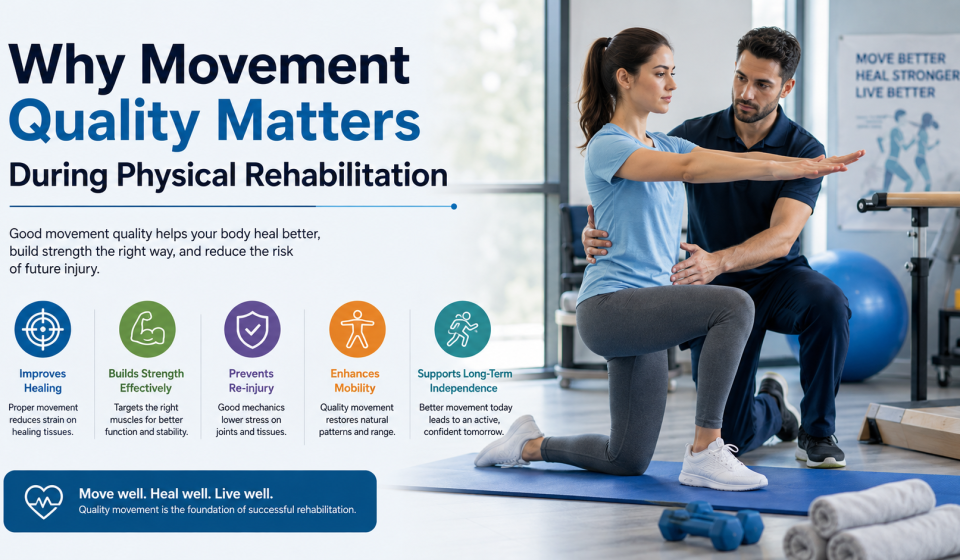
Physical rehabilitation is not simply about doing more exercises or becoming stronger. The way a person performs a movement can be just as important as the amount of exercise they complete. After an injury, surgery, illness, or period of reduced activity, the body may develop altered movement patterns because of pain, weakness, stiffness, fear, or changes in balance. Learning to move with better control can help a person gradually return to everyday activities and improve confidence during recovery.
Movement quality refers to how efficiently, safely, and appropriately a person performs a physical task. It can involve posture, coordination, balance, joint control, muscle activation, range of motion, and the ability to perform a movement without unnecessary strain. Rehabilitation is designed to optimize functioning and reduce disability, and the World Health Organization notes that it can help people become as independent as possible in everyday activities.
What Is Movement Quality?
Movement quality describes the characteristics of how the body performs a movement rather than simply whether the movement can be completed.
For example, two people may both be able to perform a squat, but their movement patterns may be very different.
Movement quality can involve:
- Posture
- Balance
- Coordination
- Joint mobility
- Muscle control
- Stability
- Timing
- Movement efficiency
- Body awareness
- Ability to control movement
During rehabilitation, healthcare professionals may assess these factors to understand how a person is moving and where additional support may be needed.
Why Movement Quality Matters After an Injury
An injury can change the way a person naturally moves.
Pain may cause someone to avoid putting weight on one side of the body. Muscle weakness may cause another part of the body to compensate. Reduced mobility can also change how a person walks, bends, reaches, or climbs stairs.
These adaptations may be useful temporarily because they can help a person protect a painful area. However, as recovery progresses, rehabilitation may focus on gradually restoring more efficient movement patterns.
Movement Quality and Pain
Pain can significantly influence movement.
When a person experiences pain, they may unconsciously change their posture or movement to avoid discomfort. This can affect how other joints and muscles are used.
For example, someone with knee discomfort may change the way they walk. Someone with shoulder pain may move the arm differently to avoid a painful position.
Pain should not automatically be ignored during rehabilitation. Instead, it is important to understand the cause and follow appropriate professional guidance.
A rehabilitation professional can help determine which movements are appropriate and how exercises should be modified.
Movement Quality and Muscle Coordination
Good movement requires different muscles to work together at the right time.
This coordination is important for activities such as:
- Walking
- Running
- Reaching
- Lifting
- Standing
- Sitting
- Climbing stairs
- Turning
- Carrying objects
After injury or prolonged inactivity, coordination may be temporarily reduced.
Rehabilitation exercises can provide controlled opportunities to practice movement and gradually improve coordination.
The Role of Balance
Balance is an important part of movement quality.
A person may have enough strength to stand or walk but still have difficulty controlling their body during movement.
Balance contributes to:
- Walking safely
- Changing direction
- Stepping over obstacles
- Getting out of a chair
- Climbing stairs
- Reaching
- Maintaining stability on uneven surfaces
The WHO recommends regular physical activity and, for older adults, varied multicomponent activity that emphasizes functional balance and strength to improve functional capacity and help prevent falls.
Movement Quality and Joint Mobility
Joints need an appropriate amount of movement for many everyday activities.
Reduced mobility can affect movement patterns.
For example, limited ankle mobility may influence walking or squatting. Reduced shoulder mobility can make reaching overhead difficult.
Rehabilitation may include mobility exercises to help restore appropriate movement.
However, more range of motion is not automatically better. The goal is to achieve movement that is appropriate for the individual’s condition and functional needs.
Why Strength Alone Is Not Enough
Strength is an important component of rehabilitation, but strength without adequate control may not fully restore functional movement.
A person may become stronger while still having difficulty controlling movement.
For example, someone may be able to lift a heavier weight but struggle to:
- Walk comfortably
- Maintain balance
- Control a step-down
- Reach safely
- Change direction
This is why rehabilitation programs often combine strength, mobility, balance, coordination, and functional training.
WHO recommends muscle-strengthening activities for adults as part of regular physical activity and emphasizes gradual progression according to individual ability.
Movement Quality and Everyday Activities
The ultimate purpose of many rehabilitation programs is to improve real-life function.
Exercises may prepare people for activities such as:
- Getting out of bed
- Standing from a chair
- Walking
- Climbing stairs
- Dressing
- Cooking
- Carrying groceries
- Returning to work
- Participating in recreation
WHO describes rehabilitation as a process that can support independence in everyday activities, education, work, recreation, and other meaningful life roles.
Therefore, movement quality should be connected to the tasks a person actually needs to perform.
The Importance of Controlled Movement
Controlled movement means being able to start, perform, and finish an activity with appropriate coordination.
For example, when performing a sit-to-stand exercise, control is needed not only to stand up but also to lower the body safely back into the chair.
Controlled movement can help a person understand how their body responds to different positions and physical demands.
Movement Quality During Walking Rehabilitation
Walking is one of the most common goals of rehabilitation.
A walking pattern may be affected by:
- Pain
- Weakness
- Balance problems
- Joint stiffness
- Reduced endurance
- Neurological changes
- Fear of falling
Rehabilitation may focus on improving specific components of walking rather than simply increasing walking distance.
These components may include:
- Step length
- Foot placement
- Weight transfer
- Balance
- Walking speed
- Coordination
- Direction changes
The appropriate approach depends on the person’s health condition and functional goals.
Movement Quality After Surgery
Surgery can temporarily change movement.
Pain, swelling, weakness, restrictions, or fear of movement can affect how a person performs everyday tasks.
A rehabilitation plan may gradually reintroduce movement while respecting medical restrictions.
The timing and type of exercise should depend on the procedure and the individual’s recovery.
Following the healthcare professional’s instructions is particularly important after surgery.
Movement Quality and Body Awareness
Body awareness refers to understanding where the body is positioned and how it is moving.
This can be especially important during rehabilitation.
A person may need to learn how to:
- Shift weight evenly
- Position a joint
- Maintain posture
- Control a movement
- Recognize compensatory patterns
- Adjust movement according to the task
Practicing controlled movements can help improve awareness of physical positioning.
Why Slow Movement Can Be Useful
Fast movement is not always better.
During rehabilitation, slower movement can allow a person to focus on:
- Alignment
- Control
- Breathing
- Balance
- Joint position
- Muscle engagement
Once a movement can be performed safely and consistently, speed may gradually increase when appropriate.
Progression Should Be Gradual
Rehabilitation usually involves progressive challenges.
A person may begin with a simple movement and gradually progress to more demanding activities.
Progression may involve:
- More repetitions
- Increased resistance
- Greater range of motion
- More complex movements
- Reduced support
- Increased walking distance
- More challenging balance tasks
- Sport-specific activities
WHO recommends that people who are not physically active start with small amounts and gradually increase frequency, intensity, and duration over time.
Movement Quality and Fatigue
Fatigue can affect movement quality.
As a person becomes tired, they may lose coordination, posture, balance, or control.
This is important during rehabilitation because completing more repetitions is not necessarily beneficial if movement quality deteriorates significantly.
A rehabilitation professional can help determine when an exercise should be modified or stopped.
The Role of Physical Therapists
Physical therapists play an important role in assessing and improving movement.
They may evaluate:
- Strength
- Range of motion
- Balance
- Walking
- Posture
- Coordination
- Functional activities
- Pain
- Movement patterns
The American Physical Therapy Association maintains a library of clinical practice guidelines intended to support evidence-based physical therapist practice and clinical decision-making.
A physical therapist can also modify exercises according to the individual’s progress.
Movement Quality and Confidence
Physical limitations can affect confidence.
A person who has fallen or experienced a painful injury may become afraid of certain movements.
This fear can sometimes lead to reduced activity.
A carefully structured rehabilitation program can provide opportunities to practice movements in a controlled environment.
As movement becomes more predictable and manageable, confidence may improve.
Avoiding Unnecessary Compensation
Compensation occurs when the body uses another movement or body part to complete a task.
Some compensation is natural and can help a person function while recovering.
However, persistent or unnecessary compensation may indicate that a movement needs to be reassessed.
For example, a person may lean heavily to one side while standing from a chair because one leg is weaker.
A rehabilitation professional can determine whether the movement should be modified.
Functional Training Improves Real-Life Movement
Functional training focuses on movements that relate to everyday activities.
Examples include:
- Squatting
- Step-ups
- Sit-to-stand
- Carrying
- Reaching
- Walking
- Turning
- Balance exercises
The purpose is to bridge the gap between isolated exercises and real-world activities.
This can be particularly valuable when the ultimate goal is returning to independence.
Movement Quality in Older Adults
Movement quality is especially important for older adults because maintaining mobility and independence can have a major impact on daily life.
Age-related changes in strength, balance, mobility, and reaction time may affect movement.
Regular physical activity can help support physical function.
WHO recommends multicomponent physical activity that includes functional balance and strength for older adults, particularly to enhance functional capacity and help prevent falls.
Movement Quality After Neurological Conditions
Neurological conditions can affect movement, coordination, balance, and muscle control.
Examples include:
- Stroke
- Parkinson’s disease
- Multiple sclerosis
- Brain injury
- Spinal cord conditions
Rehabilitation may focus on improving functional movement and independence.
WHO notes that physical exercise training can be used in rehabilitation to improve muscle strength, voluntary movement, and balance in people with conditions such as stroke and Parkinson disease.
Movement Quality and Returning to Work
Returning to work may require specific movement skills.
Depending on the job, a person may need to:
- Lift objects
- Stand for long periods
- Walk frequently
- Climb stairs
- Use tools
- Sit for extended periods
- Perform repetitive movements
Rehabilitation can gradually prepare the person for these demands.
The focus should be on the movements and abilities required for the actual job rather than only general fitness.
Movement Quality for Returning to Sports
Athletes often need more advanced movement control before returning to full activity.
Sports may involve:
- Rapid acceleration
- Deceleration
- Jumping
- Landing
- Cutting
- Rotation
- Single-leg movements
A return-to-sport program may therefore progress from basic movements to sport-specific challenges.
The timing should be based on the injury, healing status, functional performance, and professional assessment.
How to Improve Movement Quality Safely
Several general principles can support better movement during rehabilitation:
Start with the appropriate level: Exercises should match current ability.
Focus on control: Perform movements slowly enough to understand and control them.
Use proper technique: Follow instructions from your rehabilitation professional.
Progress gradually: Increase difficulty only when the current level is manageable.
Pay attention to symptoms: Report concerning or worsening symptoms.
Practice consistently: Regular rehabilitation can help build physical skills.
Connect exercises to daily activities: Functional practice can make rehabilitation more meaningful.
Why Consistency Matters
Movement skills develop through practice.
A person may not notice dramatic changes after one rehabilitation session, but repeated practice can help improve physical capacity and movement confidence over time.
Consistency does not mean pushing through every symptom. It means following an appropriate plan and progressing according to individual needs.
When Movement Quality Should Be Reassessed
Movement patterns can change during recovery.
An exercise that was appropriate early in rehabilitation may become too easy later.
Conversely, a more difficult activity may need to be temporarily modified if symptoms increase.
Reassessment can help ensure that rehabilitation remains appropriate.
The goal is to continually match the exercise program to the person’s current abilities and functional goals.
Movement Quality Is About More Than Perfect Technique
There is no single perfect movement pattern that applies to every person.
Bodies differ in structure, strength, mobility, experience, and physical needs.
Good movement quality should therefore be understood in context.
The important question is whether a person can perform the required task safely, effectively, comfortably, and consistently for their individual situation.
Source
WHO Rehabilitation
WHO Physical Activity Guidelines
WHO Physical Activity Recommendations
APTA CPG Library
Conclusion
Movement quality is an important part of physical rehabilitation because recovery involves more than simply increasing strength or completing a certain number of exercises. The way a person moves can influence their ability to walk, stand, reach, climb stairs, return to work, participate in sports, and perform everyday activities independently.
Injury, surgery, illness, pain, weakness, stiffness, balance problems, and reduced activity can all change normal movement patterns. Rehabilitation provides an opportunity to gradually restore physical abilities through appropriate exercises, functional training, education, and professional guidance. WHO describes rehabilitation as a set of interventions designed to optimize functioning and reduce disability, with the goal of helping people become as independent as possible in everyday life.
Movement quality does not mean that every movement must look identical or perfectly symmetrical. Instead, it means developing movement that is appropriate for the individual’s condition, goals, abilities, and environment. Good rehabilitation considers control, coordination, balance, strength, mobility, and functional performance together.
Progress should also be gradual. Starting with manageable movements and increasing difficulty over time can allow the body to adapt safely. WHO recommends that people who are not meeting physical activity recommendations begin with small amounts and gradually increase activity according to their abilities.
The most effective rehabilitation is usually personalized. A movement that is appropriate for one person may not be appropriate for another. Physical therapists and other healthcare professionals can assess individual movement patterns, identify limitations, modify exercises, and help establish realistic functional goals.
Ultimately, movement quality matters because rehabilitation is not only about getting stronger; it is about learning to use that strength effectively in real life. By focusing on controlled, functional, and appropriately progressed movement, people can work toward better mobility, greater confidence, and increased independence during recovery.
FAQ
1. What does movement quality mean in physical rehabilitation?
Movement quality refers to how effectively, safely, and appropriately a person performs a movement. It can include coordination, balance, posture, strength, mobility, stability, and control.
2. Why is movement quality important during rehabilitation?
It helps connect rehabilitation exercises with real-life activities such as walking, standing, reaching, climbing stairs, working, and participating in recreation.
3. Is strength more important than movement quality?
Strength is important, but strength alone may not restore functional movement. Rehabilitation often combines strength with mobility, balance, coordination, and functional training.
4. Can pain affect movement quality?
Yes. Pain can cause people to change their movement patterns to avoid discomfort. Appropriate assessment and professional guidance can help address these changes.
5. Can movement quality improve after an injury?
Yes. Depending on the injury and individual circumstances, rehabilitation can help improve strength, coordination, mobility, balance, and functional movement.
6. Does movement quality matter after surgery?
Yes. Surgery can temporarily affect strength, mobility, balance, and movement patterns. Rehabilitation can help restore appropriate function when medically appropriate.
7. What exercises can improve movement quality?
Exercises may include strength training, balance exercises, mobility work, walking practice, sit-to-stand exercises, step-ups, reaching exercises, and other functional movements.
8. Why is balance important for movement?
Balance allows the body to maintain control while standing, walking, turning, reaching, and responding to changes in the environment.
9. Can rehabilitation improve walking?
Depending on the person’s condition, rehabilitation can address factors such as strength, balance, coordination, weight transfer, mobility, and endurance that contribute to walking.
10. Should rehabilitation exercises be performed quickly?
Not necessarily. Controlled movement can be useful, particularly when learning or relearning a movement. Speed can be increased gradually when appropriate.
11. Why should rehabilitation progress gradually?
Gradual progression allows the body to adapt to increasing physical demands. WHO recommends starting with small amounts of activity and gradually increasing frequency, intensity, and duration according to individual ability.
12. Can movement quality change when a person becomes tired?
Yes. Fatigue can affect coordination, balance, posture, and control. Exercises may need to be modified when movement quality deteriorates significantly.
13. What is functional movement?
Functional movement refers to movements that relate to real-life activities, such as standing from a chair, walking, climbing stairs, reaching, lifting, and carrying.
14. Is there one perfect movement pattern for everyone?
No. Individuals have different bodies, abilities, health conditions, goals, and environments. Movement should be assessed in the context of the person’s needs.
15. Can older adults benefit from movement-quality training?
Yes. Balance, strength, mobility, and functional movement are important for maintaining independence and reducing fall risk. WHO recommends multicomponent activity emphasizing functional balance and strength for older adults.
16. Can movement quality help prevent future problems?
Appropriate rehabilitation can help address movement limitations and improve functional capacity, although it cannot guarantee that future injuries or health problems will be prevented.
17. Should I continue an exercise if it causes pain?
Do not automatically push through significant or worsening pain. Discuss concerning symptoms with your healthcare professional or rehabilitation provider.
18. When should movement be reassessed?
Movement should be reassessed when symptoms change, progress stops, exercises become too easy or difficult, or functional goals change.
19. Why is professional guidance useful during rehabilitation?
A qualified rehabilitation professional can assess movement, identify limitations, select appropriate exercises, monitor progress, and modify the program as needed.
20. What is the main goal of movement-quality training?
The goal is to help a person develop safe, controlled, functional movement that supports independence and allows them to return to meaningful daily activities as appropriately as possible.