
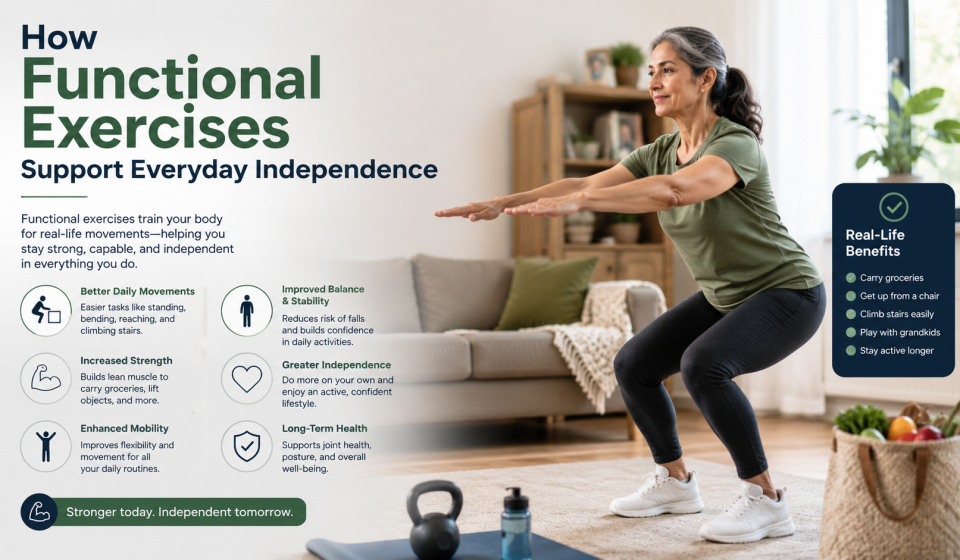
Functional Exercises for Everyday Independence: How Practical Movement Builds Strength, Balance and Confidence

Learn how functional exercises support everyday independence by improving strength, balance, mobility, coordination, flexibility, and the ability to perform daily activities safely.
Functional exercises are designed around movements that people use in everyday life. Instead of focusing only on how much weight a person can lift or how fast they can run, functional exercise focuses on practical abilities such as standing from a chair, walking, climbing stairs, reaching, carrying objects, bending, turning, and maintaining balance. These movements may appear simple, but they require several physical abilities to work together. Regular functional exercise can help people maintain the strength, mobility, coordination, and confidence needed to manage daily activities more independently.
Maintaining independence is especially important as people age or recover from illness, injury, surgery, or periods of reduced activity. Physical activity can improve physical function and make everyday tasks easier, including household chores, getting in and out of a chair or bed, and moving around the community. The National Institute on Aging notes that physical activity can improve functional ability and support independent living, while the World Health Organization recommends activities that emphasize functional balance and strength for older adults to enhance functional capacity and help prevent falls.
What Are Functional Exercises?
Functional exercises are movements that resemble or support activities performed in everyday life.
Examples include:
- Sitting down and standing up
- Walking
- Climbing stairs
- Reaching overhead
- Bending and lifting
- Carrying objects
- Turning and changing direction
- Maintaining balance
- Stepping over obstacles
- Getting up from the floor
The purpose is not necessarily to perform these exercises perfectly or intensely. Instead, the goal is to develop physical abilities that transfer into practical daily activities.
What Does Everyday Independence Mean?
Everyday independence means having enough physical and functional ability to participate in daily life with as little unnecessary assistance as possible.
Daily activities can include:
- Getting dressed
- Bathing
- Preparing meals
- Shopping
- Cleaning
- Walking around the home
- Using stairs
- Getting in and out of a chair
- Carrying groceries
- Moving around the community
The World Health Organization describes functional ability as the capability that allows people to be and do what they have reason to value, including meeting basic needs and being mobile.
Functional exercise can support these abilities by training movements that have practical value.
Why Strength Matters for Independence
Muscle strength plays an important role in everyday movement.
Standing from a chair, climbing stairs, carrying groceries, opening some doors, and maintaining posture can all require strength.
When muscles become weaker, ordinary activities may gradually become more difficult.
Strength-focused functional exercises can help train movements such as:
- Squatting
- Standing
- Pushing
- Pulling
- Carrying
- Stepping
- Reaching
The goal is to develop strength that can be used in everyday situations.
Sit-to-Stand Exercises
One of the simplest functional movements is sitting down and standing up.
People perform this movement many times throughout the day.
Examples include:
- Getting out of bed
- Standing from a dining chair
- Getting up from a sofa
- Rising from a toilet
- Standing from a waiting-room chair
A controlled sit-to-stand exercise can train the muscles involved in this movement.
A person may begin with a higher, stable chair and gradually progress according to their abilities.
Squats and Everyday Movement
Squatting movements are related to many daily activities.
People may squat or partially bend their knees when:
- Picking something up
- Reaching a low shelf
- Gardening
- Cleaning
- Getting into a lower seat
Functional squats can be modified according to a person’s strength and mobility.
For someone who has difficulty with balance, support from a stable surface or professional guidance may be appropriate.
Step-Up Exercises and Stair Mobility
Climbing stairs requires leg strength, balance, coordination, and the ability to shift body weight safely.
Step-up exercises can imitate some aspects of stair climbing.
They can help develop:
- Leg strength
- Balance
- Coordination
- Weight shifting
- Confidence with stepping
Stair-related exercises should be performed safely and adapted to the individual’s ability.
Balance Exercises
Balance is essential for independent movement.
Everyday situations that require balance include:
- Walking
- Turning
- Standing from a chair
- Reaching for an object
- Walking on uneven surfaces
- Getting into or out of a vehicle
The WHO recommends that older adults include multicomponent physical activity emphasizing functional balance and strength on three or more days each week to enhance functional capacity and help prevent falls.
Balance exercises should always be appropriate for the person’s ability and performed in a safe environment.
Walking as a Functional Exercise
Walking is one of the most accessible forms of functional physical activity.
It supports activities such as:
- Moving around the home
- Walking to shops
- Visiting friends
- Using public spaces
- Traveling
- Participating in community activities
Regular walking can also contribute to cardiovascular fitness and overall physical activity.
For someone who has become less active, starting with shorter, manageable walks and gradually increasing activity may be appropriate.
Carrying Exercises
Carrying objects is another everyday movement.
People carry:
- Groceries
- Laundry
- Bags
- Small household items
- Work materials
Functional carrying exercises can train strength, posture, grip, and stability.
However, the weight should be appropriate for the individual.
The objective is controlled movement rather than lifting the heaviest possible load.
Reaching Exercises
Reaching is involved in many everyday activities.
People reach to:
- Put items on shelves
- Get clothes
- Open cabinets
- Prepare food
- Perform household tasks
Reaching exercises can help develop shoulder mobility, coordination, and postural control.
Exercises should be performed within a comfortable range and without forcing painful movement.
Bending and Lifting
Bending and lifting are common household movements.
Examples include:
- Picking up objects
- Moving laundry
- Cleaning
- Gardening
- Handling groceries
Functional training can teach people to coordinate their legs, hips, trunk, and arms during these activities.
Proper technique is important because repeatedly lifting objects with poor mechanics may increase strain.
Core Stability and Everyday Independence
The muscles of the trunk help provide stability during movement.
Core stability can contribute to activities such as:
- Walking
- Reaching
- Standing
- Carrying
- Turning
- Getting out of bed
Functional core exercises do not necessarily require traditional abdominal exercises.
Movements involving controlled reaching, standing, carrying, and changing positions can also challenge trunk stability.
Flexibility and Functional Movement
Flexibility can contribute to comfortable movement.
Adequate mobility may make activities such as:
- Putting on shoes
- Reaching
- Turning
- Bending
- Getting dressed
easier.
Functional exercise programs may therefore include appropriate mobility and stretching exercises alongside strength and balance work.
Coordination and Independence
Daily activities often require several body parts to work together.
For example, walking while carrying a bag requires:
- Balance
- Leg strength
- Arm control
- Grip
- Coordination
- Postural stability
Functional exercises can combine different physical skills rather than training them entirely separately.
This can make exercise more relevant to real-life movement.
Functional Exercises After Injury
After an injury, a person may temporarily lose strength, mobility, or confidence.
Rehabilitation may gradually reintroduce functional movements.
Depending on the injury, exercises may progress from simple movements to more demanding activities.
For example:
- Supported standing
- Sit-to-stand movement
- Controlled walking
- Step exercises
- Carrying light objects
- More complex functional activities
The exact progression depends on the injury and the recommendations of the rehabilitation professional.
Functional Exercise During Rehabilitation
Rehabilitation programs often focus on restoring the abilities needed for everyday life.
A rehabilitation professional may assess:
- Strength
- Balance
- Walking ability
- Joint movement
- Coordination
- Endurance
- Ability to perform daily tasks
The program can then be adjusted to the person’s individual goals.
For example, a person’s goal may be to walk independently, return to household activities, climb stairs, or safely participate in community activities.
Functional Exercise After Surgery
After surgery, movement may be temporarily limited.
A structured rehabilitation program can help a person gradually rebuild functional abilities.
Exercises may focus on:
- Safe transfers
- Walking
- Strength
- Balance
- Flexibility
- Endurance
Patients should follow the instructions provided by their surgical and rehabilitation teams, especially regarding restrictions and progression.
Functional Exercises for Older Adults
Functional exercise can be particularly valuable for older adults because maintaining mobility and independence can become increasingly important with age.
The WHO recommends regular physical activity for older adults and emphasizes functional balance and strength activities as part of a varied exercise routine.
The National Institute on Aging also notes that physical activity can improve physical function and make daily tasks easier.
Functional Exercise and Fall Prevention
Falls can significantly affect independence.
Improving balance, strength, mobility, and environmental awareness can help support safer movement.
Functional exercises may include:
- Controlled stepping
- Standing balance
- Sit-to-stand exercises
- Walking
- Leg strengthening
- Direction changes
Exercise alone cannot eliminate fall risk, but it can be an important component of a broader fall-prevention strategy.
Functional Exercises and Confidence
Physical ability and confidence can influence each other.
When someone becomes less active because they are worried about falling or becoming injured, they may lose additional strength and mobility over time.
Appropriately designed functional exercise can provide opportunities to practice movements in a controlled environment.
As abilities improve, confidence may also increase.
Functional Training for Daily Chores
Household activities can require considerable physical ability.
Examples include:
- Sweeping
- Vacuuming
- Laundry
- Cooking
- Gardening
- Carrying household objects
- Cleaning
Functional exercises can help prepare the body for these activities by developing strength, balance, mobility, and endurance.
Functional Exercise and Community Mobility
Independence extends beyond the home.
People may need to:
- Walk to a shop
- Use public transportation
- Visit healthcare facilities
- Attend social events
- Navigate stairs
- Walk across uneven surfaces
Functional exercise can support the physical abilities required for these activities.
Functional Exercise and Endurance
Strength alone is not enough for many daily activities.
People also need endurance to remain active throughout the day.
Walking, cycling, swimming, and other aerobic activities can contribute to endurance.
The WHO recommends that adults generally aim for 150–300 minutes of moderate-intensity aerobic physical activity each week, or an equivalent combination of moderate and vigorous activity, when appropriate.
People who are inactive should generally begin with manageable amounts and gradually increase activity.
Functional Exercise and Muscle Strengthening
Strength training can help maintain muscle function.
The WHO recommends muscle-strengthening activities involving major muscle groups on at least two days per week for adults, including older adults, when appropriate.
Functional strengthening may include:
- Chair squats
- Step-ups
- Supported lunges
- Resistance-band exercises
- Light carrying
- Controlled pushing and pulling
The appropriate exercises depend on individual ability.
Why Gradual Progress Matters
Functional exercise should not become a competition.
Starting too aggressively can increase the risk of fatigue, poor technique, or injury.
A better approach is gradual progression.
For example:
- Start with fewer repetitions.
- Use support when necessary.
- Focus on movement quality.
- Increase repetitions gradually.
- Increase resistance only when appropriate.
- Introduce more complex movements over time.
The WHO specifically advises inactive people to start with small amounts of activity and gradually increase duration, frequency, and intensity.
Functional Exercise for People With Limited Mobility
Functional exercise can be adapted for people with different physical abilities.
Possible modifications include:
- Seated exercises
- Supported standing
- Short walking intervals
- Resistance bands
- Reduced range of motion
- Assisted transfers
- Balance exercises with support
The WHO’s physical activity toolkit emphasizes that physical activity programs for older people can be adapted to different abilities and health conditions.
The Role of Physical Therapists
Physical therapists can help design individualized exercise programs.
They may evaluate:
- Movement patterns
- Muscle strength
- Joint mobility
- Balance
- Walking
- Functional limitations
- Pain
- Recovery goals
They can then select exercises that match the person’s current abilities and goals.
This can be particularly useful after an injury, surgery, illness, or when someone has difficulty performing everyday activities.
Functional Exercise and Quality of Life
Independence is closely connected to quality of life.
Being able to move independently can make it easier to:
- Participate in hobbies
- Visit family
- Complete household tasks
- Work
- Travel
- Socialize
- Make personal choices
The WHO identifies functional ability as an important component of healthy ageing and wellbeing.
Functional exercise can therefore support more than physical fitness; it can help people remain engaged in activities that matter to them.
Functional Exercise and Mental Wellbeing
Physical activity can also support psychological wellbeing.
Exercise may provide opportunities to:
- Spend time outdoors
- Socialize
- Build confidence
- Develop routines
- Reduce sedentary time
- Participate in enjoyable activities
The WHO notes that regular physical activity provides physical and psychological benefits, while its older-adult toolkit highlights improvements in mood and quality of life.
How to Build a Functional Exercise Routine
A practical routine can include several categories.
Strength
Chair squats, resistance exercises, and step-ups.
Balance
Supported standing, controlled stepping, and balance drills.
Mobility
Gentle range-of-motion and flexibility exercises.
Endurance
Walking, cycling, swimming, or other appropriate aerobic activities.
Functional Practice
Carrying, reaching, bending, transferring, and other practical movements.
Combining these elements can create a more complete approach to functional fitness.
Example Beginner Functional Routine
A simple routine might include:
- 5 minutes of gentle walking
- 8–10 supported sit-to-stands
- 8–10 controlled step-ups per side
- Gentle reaching movements
- Short balance practice with support
- 5–10 minutes of comfortable walking
- Gentle mobility exercises
This is only a general example. People with medical conditions, significant weakness, balance problems, recent surgery, or injury should seek appropriate professional guidance before beginning a new exercise routine.
Making Functional Exercise Part of Everyday Life
Exercise does not always have to happen in a gym.
People can incorporate functional movement into daily routines by:
- Walking instead of sitting for short trips
- Taking appropriate stairs
- Gardening
- Performing household tasks
- Practicing sit-to-stand movements
- Carrying light objects safely
- Taking regular movement breaks
The NIA notes that many activities, including household tasks, can contribute to physical activity.
Common Mistakes to Avoid
Doing Exercises That Are Too Difficult
Start at an appropriate level.
Ignoring Balance
Strength and balance should both be considered.
Moving Too Quickly
Controlled movement is often more useful than rushing.
Avoiding Rest
Recovery is part of an effective exercise routine.
Ignoring Pain
Persistent or significant pain should be evaluated appropriately.
Comparing Yourself With Others
Functional ability varies greatly between individuals.
Expecting Immediate Results
Improvement often requires consistent practice.
Safety Tips for Functional Exercises
Safety should always come first.
Consider:
- Exercising in a clear space
- Wearing appropriate footwear
- Using stable support when necessary
- Avoiding slippery surfaces
- Starting slowly
- Staying hydrated
- Paying attention to fatigue
- Following professional instructions after injury or surgery
People with medical conditions should discuss exercise plans with an appropriate healthcare professional when necessary.
When Professional Guidance Is Important
Professional assessment may be especially helpful if someone:
- Has recently had surgery
- Is recovering from an injury
- Has significant balance problems
- Experiences unexplained pain
- Has major mobility limitations
- Has a neurological condition
- Has a history of falls
- Has a significant chronic health condition affecting exercise
A healthcare or rehabilitation professional can help determine safe and appropriate activities.
Measuring Functional Progress
Progress does not always mean lifting more weight.
Functional improvement may look like:
- Standing from a chair more easily
- Walking farther
- Climbing stairs with greater confidence
- Carrying groceries more comfortably
- Getting dressed independently
- Maintaining balance for longer
- Completing household tasks with less fatigue
These practical improvements can be meaningful indicators of progress.
Why Consistency Matters
Functional ability is maintained through regular use.
A person does not need to perform an intense workout every day to benefit from movement.
Consistent activity can help maintain:
- Strength
- Balance
- Mobility
- Endurance
- Coordination
- Confidence
The WHO emphasizes that regular physical activity is beneficial and that some activity is better than none.
The Long-Term Value of Functional Exercise
Functional exercise can become part of a long-term strategy for maintaining independence.
As people age, physical abilities can change. Regular movement provides an opportunity to maintain physical capacity and adapt to those changes.
The goal is not simply to become stronger today but to preserve the ability to perform meaningful activities over time.
Source
National Institute on Aging – Health
World Health Organization – Physical
World Health Organization – Healthy
Conclusion
Functional exercises are valuable because they connect physical fitness with the activities people actually perform in everyday life. Movements such as standing from a chair, walking, climbing stairs, reaching, bending, carrying objects, and maintaining balance may seem ordinary, but they require strength, coordination, mobility, endurance, and stability. Training these abilities can help people remain capable of managing everyday tasks and participating in activities that are important to them.
Physical activity can improve physical function and make daily activities easier, while the WHO specifically recommends functional balance and strength activities for older adults to enhance functional capacity and help prevent falls.
Functional exercise can also be adapted to different abilities. Someone who is highly active may perform more challenging movements, while a person recovering from injury or living with limited mobility may begin with supported or seated exercises. The important principle is to choose activities that are appropriate, safe, progressive, and relevant to individual goals.
Independence is not simply about physical strength. It is about being able to make choices, move through one’s environment, complete meaningful tasks, and participate in family and community life. The WHO considers functional ability an important part of healthy ageing and wellbeing.
A consistent combination of strength, balance, mobility, endurance, and practical movement can therefore become an important part of maintaining independence. Functional exercise does not have to be complicated or require expensive equipment. With appropriate guidance and gradual progression, everyday movement can become an effective way to support physical capability and confidence.
For anyone recovering from an injury or managing a health condition, professional guidance can help ensure exercises are appropriate. Ultimately, the most useful exercise program is one that supports the movements and activities that matter most in a person’s everyday life.
FAQ
1. What are functional exercises?
Functional exercises are movements designed to improve physical abilities used in everyday activities, such as standing, walking, climbing stairs, reaching, bending, and carrying.
2. How do functional exercises support independence?
They can improve strength, balance, mobility, coordination, and endurance, making everyday activities easier to perform independently.
3. Are functional exercises only for older adults?
No. Functional exercises can benefit adults of different ages and fitness levels, particularly people who want to improve practical movement or are recovering from injury.
4. What is an example of a functional exercise?
Sit-to-stand exercises are a simple example because standing from a chair is a movement people perform regularly throughout the day.
5. Can functional exercises help with balance?
Yes. Balance-focused functional activities can help improve stability and are an important component of physical activity for older adults.
6. Can functional exercise help prevent falls?
Balance and strength training can contribute to fall prevention, particularly in older adults. However, exercise is only one part of a comprehensive fall-prevention approach.
7. How often should older adults perform functional exercises?
WHO guidance recommends that older adults include varied physical activity emphasizing functional balance and strength on three or more days per week.
8. Can functional exercises be done at home?
Yes. Many functional exercises can be performed at home using a stable chair, wall, resistance band, or other appropriate equipment.
9. Do functional exercises require gym equipment?
No. Many functional movements can be performed with little or no equipment.
10. Can functional exercise help after an injury?
Functional exercise may be included in rehabilitation to help restore movement and everyday abilities, but the exercises should be appropriate for the injury and recovery stage.
11. Can functional exercise help after surgery?
It can be part of rehabilitation after some surgeries. Patients should follow the exercise and activity recommendations provided by their healthcare and rehabilitation teams.
12. What muscles do functional exercises work?
Depending on the movement, functional exercises can involve the legs, hips, core, back, shoulders, arms, and hands.
13. Is walking a functional exercise?
Yes. Walking is an everyday movement and can support mobility, endurance, and independence.
14. Can household chores count as physical activity?
Yes. Activities such as household chores can contribute to overall physical activity.
15. Should beginners start functional exercises slowly?
Yes. People who are inactive should generally start with manageable amounts of activity and gradually increase duration, frequency, and intensity.
16. Can functional exercises improve confidence?
Improving physical ability and practicing everyday movements in a controlled environment may help some people feel more confident about movement.
17. Are functional exercises safe for people with chronic conditions?
Physical activity can benefit people with many chronic conditions, but the appropriate type and intensity depend on the person’s health status. Professional guidance may be appropriate.
18. When should I consult a physical therapist?
Consider professional guidance if you have significant mobility limitations, persistent pain, recent surgery, a serious injury, repeated falls, or difficulty performing everyday activities.
19. How can I measure functional exercise progress?
Look at practical improvements, such as standing more easily, walking farther, climbing stairs more comfortably, carrying objects, or completing daily activities with less fatigue.
20. What is the most important goal of functional exercise?
The main goal is to improve or maintain physical abilities that help a person perform meaningful everyday activities safely and as independently as possible.