Medical Screening Tests Every Adult Should Consider: Your Complete Guide to Preventive Health

Discover the most important medical screening tests adults should consider, including blood pressure, cholesterol, diabetes, cancer, infectious disease, mental health, and age-based screenings.
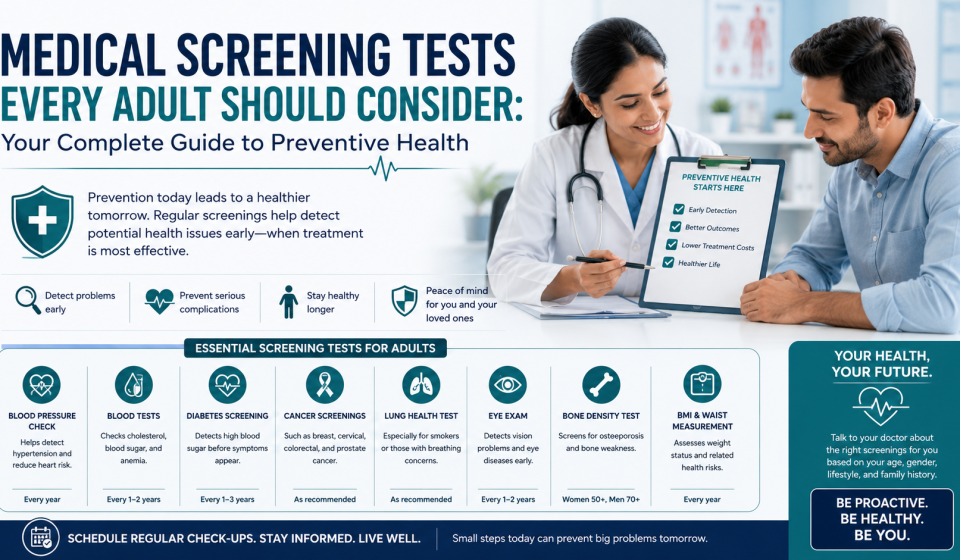
Medical screening tests are an important part of preventive healthcare because they can help identify certain diseases and health risks before noticeable symptoms appear. Many adults feel healthy and assume that they do not need medical testing unless something feels wrong. However, some conditions, including high blood pressure, certain cancers, diabetes, and elevated cholesterol, can develop gradually without obvious warning signs. Regular preventive care gives adults an opportunity to discuss their individual risks with healthcare professionals and determine which screenings are appropriate for their age, health history, family history, and lifestyle.
Not every adult needs every medical screening test, and screening recommendations can change as people get older or develop new risk factors. The U.S. Preventive Services Task Force (USPSTF) maintains evidence-based recommendations for preventive services, including screening for conditions such as hypertension, colorectal cancer, lung cancer, hepatitis C, HIV, diabetes, osteoporosis, depression, and several other health concerns. The right screening plan should therefore be personalized rather than based on a one-size-fits-all checklist.
What Are Medical Screening Tests?
Medical screening tests are examinations, measurements, laboratory tests, imaging procedures, or questionnaires used to look for a disease or health risk in people who may not have obvious symptoms.
Screening is different from diagnostic testing.
A diagnostic test is generally used when a person has symptoms or an abnormal finding that needs further investigation.
Screening, on the other hand, may be performed before symptoms develop.
Examples include:
- Blood pressure screening
- Cholesterol testing
- Diabetes screening
- Colorectal cancer screening
- Breast cancer screening
- Cervical cancer screening
- Lung cancer screening for eligible smokers
- HIV screening
- Hepatitis C screening
- Osteoporosis screening
- Depression screening
The purpose is not to test for everything. Instead, appropriate screening aims to identify conditions where early detection or intervention can provide meaningful benefits.
Why Preventive Screening Matters
Preventive screening can help people become more aware of their health status.
Early identification may allow healthcare professionals to:
- Confirm a health condition
- Monitor a risk factor
- Recommend lifestyle changes
- Begin appropriate treatment
- Provide counseling
- Arrange follow-up
- Refer a patient to a specialist
The USPSTF grades preventive services according to the strength of evidence and expected benefits and harms. Its A and B recommendations represent services that the task force recommends implementing for preventive care.
1. Blood Pressure Screening
Blood pressure screening is one of the most important routine health checks for adults.
High blood pressure, also called hypertension, can exist without obvious symptoms.
Over time, uncontrolled hypertension can contribute to cardiovascular and other health problems.
The USPSTF recommends screening adults aged 18 years or older who do not already have a diagnosis of hypertension. It also recommends confirming elevated office blood pressure measurements outside the clinical setting before starting treatment.
Blood pressure screening is simple and commonly performed during healthcare visits.
2. Cholesterol Testing
Cholesterol testing can help assess cardiovascular risk.
A lipid panel may measure substances such as:
- LDL cholesterol
- HDL cholesterol
- Triglycerides
- Total cholesterol
The results are interpreted alongside other factors rather than being considered in isolation.
Healthcare professionals may consider:
- Age
- Blood pressure
- Smoking
- Diabetes
- Family history
- Previous cardiovascular disease
- Other risk factors
The appropriate testing frequency depends on the individual’s health profile.
3. Diabetes and Prediabetes Screening
Diabetes can develop gradually, and some people may have elevated blood sugar without obvious symptoms.
The USPSTF recommends screening for prediabetes and type 2 diabetes in adults aged 35 to 70 years who have overweight or obesity. People with prediabetes should be offered or referred to effective preventive interventions.
Common tests used to evaluate blood glucose include:
- Fasting blood glucose
- Hemoglobin A1C
- Oral glucose tolerance testing
The appropriate test depends on the clinical situation.
4. Colorectal Cancer Screening
Colorectal cancer screening is an important age-based preventive service.
The USPSTF recommends colorectal cancer screening for adults aged 45 to 75 years. Several screening strategies are available, so the appropriate method can depend on individual circumstances and discussion with a healthcare professional.
Possible screening approaches may include:
- Stool-based tests
- Colonoscopy
- Other approved visualization tests
Screening recommendations can differ for people with significant family history or other risk factors.
5. Breast Cancer Screening
Breast cancer screening is an important preventive consideration for many women.
The USPSTF updated its breast cancer screening recommendation in 2024. Adults should discuss screening based on age, personal health history, family history, and individual risk.
Mammography is the primary screening method used in the USPSTF recommendation.
Women with specific risk factors may need individualized evaluation.
6. Cervical Cancer Screening
Cervical cancer screening can help identify changes that may require further evaluation before they develop into cancer.
The USPSTF recommends cervical cancer screening for women aged 21 to 65 years, with different testing options depending on age. For women aged 30 to 65, options include cervical cytology alone every three years, high-risk HPV testing alone every five years, or co-testing every five years.
Screening recommendations may differ based on medical history.
7. Lung Cancer Screening
Lung cancer screening is not recommended for every adult.
The USPSTF recommends annual low-dose CT screening for adults aged 50 to 80 years who have a 20 pack-year smoking history and currently smoke or quit within the past 15 years.
Screening should be discontinued when a person has not smoked for 15 years or develops a health problem that substantially limits life expectancy or the ability or willingness to undergo curative lung surgery.
This is an example of why screening should be based on individual risk rather than simply age.
8. HIV Screening
HIV screening is another important preventive health service.
The USPSTF recommends screening adolescents and adults aged 15 to 65 years, as well as younger or older people who have increased risk of infection.
Testing can help people understand their health status and, when appropriate, access medical care and prevention services.
9. Hepatitis C Screening
Hepatitis C can sometimes exist without noticeable symptoms.
The USPSTF recommends screening adults aged 18 to 79 years for hepatitis C virus infection.
A healthcare professional can determine whether additional testing or follow-up is needed after an initial result.
10. Depression Screening
Mental health is an important part of overall health.
The USPSTF recommends screening adults, including pregnant and postpartum people and older adults, for depression when systems are available to ensure accurate diagnosis, effective treatment, and appropriate follow-up.
Depression screening may involve questions about:
- Mood
- Interest in activities
- Sleep
- Energy
- Concentration
- Appetite
- Feelings of hopelessness
Screening is not the same as a diagnosis. A positive screening result generally requires further evaluation.
11. Anxiety Screening
Anxiety can affect sleep, concentration, work, relationships, and quality of life.
The USPSTF recommends screening for anxiety disorders in adults aged 64 years or younger, including pregnant and postpartum people, when appropriate systems for diagnosis and care are available.
Adults who experience persistent anxiety symptoms should discuss them with a healthcare professional.
12. Osteoporosis Screening
Bone health becomes increasingly important with age.
Osteoporosis can weaken bones and increase the risk of fractures.
The USPSTF recommends osteoporosis screening for women aged 65 years or older and for postmenopausal women younger than 65 who have increased fracture risk based on clinical risk assessment.
Screening may involve bone mineral density testing.
Men and younger individuals may need individualized assessment depending on risk factors.
13. Abdominal Aortic Aneurysm Screening
Abdominal aortic aneurysm, or AAA, may develop without obvious symptoms.
The USPSTF recommends one-time ultrasound screening for men aged 65 to 75 years who have ever smoked.
This is another example of risk-specific screening rather than a test recommended for every adult.
14. Sexually Transmitted Infection Screening
Some sexually transmitted infections can occur without obvious symptoms.
Screening recommendations depend on:
- Age
- Sex
- Sexual activity
- Pregnancy
- Number of partners
- Exposure risk
- Previous infections
The USPSTF recommends screening for chlamydia and gonorrhea in sexually active women aged 24 years or younger and in older women who have increased risk. It also recommends syphilis screening for nonpregnant adults at increased risk.
People should discuss their individual risk with a healthcare professional.
15. Hepatitis B Screening
Hepatitis B screening may be appropriate for adults at increased risk.
Risk can vary according to:
- Country of origin
- Vaccination status
- Sexual exposure
- Household exposure
- Certain medical conditions
- Occupational exposure
The USPSTF recommends screening adolescents and adults at increased risk for hepatitis B infection.
16. Tuberculosis Screening
Tuberculosis screening is not necessarily required for every adult.
The USPSTF recommends screening asymptomatic adults who are at increased risk for latent tuberculosis infection.
Risk factors can influence whether testing is appropriate.
17. Tobacco Use Assessment
Tobacco use is an important health risk factor.
Screening may involve asking whether a person currently uses tobacco.
The USPSTF recommends that clinicians ask all adults about tobacco use, advise those who use tobacco to stop, and provide behavioral interventions and appropriate FDA-approved pharmacotherapy for cessation in nonpregnant adults.
The purpose is not simply to record smoking status. It is also an opportunity to support cessation.
18. Alcohol Use Screening
Alcohol use can affect physical and mental health.
The USPSTF recommends screening adults aged 18 years or older for unhealthy alcohol use in primary care settings and providing brief behavioral counseling to people engaged in risky or hazardous drinking.
Screening typically involves questions about alcohol consumption patterns.
19. Unhealthy Drug Use Screening
The USPSTF recommends screening adults aged 18 years or older for unhealthy drug use when accurate diagnosis, effective treatment, and appropriate care can be provided or referred. The recommendation describes screening through questions rather than routine biological testing of everyone.
Open communication can help healthcare professionals provide appropriate support.
20. Weight and Obesity Assessment
Weight and body size can be considered as part of preventive healthcare.
The USPSTF recommends offering or referring adults with a BMI of 30 or higher to intensive, multicomponent behavioral interventions for weight management.
Weight should not be considered the only measure of health.
Healthcare professionals may also evaluate:
- Blood pressure
- Blood sugar
- Cholesterol
- Physical activity
- Nutrition
- Family history
- Other risk factors
Screening Is Not the Same for Everyone
One of the most important things to understand about medical screening is that there is no universal checklist that every adult should follow exactly.
Screening can depend on:
- Age
- Sex
- Pregnancy status
- Family history
- Personal medical history
- Smoking history
- Lifestyle
- Previous test results
- Symptoms
- Risk factors
A 25-year-old adult and a 70-year-old adult will naturally have different screening priorities.
Why Age-Based Screening Matters
Many preventive services are recommended within particular age ranges.
For example:
- Blood pressure screening begins in adulthood.
- Colorectal cancer screening begins at age 45 according to USPSTF recommendations.
- Lung cancer screening applies to certain adults aged 50 to 80 with specific smoking histories.
- Osteoporosis screening is recommended for women aged 65 and older.
- AAA screening applies to certain men aged 65 to 75 who have ever smoked.
These differences show why preventive care should be reviewed throughout adulthood.
Family History Can Change Screening Needs
Family history may influence screening decisions.
A person with a close relative who developed a particular disease at a young age may have different risk from someone without that family history.
Adults should tell healthcare professionals about significant family health conditions, particularly cancers and inherited diseases.
Personal Medical History Also Matters
Previous illnesses, surgeries, abnormal test results, medications, and existing medical conditions can affect screening decisions.
For example, someone who has previously had an abnormal screening result may need a different follow-up schedule.
Why Symptoms Require Diagnostic Care
Screening recommendations generally apply to people without symptoms.
If someone has symptoms such as unexplained weight loss, persistent bleeding, a new lump, severe fatigue, persistent pain, or unusual changes in bodily function, they should not simply wait for a routine screening appointment.
Symptoms may require diagnostic evaluation.
Screening Benefits and Possible Limitations
Screening can provide important benefits, but it is not perfect.
Potential benefits include:
- Earlier detection
- Risk identification
- Earlier intervention
- Better awareness
- Preventive counseling
Potential limitations can include:
- False-positive results
- False-negative results
- Anxiety
- Additional testing
- Unnecessary procedures
- Overdiagnosis
This is why evidence-based screening recommendations are important.
Why More Tests Are Not Always Better
It can be tempting to believe that a complete health check should include every available test.
However, unnecessary testing can sometimes create problems.
A test may identify an abnormality that is harmless but requires additional investigations.
Evidence-based guidelines help healthcare professionals balance benefits and potential harms.
What Should Adults Ask Their Doctor?
Useful questions include:
- Which screenings are appropriate for my age?
- Does my family history change my screening needs?
- When should I repeat this test?
- What does this result mean?
- Do I need additional testing?
- Are there screenings I do not need?
- What lifestyle changes would reduce my health risks?
These questions can make preventive appointments more productive.
How to Prepare for Screening
Before an appointment, adults can prepare:
- Current medication list
- Family health history
- Previous test results
- Vaccination records
- Smoking history
- Relevant symptoms
- Questions about preventive care
Being prepared can help healthcare professionals understand the full health picture.
Keep Track of Screening Results
Keeping personal health records can be helpful.
Important information may include:
- Date of screening
- Test performed
- Result
- Recommended follow-up
- Next screening date
Digital medical records may make this easier, but individuals can also maintain their own health records.
Screening and Healthy Lifestyle Choices
Screening is only one part of preventive healthcare.
Adults should also focus on:
- Regular physical activity
- Balanced nutrition
- Adequate sleep
- Tobacco avoidance
- Responsible alcohol use
- Healthy weight management
- Stress management
- Regular medical care
Screening can identify risk, but healthy daily habits remain important for long-term health.
The Role of Regular Healthcare Visits
A routine healthcare visit provides an opportunity to review preventive needs.
During a visit, a healthcare professional can consider:
- Age
- Current health
- Family history
- Previous screening
- Vaccination status
- Lifestyle
- New risk factors
This can help keep preventive care up to date.
Why Preventive Screening Should Be Personalized
The phrase “every adult should consider” does not mean that every adult needs every test.
Instead, adults should consider discussing the major categories of preventive screening with their healthcare professional.
The final screening plan should be personalized.
Screening Throughout Different Life Stages
Young Adulthood
Important considerations may include:
- Blood pressure
- Mental health
- Sexual health
- HIV and STI screening when appropriate
- Tobacco and alcohol use
- Vaccination
- Family history
Middle Adulthood
Additional priorities may include:
- Cardiovascular risk
- Diabetes screening
- Colorectal cancer screening
- Breast or cervical cancer screening when applicable
- Mental health
- Lifestyle risk factors
Older Adulthood
Screening may increasingly focus on:
- Cancer prevention
- Bone health
- Cardiovascular risk
- Falls and mobility
- Vision and hearing
- Medication review
- Cognitive and mental health concerns
The appropriate plan should always be individualized.
Why Screening Schedules Change
Medical evidence evolves over time.
Recommendations may change as researchers learn more about:
- Disease risk
- Benefits of early detection
- Screening accuracy
- Treatment effectiveness
- Potential harms
For this reason, adults should use current recommendations rather than relying on outdated information.
The Importance of Evidence-Based Screening
The USPSTF reviews scientific evidence and publishes recommendations for preventive services.
Its A and B recommendations represent services with a high or moderate net benefit according to the task force’s assessment.
Using evidence-based recommendations can help reduce unnecessary testing while ensuring important preventive services are considered.
A Practical Adult Screening Checklist
Adults can use the following checklist when discussing preventive care:
- Blood pressure
- Cholesterol and cardiovascular risk
- Diabetes or prediabetes
- Colorectal cancer
- Breast cancer when applicable
- Cervical cancer when applicable
- Lung cancer when eligible
- HIV
- Hepatitis C
- Other STI screening when indicated
- Depression
- Anxiety
- Osteoporosis when appropriate
- Abdominal aortic aneurysm when eligible
- Tobacco use
- Alcohol use
- Drug use
- Vaccinations
- Weight and lifestyle risk factors
This is a discussion checklist, not a universal testing schedule.
When to Talk to a Healthcare Professional
Adults should speak with a healthcare professional about screening when:
- They have not had preventive care for several years.
- They are unsure which tests they need.
- Their family history has changed or become clearer.
- They have a new medical condition.
- They have a history of abnormal results.
- They are approaching a new age-based screening milestone.
- They have concerns about symptoms.
Source
https://www.uspreventiveservice
https://www.uspreventiveservice
https://www.cdc.gov
https://www.cdc.gov
https://medlineplus.gov
Conclusion
Medical screening tests are an important part of preventive healthcare, but the right approach is personalized rather than universal. Adults should regularly discuss preventive screening with healthcare professionals and consider factors such as age, family history, personal medical history, lifestyle, smoking history, and other risk factors. Screening can help identify certain diseases or health risks earlier, giving people an opportunity to receive appropriate follow-up and make informed health decisions.
Some screenings apply broadly to adults, while others are recommended only for specific groups. For example, the USPSTF recommends hypertension screening for adults aged 18 years and older, colorectal cancer screening beginning at age 45, hepatitis C screening for adults aged 18 to 79, and osteoporosis screening for women aged 65 and older or younger postmenopausal women at increased risk. Lung cancer screening is reserved for adults who meet specific age and smoking-history criteria.
It is also important to understand that screening is not a substitute for medical attention when symptoms are present. Symptoms may require diagnostic testing rather than routine screening. Similarly, more testing is not automatically better. Evidence-based recommendations help healthcare professionals balance the potential benefits and harms of screening.
Ultimately, preventive healthcare works best when screening is combined with healthy lifestyle habits, appropriate vaccinations, regular healthcare visits, and timely follow-up. Adults should keep track of their screening history and speak with their healthcare professionals whenever they are unsure about what tests are appropriate. A personalized screening plan can help turn preventive healthcare into a long-term habit and support better health throughout adulthood.
FAQ
1. What medical screening tests should adults consider?
Adults should discuss blood pressure, cardiovascular risk, diabetes, cancer screening, infectious disease screening, mental health screening, bone health, and lifestyle-related assessments with their healthcare professional. The exact tests depend on individual risk factors.
2. Does every adult need the same screening tests?
No. Screening recommendations vary based on age, sex, family history, personal medical history, smoking history, pregnancy status, and other risk factors.
3. Why is blood pressure screening important?
High blood pressure may not cause obvious symptoms. The USPSTF recommends screening adults aged 18 years or older for hypertension.
4. When should adults start colorectal cancer screening?
The USPSTF recommends colorectal cancer screening beginning at age 45 for average-risk adults.
5. Who should consider lung cancer screening?
The USPSTF recommends annual low-dose CT screening for adults aged 50 to 80 who have a 20 pack-year smoking history and currently smoke or quit within the previous 15 years.
6. Who should be screened for diabetes?
The USPSTF recommends screening adults aged 35 to 70 years who have overweight or obesity for prediabetes and type 2 diabetes.
7. Is cholesterol testing important?
Cholesterol testing can help assess cardiovascular risk. Results should be interpreted together with other risk factors such as age, blood pressure, smoking, and diabetes.
8. Should adults be screened for hepatitis C?
The USPSTF recommends hepatitis C screening for adults aged 18 to 79 years.
9. Should adults have HIV screening?
The USPSTF recommends HIV screening for adolescents and adults aged 15 to 65 and for younger or older people at increased risk.
10. Is depression screening recommended for adults?
Yes. The USPSTF recommends depression screening for adults, including older adults and pregnant or postpartum people, when appropriate systems for diagnosis, treatment, and follow-up are available.
11. Should adults be screened for anxiety?
The USPSTF recommends anxiety screening for adults aged 64 years or younger, including pregnant and postpartum people.
12. Who should consider osteoporosis screening?
The USPSTF recommends screening women aged 65 years or older and younger postmenopausal women who have increased fracture risk based on clinical assessment.
13. What is the difference between screening and diagnostic testing?
Screening generally looks for disease or risk in people without obvious symptoms, while diagnostic testing is generally used to investigate symptoms or abnormal findings.
14. Can screening tests prevent disease?
Screening itself does not prevent every disease, but early identification can sometimes allow treatment or preventive intervention that reduces future health risks.
15. Can screening tests have disadvantages?
Yes. Screening can sometimes produce false-positive or false-negative results, lead to additional testing, or identify abnormalities that may not cause harm. This is why evidence-based recommendations are important.
16. Should smokers receive additional screening?
Some smokers may qualify for lung cancer screening depending on age and smoking history. Tobacco-use assessment and cessation support are also important parts of preventive healthcare.
17. Should adults keep records of their screening tests?
Yes. Keeping track of previous tests, results, and recommended follow-up dates can help make preventive healthcare easier to manage.
18. What if I have symptoms but my screening test is not due?
Do not wait for a routine screening appointment if you have concerning symptoms. Contact an appropriate healthcare professional for evaluation because symptoms may require diagnostic testing.
19. Why does family history matter for screening?
Family history can influence disease risk and may affect which screenings are appropriate or when they should begin.
20. What is the best way to determine which screening tests I need?
Discuss your age, family history, medical history, medications, lifestyle, smoking history, and other risk factors with a healthcare professional. They can help develop a screening plan appropriate for your individual circumstances.