The Importance of Proper Body Mechanics During Physical Recovery: Safe Movement for Better Rehabilitation

Learn why proper body mechanics are important during physical recovery, how safe movement supports rehabilitation, reduces unnecessary strain, and improves confidence in everyday activities.
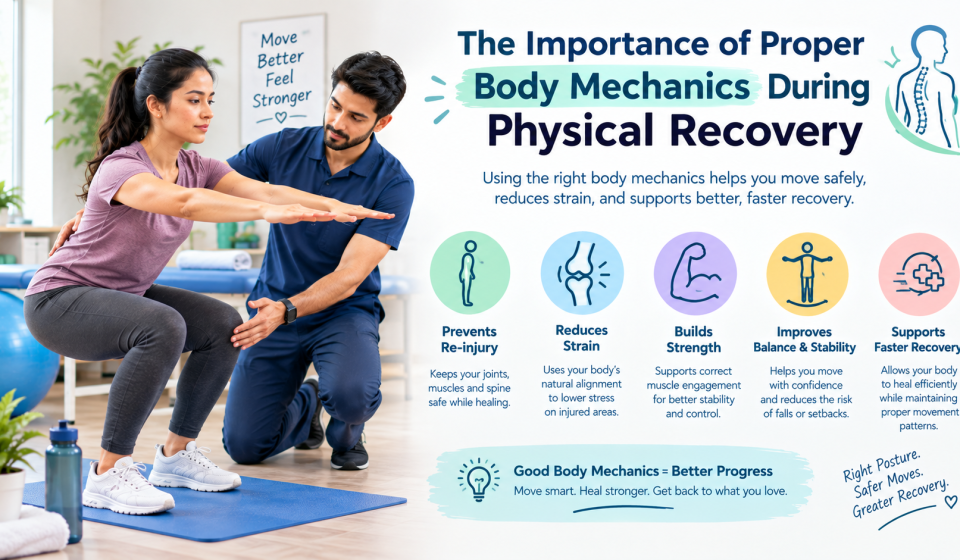
Physical recovery is not only about completing exercises or following a rehabilitation program. The way a person moves, sits, stands, bends, lifts, reaches, walks, and changes position can also influence how safely they perform everyday activities. Proper body mechanics refers to using the body in a controlled and efficient way during movement so that unnecessary stress on muscles, joints, and other body structures can be reduced. During recovery, learning safer movement habits can help people perform daily activities with greater awareness and confidence.
After an injury, surgery, illness, or period of reduced activity, normal movement patterns may change. A person may unconsciously compensate by putting more pressure on another part of the body, twisting while moving, bending incorrectly, or relying too heavily on one side. These habits can make everyday tasks more physically demanding. Rehabilitation professionals can help individuals understand movement patterns and practice safer ways of completing functional activities according to their abilities and recovery goals.
What Is Proper Body Mechanics?
Body mechanics describes how the body is positioned and coordinated while performing physical movements. It includes posture, balance, alignment, joint positioning, muscle use, weight distribution, and movement control.
Good body mechanics does not mean that there is only one “perfect” way to move. Movement needs can vary depending on the person, activity, environment, physical ability, and stage of recovery. Instead, the goal is to use movement strategies that are appropriate, controlled, and safe for the specific task.
During rehabilitation, therapists may observe how a person performs everyday movements such as:
- Sitting down and standing up
- Walking
- Bending
- Reaching
- Turning
- Getting into or out of bed
- Getting in and out of a chair
- Carrying light objects
- Climbing stairs
- Changing direction while walking
These observations can provide useful information about strength, balance, coordination, mobility, and movement control.
Why Body Mechanics Matter During Physical Recovery
Recovery can place additional demands on the body. Muscles may be weaker, joints may have limited movement, or balance and coordination may not yet have returned to previous levels. In such situations, inefficient movement may require more effort than necessary.
Poor movement patterns can also involve bending, twisting, reaching, awkward positioning, or forceful movements. OSHA identifies factors such as twisting while lifting, bending while lifting, repetitive lifting, awkward postures, fatigue, and heavy loads as factors associated with back disorders.
Learning appropriate movement strategies can therefore be an important part of functional rehabilitation. Instead of focusing only on isolated exercises, individuals can learn how to apply movement principles to real-life situations.
Proper Alignment Can Support Safer Movement
Alignment refers to the positioning of different parts of the body in relation to one another. During recovery, maintaining an appropriate alignment can make certain movements easier to control.
For example, when standing from a chair, a person may benefit from positioning the feet securely, bringing the body forward appropriately, and using the legs to assist with the movement rather than relying excessively on the back or arms.
Similarly, when reaching for an object, moving closer to the object may reduce the need for excessive stretching or leaning. Keeping frequently used objects within a comfortable range can also reduce unnecessary reaching.
The appropriate technique depends on the person’s condition and should be adapted to individual rehabilitation recommendations.
Body Mechanics During Sitting and Standing
Sitting and standing are common activities that people perform many times each day. After an injury or surgery, these simple movements may become challenging.
A person may compensate by pushing heavily with the arms, shifting weight unevenly, or using momentum to stand. These patterns can increase physical effort and may affect balance.
During rehabilitation, therapists may practice sit-to-stand movements with patients. The focus may include foot placement, trunk control, weight transfer, balance, and controlled movement.
Practicing these movements can help a person become more aware of how their body moves during everyday activities.
Safe Bending and Reaching
Bending and reaching are unavoidable parts of daily life. People bend to pick up objects, reach into cabinets, make beds, clean, dress, or perform household activities.
During recovery, repeatedly bending or reaching with poor control can place additional physical demands on the body. OSHA notes that awkward postures, reaching while lifting, twisting, and bending while lifting can contribute to back-related risks.
One useful principle is to bring the body closer to the object whenever practical instead of reaching excessively from a distance. For heavier or difficult objects, asking for assistance or using an appropriate device may be safer than attempting to manage the task alone.
Proper Body Mechanics When Lifting
Lifting is one of the activities where body mechanics receives significant attention. However, safe lifting is not simply about “using your legs instead of your back.”
The weight, size, stability, distance, height, frequency, and environment all influence the physical demands of a lifting task. OSHA’s ergonomic guidance identifies factors such as horizontal distance from the body, vertical movement, twisting, grip, and lifting frequency when evaluating manual lifting tasks.
During physical recovery, individuals should not assume that they are ready to lift an object simply because they can physically pick it up. Their therapist or healthcare professional may recommend restrictions or gradual progression depending on the injury or procedure.
For patients who have significant mobility limitations, transferring or lifting themselves or another person manually may not be appropriate. Assistive equipment or help from another person may be necessary.
Body Mechanics During Transfers
Transfers involve moving from one surface or position to another. Examples include:
- Bed to chair
- Chair to standing
- Wheelchair to toilet
- Car seat to standing
- Floor to standing
Transfers can be particularly demanding during physical recovery because they combine strength, balance, coordination, and movement control.
Healthcare guidance emphasizes that high-risk patient transfers may involve awkward postures and significant force. OSHA recommends minimizing manual lifting of patients and using appropriate assistive equipment when necessary rather than relying only on body mechanics.
For patients, this means that asking for assistance is not a sign of weakness. Using the correct transfer technique or equipment can be an important part of safe recovery.
The Importance of Keeping Objects Close
Distance matters during physical tasks. When an object is held farther away from the body, the mechanical demands of the task can increase. OSHA explains that moving a load farther from the body increases the forces involved in lifting and can place greater demands on the musculoskeletal system.
This principle can be applied to everyday recovery activities. Instead of stretching across a table to pick something up, moving closer may make the task easier. When carrying an appropriate lightweight object, keeping it reasonably close to the body may also improve control.
However, people recovering from surgery or injury should follow any specific lifting or carrying restrictions provided by their healthcare team.
Body Mechanics and Balance
Balance is another important part of proper movement. A person who has reduced balance may use unusual movement strategies to avoid falling.
For example, they may hold onto furniture, move too quickly, take unusually wide steps, or avoid turning. While some compensations may provide temporary support, they may not always be the safest long-term strategy.
Physical therapists can assess movement, balance, gait, transfers, and other functional abilities as part of rehabilitation.
Improving movement awareness alongside strength and balance training can help individuals become more confident while performing everyday tasks.
Avoiding Unnecessary Twisting
Twisting can become problematic when combined with lifting, reaching, or forceful movement. A person may twist because an object is positioned behind them or because they are trying to complete a task quickly.
During recovery, controlled movement is generally more appropriate than sudden or forceful movements. When possible, repositioning the feet and turning the whole body can be more controlled than twisting the trunk while handling a load.
The safest strategy depends on the activity and the person’s condition, so rehabilitation professionals may teach specific techniques based on individual needs.
Body Mechanics and Fatigue
Fatigue can change movement quality. When people become tired, they may lose posture, move more quickly, use poor alignment, or rely on compensation.
This is particularly important during physical recovery because endurance may be reduced after injury, illness, surgery, hospitalization, or prolonged inactivity.
Taking appropriate rest breaks and dividing demanding activities into manageable steps can help prevent unnecessary fatigue. A rehabilitation professional can also help determine how much activity is appropriate at a particular stage of recovery.
Why Proper Foot Position Matters
The feet provide an important foundation for many movements. Poor foot placement can affect stability during standing, walking, turning, lifting, and transfers.
Before beginning a movement, ensuring that the feet are positioned securely can improve balance and control. For example, during a sit-to-stand movement, stable foot placement can help create a stronger base for transferring weight.
During recovery, therapists may teach patients to pay attention to foot placement because small adjustments can influence the overall movement pattern.
Using Assistive Devices Correctly
Assistive devices can support mobility and reduce physical demands when used appropriately. Examples include walkers, canes, transfer boards, grab bars, wheelchairs, and mechanical lifting devices.
The correct device depends on the individual’s physical abilities and the task being performed. Using an inappropriate device or using a suitable device incorrectly may create additional risks.
OSHA recommends appropriate assistive equipment for patient lifting, transferring, and repositioning and emphasizes that equipment should be selected according to the specific needs of the patient and situation.
Patients should therefore receive instruction from qualified professionals on how and when to use their prescribed mobility equipment.
Body Mechanics and Independence
One of the major goals of rehabilitation is often to help people participate more safely and independently in daily life.
Proper body mechanics can become part of that independence. Instead of thinking about movement only during therapy sessions, patients can learn to apply movement principles at home, at work, and during routine activities.
For example, someone recovering from a lower-body injury may learn safer ways to sit, stand, walk, enter a vehicle, and manage household activities. These practical skills can make rehabilitation more relevant to everyday life.
Why Body Mechanics Should Be Individualized
There is no universal movement technique that is appropriate for every person or every situation.
A person recovering from knee surgery may have different movement restrictions from someone recovering from a back injury. Someone recovering from a neurological condition may have different balance and coordination needs from someone recovering from a fracture.
For this reason, body mechanics education should be individualized. Therapists consider factors such as strength, mobility, pain, balance, coordination, endurance, functional goals, environment, and stage of recovery when selecting appropriate exercises and movement strategies.
Proper Body Mechanics Is Not the Only Safety Strategy
An important point is that proper body mechanics should not be treated as a complete solution for every lifting or transfer risk.
OSHA specifically states that focusing only on body mechanics and lifting techniques is not sufficient in situations involving patient handling. Mechanical lifting devices, transfer equipment, environmental modifications, and adequate assistance may be necessary.
This principle is also useful for patients at home. If a task is too heavy, unstable, painful, or difficult to perform safely, changing the task or asking for help may be more appropriate than trying to “lift correctly.”
How Therapists Teach Better Movement Habits
Therapists may use demonstrations, verbal instructions, hands-on guidance, repetition, functional activities, and feedback to help patients understand movement.
A therapist might observe how a person performs a specific task and identify areas that need improvement. The patient may then practice the movement several times while receiving feedback.
Over time, the goal is to make appropriate movement strategies more familiar so the person can apply them during daily activities.
Building Better Movement Habits During Recovery
Improving body mechanics is usually a gradual process. Patients should not expect to change every movement pattern immediately.
Useful habits may include:
- Move with control rather than rushing.
- Keep frequently used objects within an accessible range.
- Avoid unnecessary twisting while handling objects.
- Use stable support when recommended.
- Follow lifting and weight-bearing restrictions.
- Use prescribed assistive devices correctly.
- Ask for help when a task exceeds current abilities.
- Take rest breaks when fatigue affects movement quality.
- Practice recommended functional movements consistently.
- Follow individualized instructions from the rehabilitation team.
These habits can help make everyday movement more deliberate and controlled.
The Long-Term Value of Proper Body Mechanics
The benefits of learning safe movement strategies can extend beyond the immediate recovery period. Once individuals understand how their body responds to different movements, they may become more aware of posture, balance, fatigue, and physical limitations.
This awareness can help people make better decisions about daily activities. It may also encourage them to avoid unnecessary strain and recognize when a task requires assistance or modification.
The ultimate purpose of rehabilitation is not simply to perform exercises correctly in a clinic. It is to help people function as safely and independently as possible in their everyday environments.
Source
OSHA – Safe Patient Handling
OSHA – Technical Manua
OSHA – Safe Patient Handling Equipment
Conclusion
Proper body mechanics can be an important part of physical recovery because everyday movements are closely connected with functional independence. Learning how to sit, stand, bend, reach, walk, transfer, and handle appropriate loads with better movement control can help people become more aware of how they use their bodies during daily activities. Rehabilitation professionals can assess individual movement patterns and teach strategies that match a person’s abilities, limitations, environment, and recovery goals.
At the same time, body mechanics should not be viewed as a substitute for appropriate assistance or equipment. When a task is too difficult, heavy, unstable, or unsafe, modifying the task, using an assistive device, or asking for help may be the better choice. A gradual, individualized approach to movement can support safer participation in everyday activities throughout the recovery process.
FAQ
1. What are proper body mechanics?
Proper body mechanics refers to using controlled and appropriate body positioning during activities such as standing, sitting, lifting, reaching, walking, and transferring. The goal is to perform movements efficiently while avoiding unnecessary physical strain.
2. Why are body mechanics important during physical recovery?
During recovery, strength, balance, mobility, coordination, or endurance may be temporarily reduced. Appropriate movement strategies can help individuals perform everyday tasks more safely and with better control.
3. Can proper body mechanics prevent all injuries?
No. Proper body mechanics is only one part of injury prevention. Depending on the task, appropriate equipment, assistance, environmental changes, and task modification may also be necessary. OSHA specifically notes that body mechanics alone are not sufficient for safe patient handling.
4. Should I lift heavy objects during recovery?
Not unless your healthcare professional has determined that the activity is appropriate for your condition. After surgery, injury, or certain medical conditions, specific lifting or weight-bearing restrictions may apply.
5. Can a physical therapist help improve body mechanics?
Yes. Physical therapists can assess movement, balance, gait, transfers, coordination, and other functional activities and may provide individualized instruction to improve movement strategies.
6. Is twisting while lifting dangerous?
Twisting while lifting can increase physical demands on the body, particularly when combined with force or awkward positioning. OSHA identifies twisting and bending while lifting among factors associated with back disorders.
7. Are assistive devices useful during recovery?
Assistive devices can be useful when appropriately selected and correctly used. Depending on the person’s needs, devices may include walkers, canes, transfer boards, wheelchairs, grab bars, or mechanical lifting equipment.
8. How can I improve my body mechanics at home?
Start by following your rehabilitation professional’s instructions. Move slowly and deliberately, avoid unnecessary twisting, keep frequently used objects accessible, use prescribed assistive devices correctly, and ask for help with tasks that exceed your current abilities.
9. Does good body mechanics mean maintaining perfect posture all the time?
No. Human movement is dynamic, and there is no single perfect posture for every activity. Good body mechanics is better understood as using appropriate, controlled movement strategies for the specific task and individual.
10. When should I ask for help during physical recovery?
You should consider asking for help when a task causes significant pain, requires more strength or balance than you currently have, involves a heavy or unstable load, or feels unsafe. Following professional guidance can help you determine which activities are appropriate at each stage of recovery.