Mobility vs Stability vs Strength: Understanding the Key Differences for Better Movement and Fitness

Understand the difference between mobility, stability, and strength, why each matters for movement and fitness, and how balancing all three can support safer everyday activity.
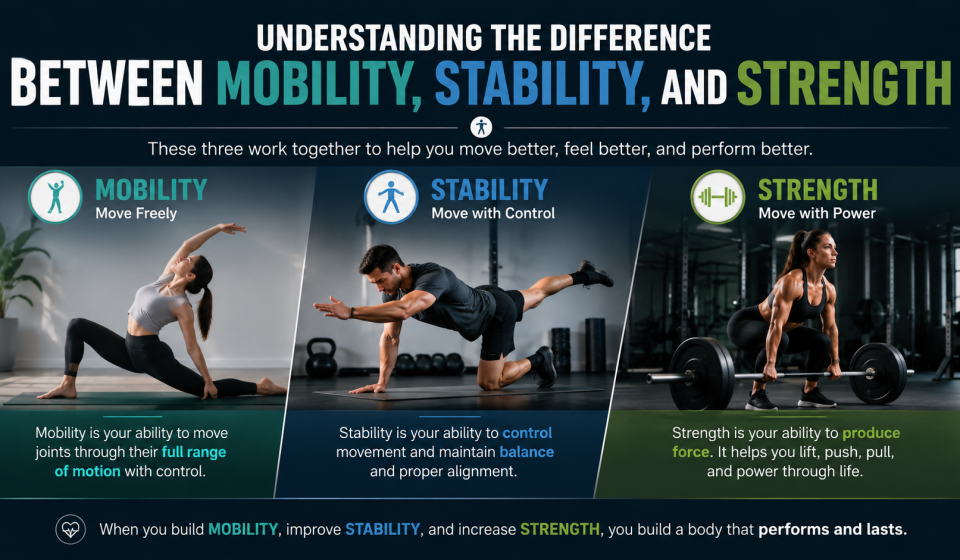
Mobility, stability, and strength are three important components of physical function, but they are often treated as if they mean the same thing. In reality, each describes a different ability of the body. Mobility relates to how freely a joint or body part can move, stability refers to how well the body can control and maintain a position, and strength describes the ability of muscles to produce force. Understanding these differences can help people make better decisions about exercise, movement, rehabilitation, and everyday physical activity.
These three qualities also work together. Good mobility without adequate stability may make certain movements difficult to control, while strength without sufficient mobility may limit movement quality. Similarly, strong and stable muscles cannot always compensate for severely restricted joint movement. A balanced approach that develops mobility, stability, and strength can support functional movement and help people perform daily activities more effectively.
What Is Mobility?
Mobility refers to the ability of a joint or body segment to move through an available range of motion with appropriate control.
For example, shoulder mobility affects how easily you can raise your arm overhead. Hip mobility can influence activities such as walking, squatting, sitting, and climbing stairs.
Mobility is influenced by several factors, including:
- Joint structure
- Muscle flexibility
- Soft-tissue flexibility
- Previous injuries
- Pain
- Nervous-system control
- Age
- Physical activity habits
Mobility is not simply the same as flexibility. Flexibility generally refers to the ability of muscles and soft tissues to lengthen, while mobility involves movement of a joint or body segment with control.
What Is Stability?
Stability is the ability to control a joint or body position while resisting unwanted movement.
For example, when standing on one leg, the body must control movement around the ankle, knee, hip, and trunk. This requires coordination between muscles, joints, the nervous system, and balance mechanisms.
Stability can involve:
- Balance
- Coordination
- Joint control
- Muscle activation
- Postural control
- Body awareness
A person may have adequate joint mobility but still struggle to control that available movement.
What Is Strength?
Strength refers to the ability of muscles to produce force.
Strength is important for everyday activities such as:
- Standing up from a chair
- Carrying groceries
- Climbing stairs
- Lifting objects
- Pushing and pulling
- Walking uphill
- Maintaining posture
Strength can be developed through resistance exercises, bodyweight movements, functional activities, and other forms of physical training.
Mobility vs Stability vs Strength
The easiest way to understand the difference is to think of them as three separate questions.
Mobility: Can I move through the required range?
Stability: Can I control that movement?
Strength: Can I produce enough force to perform the movement?
A healthy movement pattern often requires all three.
For example, performing a squat requires sufficient hip, knee, and ankle mobility. The body also needs stability to maintain alignment and control the movement. Finally, the muscles must produce enough strength to lower and raise the body.
Why Mobility Is Important
Good mobility can make everyday movement easier.
Adequate mobility allows people to:
- Reach overhead
- Bend down
- Turn the body
- Walk comfortably
- Sit and stand
- Climb stairs
- Perform exercise movements
- Complete household activities
Restricted mobility may make certain activities more difficult.
However, improving mobility should not always mean trying to achieve the maximum possible range of motion. The goal is usually to achieve the amount of movement required for safe and effective function.
Why Stability Is Important
Stability allows the body to control movement.
Consider walking. Every step involves shifting body weight from one side to another. The body must maintain balance while the joints and muscles coordinate movement.
Stability contributes to:
- Balance
- Posture
- Joint control
- Movement efficiency
- Coordination
- Functional independence
For older adults, activities that emphasize balance and strength are particularly important. WHO recommends that older adults with poor mobility include physical activity that enhances balance and helps prevent falls on three or more days per week.
Why Strength Is Important
Strength supports physical independence.
Strong muscles can help people perform everyday tasks more comfortably and efficiently.
Strength training can support:
- Muscle function
- Bone health
- Physical capacity
- Daily activities
- Functional independence
- Exercise performance
WHO recommends muscle-strengthening activities involving major muscle groups on at least two days per week for adults.
How Mobility, Stability, and Strength Work Together
These qualities are connected.
Imagine reaching for an object on a high shelf.
First, the shoulder and upper body need sufficient mobility to reach overhead.
Second, the shoulder blade, trunk, and other body structures need stability to control the position.
Third, the muscles need enough strength to maintain the arm position and handle the object.
If any one of these components is significantly limited, the movement may become more difficult.
Mobility Without Stability
Having a large range of motion does not automatically mean that movement is efficient or safe.
A person may be flexible but have difficulty controlling the available movement.
This is why mobility exercises are often paired with strengthening and control exercises.
The objective is not simply to move farther. It is to move effectively and with appropriate control.
Stability Without Mobility
The opposite situation can also occur.
A person may have good muscular control but limited joint movement.
For example, restricted ankle mobility may affect the way a person performs a squat even if their leg muscles are strong.
In such cases, addressing mobility limitations may help improve movement quality.
Strength Without Mobility
Strength alone cannot provide every physical ability.
A person may have strong muscles but still struggle with movements that require adequate joint range.
For example, strong leg muscles cannot completely compensate for severely restricted hip or ankle movement during certain activities.
A balanced exercise program should therefore include appropriate movement training as well as strengthening.
Strength Without Stability
Strength is also different from control.
Someone may be capable of producing a large amount of force but have difficulty maintaining balance or controlling a movement.
Stability exercises can help develop coordination and control alongside strength.
Mobility Exercises
Mobility exercises are designed to improve or maintain useful movement.
Examples can include:
- Controlled joint circles
- Dynamic stretching
- Gentle range-of-motion movements
- Hip mobility exercises
- Shoulder mobility movements
- Ankle mobility exercises
- Thoracic spine movements
The appropriate exercise depends on the person’s needs and physical condition.
People recovering from an injury should follow guidance from an appropriate healthcare or rehabilitation professional.
Stability Exercises
Stability exercises often focus on controlled movement and balance.
Examples include:
- Single-leg balance
- Controlled step-ups
- Core stabilization exercises
- Slow bodyweight movements
- Balance drills
- Controlled lunges
- Postural exercises
The difficulty should be appropriate for the person’s ability.
For beginners, stability training may start with simple movements performed near a stable support.
Strength Exercises
Strength exercises create resistance against which muscles must work.
Examples include:
- Squats
- Lunges
- Push-ups
- Rows
- Resistance-band exercises
- Weight training
- Step-ups
- Carrying exercises
Exercises should be performed with appropriate technique and gradually progressed.
The Role of Functional Movement
Functional movement refers to physical activities that relate to everyday life.
Examples include:
- Sitting and standing
- Walking
- Climbing stairs
- Reaching
- Carrying
- Bending
- Turning
- Getting in and out of a vehicle
Functional exercises often combine mobility, stability, and strength rather than training each quality in isolation.
Mobility, Stability, and Strength for Older Adults
These qualities become particularly important as people age.
Maintaining physical function can support independence and everyday activities.
WHO recommends regular physical activity for older adults and specifically emphasizes varied activities involving balance and strength for those with mobility concerns.
A suitable program may include:
- Walking
- Strength exercises
- Balance exercises
- Mobility activities
- Functional movements
The intensity and exercise selection should match the person’s health and ability.
Mobility, Stability, and Strength for Beginners
Beginners do not need complicated exercise programs.
A simple routine can gradually introduce all three areas.
For example:
Mobility: Gentle hip, shoulder, and ankle movements.
Stability: Balance exercises and controlled bodyweight movements.
Strength: Squats, wall push-ups, resistance bands, or other beginner-friendly exercises.
The key is consistency rather than trying to do everything at once.
How to Identify a Mobility Limitation
Possible signs of limited mobility include:
- Difficulty reaching overhead
- Difficulty squatting
- Restricted shoulder movement
- Difficulty turning the neck
- Limited ankle movement
- Difficulty bending comfortably
- Reduced movement on one side
Persistent or painful limitations should be evaluated by a qualified healthcare professional.
How to Identify Stability Problems
Possible signs of poor stability include:
- Frequent loss of balance
- Difficulty standing on one leg
- Wobbling during exercises
- Poor control during movement
- Difficulty maintaining posture
- Uncontrolled joint movement
Balance problems can have many causes, so persistent issues should be professionally assessed.
How to Identify Strength Limitations
Strength limitations may appear during everyday tasks.
Examples include:
- Difficulty rising from a chair
- Trouble climbing stairs
- Difficulty carrying normal objects
- Reduced grip strength
- Difficulty lifting
- Fatigue during simple physical activities
Strength can often improve through progressive resistance training when appropriately prescribed.
The Importance of Progressive Training
Exercise should generally progress gradually.
WHO recommends that inactive adults start with small amounts of physical activity and gradually increase frequency, intensity, and duration over time.
This principle can apply to mobility, stability, and strength training.
Starting too aggressively may increase discomfort or make it harder to maintain consistency.
How to Build a Balanced Exercise Program
A balanced program can include several components.
For example:
Warm-up: Gentle mobility movements.
Main exercise: Strength training.
Control work: Balance or stability exercises.
Aerobic activity: Walking, cycling, swimming, or another suitable activity.
Recovery: Rest and appropriate stretching or mobility work.
The exact combination should depend on individual goals and health status.
Why Technique Matters
Exercise quality is important.
Performing an exercise with poor control may reduce its effectiveness and increase unnecessary stress on the body.
Beginners should focus on:
- Controlled movement
- Appropriate range
- Good posture
- Gradual progression
- Proper breathing
- Suitable resistance
Professional instruction can be useful when learning unfamiliar exercises.
The Role of Consistency
Mobility, stability, and strength usually improve through consistent practice rather than occasional intense workouts.
Regular physical activity is associated with multiple health benefits, and WHO recommends regular physical activity for adults.
Even small amounts of activity can be beneficial for people who are currently inactive.
Mobility, Stability, and Strength During Rehabilitation
Rehabilitation programs often address all three areas.
After an injury or medical condition, a person may experience:
- Reduced joint mobility
- Muscle weakness
- Poor balance
- Reduced coordination
- Difficulty performing everyday tasks
A rehabilitation professional may develop a personalized program that gradually restores movement, control, and strength.
The order and emphasis can change depending on the person’s condition and recovery stage.
Why All Three Matter for Everyday Independence
Independence depends on more than muscle strength.
A person may need mobility to bend and reach, stability to maintain balance, and strength to lift and move objects.
For example, preparing a meal may involve standing, reaching, turning, carrying, and lifting.
These activities require multiple physical abilities working together.
When to Seek Professional Guidance
People should consider professional guidance when they have:
- Persistent joint pain
- Significant movement restrictions
- Repeated falls
- Severe balance problems
- Sudden weakness
- Difficulty performing normal activities
- A recent injury or surgery
- A diagnosed medical condition affecting movement
A physical therapist, doctor, or other qualified professional can assess individual needs and recommend appropriate exercises.
Source
WHO Physical Activity
WHO Physical Activity Guidelines
WHO Guidelines Recommendations
Conclusion
Mobility, stability, and strength are different but closely connected components of physical function. Mobility allows the body to move through an appropriate range, stability helps control that movement, and strength allows muscles to produce the force required for physical tasks. None of these qualities should be viewed in isolation because everyday movement usually requires all three working together.
Developing mobility can make reaching, bending, walking, and other movements easier. Stability supports balance, coordination, posture, and joint control. Strength helps people perform activities such as standing, lifting, carrying, climbing stairs, and maintaining physical independence. A balanced approach can therefore support both exercise performance and everyday function.
The importance of combining different types of physical activity is also reflected in WHO recommendations. Adults are encouraged to perform regular aerobic activity and muscle-strengthening exercises, while older adults can benefit from activities that emphasize balance and strength.
The best exercise program depends on the individual. Beginners should start gradually, while people with injuries, persistent pain, significant mobility limitations, or medical conditions may benefit from professional guidance. Consistent, appropriate training is generally more useful than occasional intense workouts.
Ultimately, good physical function is not simply about being strong or flexible. It is about having enough mobility to move, enough stability to control movement, and enough strength to perform the tasks that matter in everyday life. By understanding the difference between these three qualities, people can create more balanced exercise routines and make informed decisions about their physical health.
FAQ
1. What is the difference between mobility and flexibility?
Flexibility generally refers to the ability of muscles and soft tissues to lengthen, while mobility refers to the ability to move a joint or body segment through an appropriate range with control.
2. What is stability in fitness?
Stability is the ability to control a joint or body position and resist unwanted movement during physical activity.
3. What is strength?
Strength is the ability of muscles to produce force against resistance.
4. Can you have good mobility but poor stability?
Yes. A person may have a large range of motion but have difficulty controlling that movement.
5. Can you be strong but have poor mobility?
Yes. Muscle strength does not automatically guarantee adequate joint range of motion.
6. Why are mobility, stability, and strength important together?
They work together to support efficient movement. Mobility provides range, stability provides control, and strength provides force.
7. Which should I train first: mobility, stability, or strength?
There is no single order that works for everyone. The appropriate focus depends on individual needs, goals, physical condition, and experience.
8. Can mobility exercises improve movement?
Appropriate mobility exercises may help maintain or improve useful range of motion and make certain movements easier.
9. Why is stability important for older adults?
Balance and stability can support functional movement and help reduce fall risk. WHO recommends balance-focused activity for older adults with poor mobility.
10. How often should adults do strength training?
WHO recommends muscle-strengthening activities involving major muscle groups on two or more days per week.
11. Can beginners train mobility, stability, and strength together?
Yes. A beginner-friendly exercise program can include simple mobility movements, balance or stability exercises, and basic resistance exercises.
12. Does walking improve strength?
Walking provides physical activity and can support endurance and functional capacity, but additional resistance exercises may be needed to specifically develop muscle strength.
13. What are examples of stability exercises?
Examples include single-leg balance, controlled step-ups, balance drills, core stabilization exercises, and controlled bodyweight movements.
14. What are examples of strength exercises?
Examples include squats, lunges, push-ups, resistance-band exercises, rows, step-ups, and weight training.
15. What are examples of mobility exercises?
Examples include controlled joint movements, dynamic stretching, shoulder mobility exercises, hip movements, ankle mobility exercises, and gentle range-of-motion exercises.
16. Can poor mobility affect strength exercises?
Yes. Limited joint movement can make some exercises harder to perform correctly or comfortably.
17. Can stability improve with exercise?
Yes. Balance, coordination, and controlled movement can be trained progressively through appropriate exercises.
18. Should people exercise through pain?
Persistent or significant pain should not simply be ignored. People with pain during exercise should seek appropriate professional advice, especially when pain is new or worsening.
19. Why is gradual progression important?
Gradual progression gives the body time to adapt to increasing physical demands. WHO recommends that inactive adults begin with small amounts of activity and gradually increase frequency, intensity, and duration.
20. Do mobility, stability, and strength matter for everyday activities?
Yes. Everyday activities such as walking, climbing stairs, reaching, carrying objects, standing, and getting up from a chair can require a combination of mobility, stability, and strength.